 elc team
The Breeder presents the fourth solo exhibition by Luke Edward Hall at the gallery, titled Dancing with Serpents.
Hall, a multidisciplinary artist and designer, works across painting, ceramics, drawing, interior design, and fashion, dissolving the boundaries between fine and applied arts. His artistic practice unfolds as a form of world-building, cultivating a vivid yet fluid visual language in which mythology, local traditions, and everyday life converge. His work is marked by a poetic sensibility that feels at once intimate and expansive, where figures, landscapes, and symbols drift between the real and the imagined.
Fascinated by antiquity, Hall combines Northern European folkloric elements with Arthurian legends, bringing together different narrative traditions within a shared, timeless space. His mythic figures are never fixed, but continuously reinterpreted as emotionally resonant presences rather than distant archetypes. Through this lens, the artist softens traditional narratives, revealing moments of vulnerability, sensuality, and introspection. His protagonists, often mythological male figures, possess a lyrical ambiguity that challenges conventional patriarchal depictions of heroism, allowing tenderness and desire to emerge.
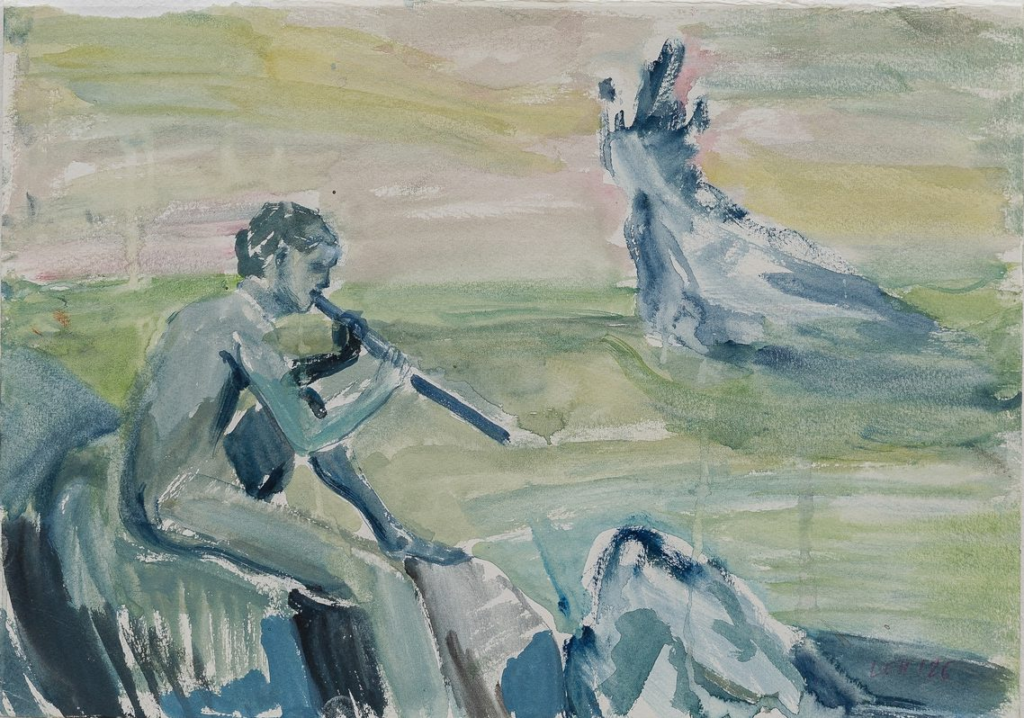
In this new body of work, Hall draws inspiration from both everyday and imaginary landscapes: coastal horizons, open plains, and pastoral scenes. These environments function less as settings and more as emotionally charged spaces, territories of encounter and transformation. Color plays a central role, applied intuitively through a combination of soft pastel tones and intense earthy hues that destabilize naturalism while emphasizing atmosphere and sensation. Figures emerge and dissolve within chromatic fields, their bodies becoming porous and responsive to the surrounding world.
In Dancing with Serpents, Hall continues his exploration of storytelling through painting, focusing on the folk traditions of West Penwith in Cornwall – fairies, giants, and mermaids – alongside recurring mythological figures such as Pan, Antinous, and Dionysus. Rather than depicting specific stories, the works highlight the affinities between these traditions, allowing them to coexist and transform one another.
The intersection of mythologies emerges organically through the relationship between figure and landscape. In works such as The Bather and Guardian, the solitary body becomes a tool for introspection, balancing revelation and isolation, while Guardian II extends this atmosphere into a brighter, more serene emotional register. Elsewhere, relationships appear more ambiguous: The Magician and The Riders suggest moments of guidance, companionship, or ritual without resolving into a definitive narrative. Meanwhile, in works such as In the Woods and In the Woods II, figures are absorbed into their environments, their identities dissolving into branching, rhythmic landscapes.
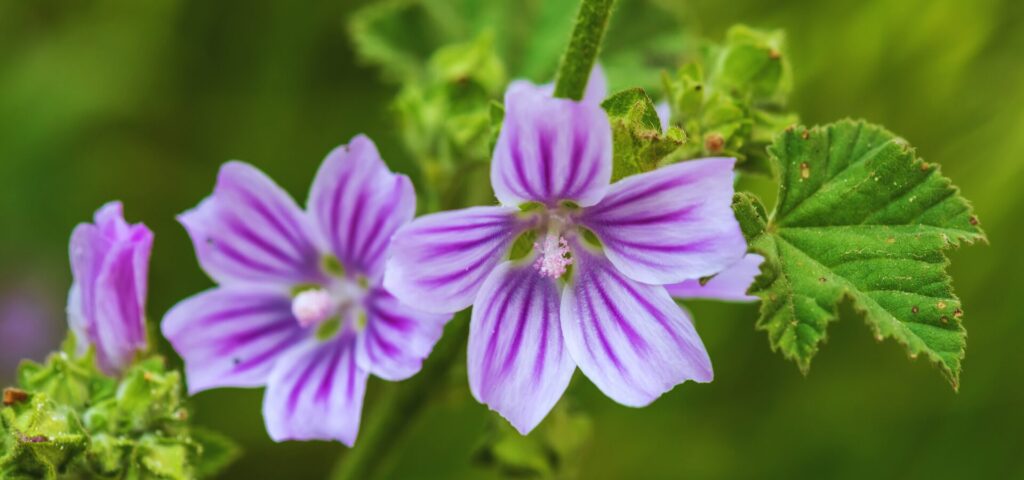
Another dimension of the exhibition engages with transformation and magic. Works such as Phantom Caer and Field Prayer (White Horse) evoke acts of invocation toward unseen forces, while The Wanderer and Shadow Boy introduce more elusive, solitary presences, figures defined as much by atmosphere as by form. Even in seemingly calmer works such as Foxglove, Wildflowers, or Red Stones, the landscape itself carries a spiritual charge, suggesting that myth resides not only within figures but also within nature.
A symbolic world gradually takes shape, one in which mythology is not distant but lived through gestures, relationships, and sensory conditions. Hall does not merely narrate, but renders a feeling of presence, allowing fragments of emotion, memory, and place to surface and reassemble within each work. Through this approach, Dancing with Serpents proposes a newly “enchanted” vision of the world, grounded in fluid identities, sensuality, and an enduring sense of optimism.
Luke Edward Hall is a British artist and designer whose practice spans interior design, fashion, murals, and illustration. He has collaborated with institutions such as the Louvre Museum, the Royal Academy of Arts, and the Victoria and Albert Museum, as well as international fashion, textile, and porcelain houses including Burberry, Lanvin, Christie’s, Ginori 1735, Svenskt Tenn, Rubelli, and Diptyque.
In 2020, he completed his first major interior design and artistic direction project with the opening of Hôtel Les Deux Gares in Paris. He has also completed design projects for Amaru at Kulm Hotel St. Moritz and for Hotel Saint-Georges. In 2022, he launched his own brand, Chateau Orlando, featuring clothing and homeware collections.
His books Greco Disco: The Art & Design of Luke Edward Hall, A Kind of Magic: The Kaleidoscopic World of Luke Edward Hall, and 300,000 Kisses: Tales of Queer Love from the Ancient World were published by teNeues, Vendome, and Penguin Random House respectively. From 2019 to 2025, Hall was a columnist for the Financial Times (FT Weekend), answering readers’ questions on interiors and wellbeing.
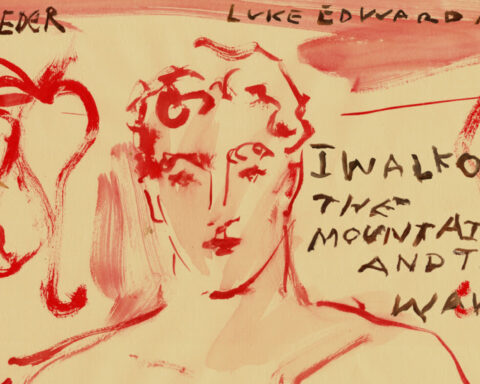
Hall has presented solo exhibitions with The Breeder including Figs and Honey and Sailing (2021), The Hunter Hunts in a Pink Mist (2022) in Athens, I Walk Over The Mountains and the Waves in Patmos (2024), and 300,000 Kisses at Frieze No.9 Cork Street (2023). He has also exhibited at Daniel Cooney Fine Art (2023) and Patricia Low Contemporary (2025).
He is also participating in the 2nd Contemporary Ceramics Biennale in Rhodes, Where the Day Starts (2026), curated by Anissa Touati, Stamatia Dimitrakopoulou, and Loukia Thomopoulou.
Info
Opening: Saturday, May 23, 2026, 17:00–21:00
Exhibition Duration: May 23 – June 16, 2026
Opening Hours: Tue–Fri 11am–7pm, Sat 11am–5pm