 PEPI NIKOLOPOULOU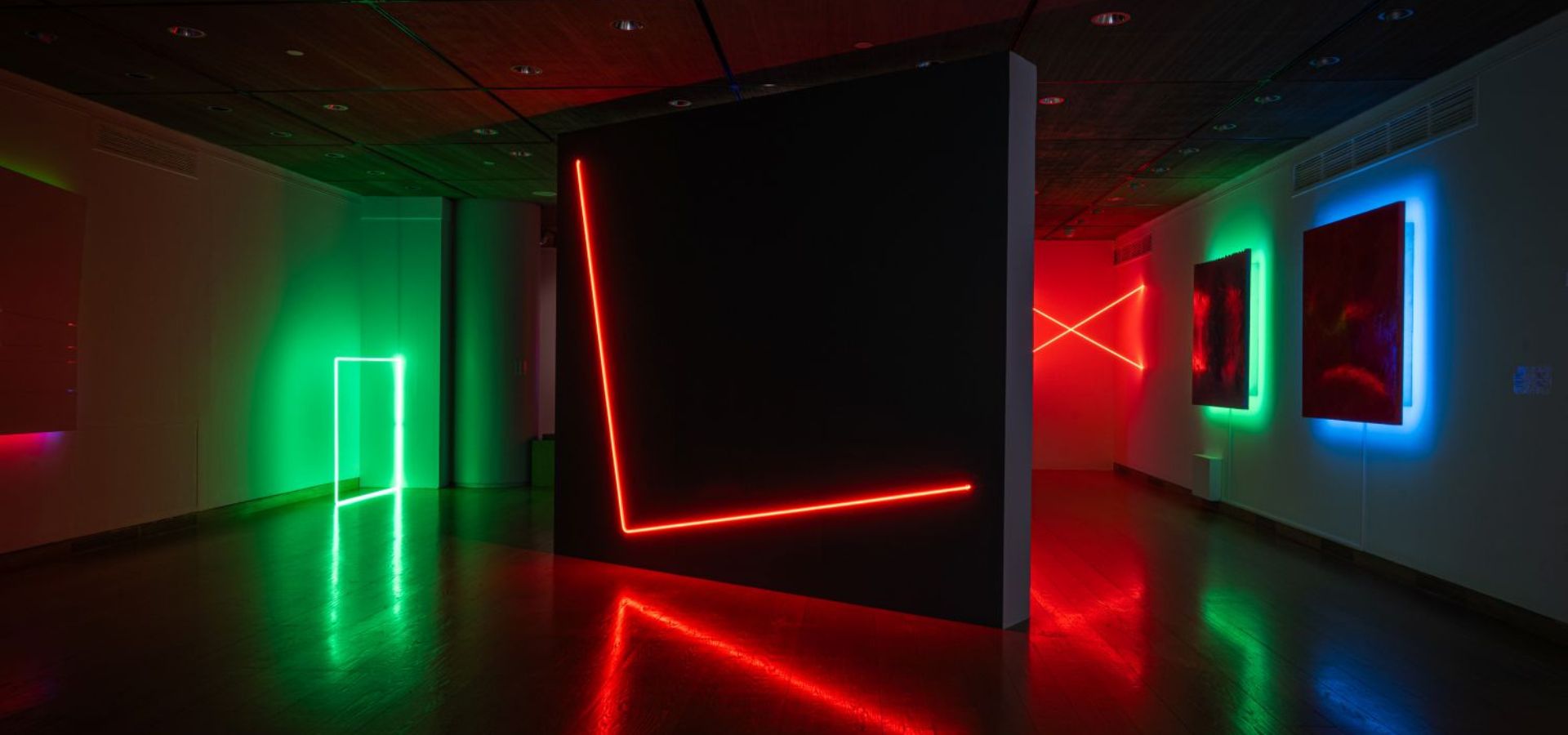
Following the work of Stephen Antonakos at the Theocharakis Foundation, a journey through light, geometry, and memory
“My work is real things in real spaces. In the here and now. Without illusions.”
With this phrase, Stephen Antonakos encapsulates the attitude that runs through his entire body of work. During our visit to the exhibition “Stephen Antonakos: Postscripts of Time and Space” at the B. & M. Theocharakis Foundation, marking the 100th anniversary of his birth, I had the opportunity to walk through the exhibition alongside curator (educator and writer) Sara Reisman and discuss both the thinking behind its structure and the work of the Greek-American artist itself. The exhibition is an extensive retrospective attempting to map six decades of artistic creation, a practice moving between light, geometry, and memory. Its title, both sharp and poetic, reflects the complexity of the artist’s Greek-American identity: in English, Vectors of Time and Space, and in Greek, Postscripts of Time and Space. On the one hand, there is strict geometric abstraction: lines carving through space, forms defined through precision and direction. On the other, more inward, silent, and emotional bodies of work emerge as vessels of memory, intimacy, and time. This almost “bipolar” coexistence between the introverted and the extroverted seems to run throughout his oeuvre.
This dual direction becomes immediately perceptible as one moves through the space. The neon works, strongly architectural in nature, guide the gaze; some, initially incomplete, invite viewers to mentally continue and complete them. Meanwhile, works such as the Travel Collages, the Packages, or the pillow bearing the word Dream transport the viewer somewhere else entirely: toward a more personal and emotionally charged experience. As Sara Reisman explains while we stand before the striking neon work greeting visitors at the entrance of the third floor, Red Incomplete Square on a Green Wall, Antonakos’ work “is completed through the viewer’s presence and gaze.” This was his original intention. Antonakos himself spoke of a “communication that happens between the lines.” And indeed, these works are far more than geometric structures; they possess intensity and vitality. Their light, though seemingly static, pulses and breathes. “The notion of intervallic time, according to art historian George Kubler in The Shape of Time (1962), is that moment defined between two events, between two states: the darkness between the flashes of a lighthouse, the pause between the ticks of a clock, a void constantly slipping through time. The pillow works are situated precisely within that territory, between sleep and wakefulness, at the threshold where nothingness and somethingness coexist,” shares Sara Reisman.
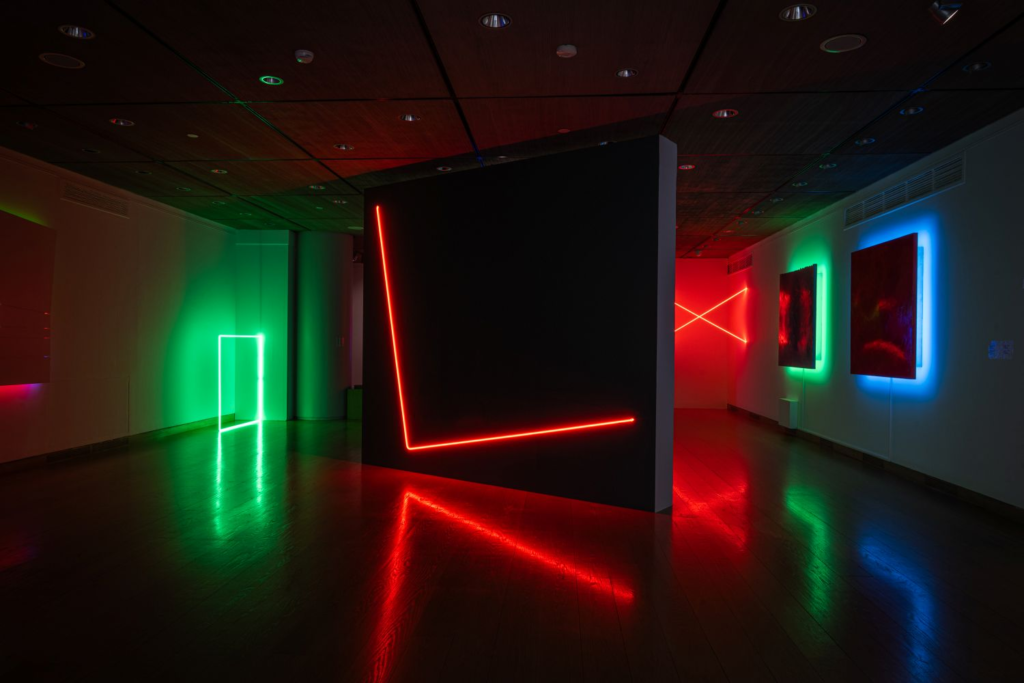
Works featured in the photograph: Stephen Antonakos (1926–2013), Entry, 2007, white paint on versacel, neon, 145 x 122 x 12.5 cm. Collection of the Onassis Foundation. Stephen Antonakos, EGL Green Square on the Floor, 1973, neon, 121 x 121 cm. Stephen Antonakos Studio LLC. Exhibition replica. Stephen Antonakos, Eight Foot Red Incomplete Neon Square on a Green Wall, 1977, neon and paint on wall, 250 x 305 cm. Stephen Antonakos Studio LLC. Exhibition replica. Stephen Antonakos, Red X in Corner, 1972, neon, 90 x 180 x 200 cm (height x width x diagonal). Stephen Antonakos Studio LLC. Exhibition replica. Stephen Antonakos, Angel, 1992, paint on metal, neon, 122 x 122 x 14 cm. Stephen Antonakos Studio LLC. Stephen Antonakos, The Apostle Saint Peter, 1992, paint on iron, neon, 122 x 122 x 14 cm. Stephen Antonakos Studio LLC. Photographer: Aphroditi Houlaki.
The exhibition does not follow a chronological narrative. Instead, it unfolds across the three floors of the Theocharakis Foundation like parallel pathways, reflecting the way the artist himself worked: simultaneously, across different media and scales. As Sara Reisman notes, Antonakos did not move from one period to another in a linear progression, but developed multiple bodies of work at once, creating a multifaceted universe that resists linear reading. This complexity is also embedded in the structure of the exhibition itself, conceived as a “constellation of relationships.”
The construction of this “constellation” was neither self-evident nor easy. As Marina Miliou Theocharaki, Head of Strategic Exhibition Planning, explains during our conversation, the exhibition relied on an extensive process of collaborations and loans – from Greek collections such as the Alpha Bank Collection, MOMUS-Museum of Contemporary Art-Collections of the Macedonian Museum of Contemporary Art, the State Museum of Contemporary Art, MOMUS-Museum of Modern Art-Costakis Collection, and the Onassis Foundation, to international institutions and artists’ estates, including the Ray Johnson Estate / ARS, New York, the Gordon Matta-Clark Estate, the One Million Years Foundation, and the Fred Sandback Estate.

“Perhaps this is the first time we have worked in such an outward-looking way,” she remarks, emphasizing the importance of these exchanges not only for the exhibition itself, but also for the way artworks gain new life outside storage facilities. Bringing the works together, communicating with institutions and archives, and collaborating with a curator based in another country all formed part of a production with considerable demands. The result, however, justifies this complexity: an exhibition that maintains coherence while opening itself to multiple readings. Works never before presented in Greece coexist here, underscoring the importance of extroversion and collaboration in contemporary museum practice.
The inclusion of works by thirteen additional artists – namely Francis Alÿs, Yiannis Bouteas, Christo, Chryssa, Ksenia Ender, Lucio Fontana, Ray Johnson, Kazimir Malevich, Gordon Matta-Clark, On Kawara, Judy Pfaff, Robert Ryman, and Fred Sandback – functions as a compelling way of opening Stephen Antonakos’ work to new interpretations and viewing it through a broader lens.
The choice to create these dialogues is not intended merely to expand the viewer’s perspective, but also to highlight a fundamental truth: that art is never created in isolation. As Sara Reisman points out, Antonakos existed in constant exchange with other creators, whether through personal relationships or through practices that encouraged participation and collaboration. The artist himself sought to create networks, to connect, and to activate community.
The Neon Works: Carving Space Through Light
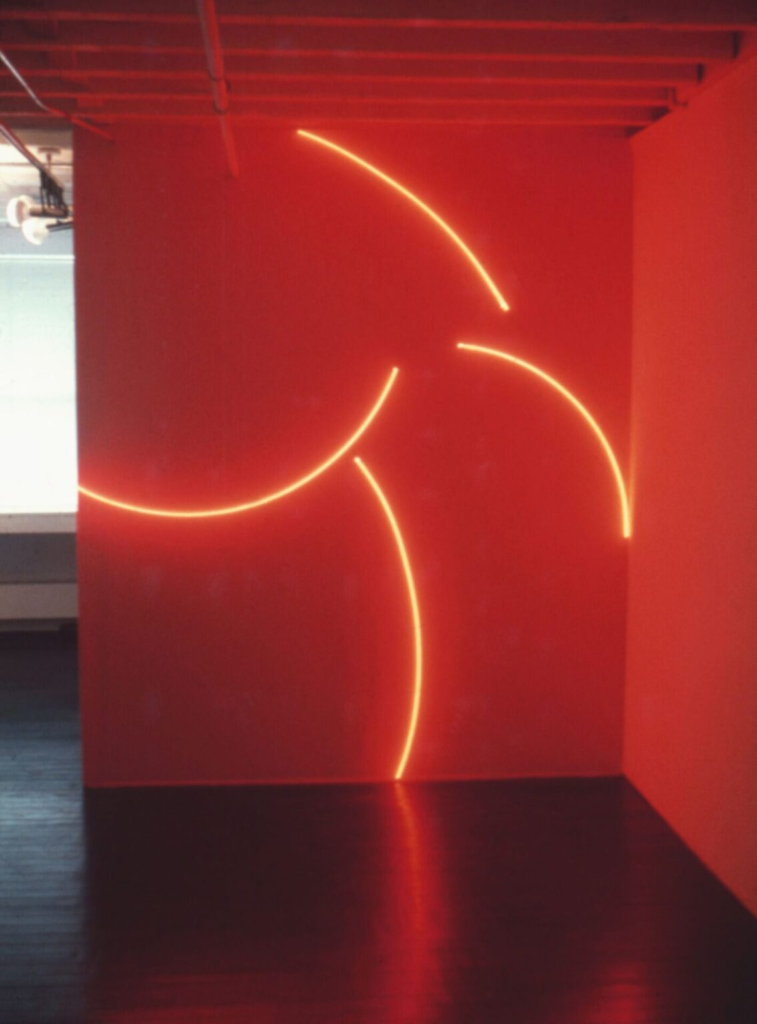
From the very first room, one enters a space where light itself becomes a fundamental element of the experience. Stephen Antonakos’ neon works define the surrounding environment: geometric forms, squares, and lines that seem to hover or cut across surfaces, activated through the very light that envelops them. Color spills onto the wall, the floor, and the viewer’s gaze, shifting according to one’s position and movement within the space.
“I find that the minimum can do the most and then I once again recognize the deep, defining bonds between geometry and space. I seek these powerful, still unexplored possibilities that life holds for all of us.” – Stephen Antonakos
On this first level of the exhibition, the neon works function as “vectors” — forces mapping space, defining directions, tracing pathways and relationships. This is perhaps the most immediate and architectural aspect of Antonakos’ practice. In one of the early works, a square is framed by an aura of red or blue light; elsewhere, an angular red line cuts across the surface of a wall.

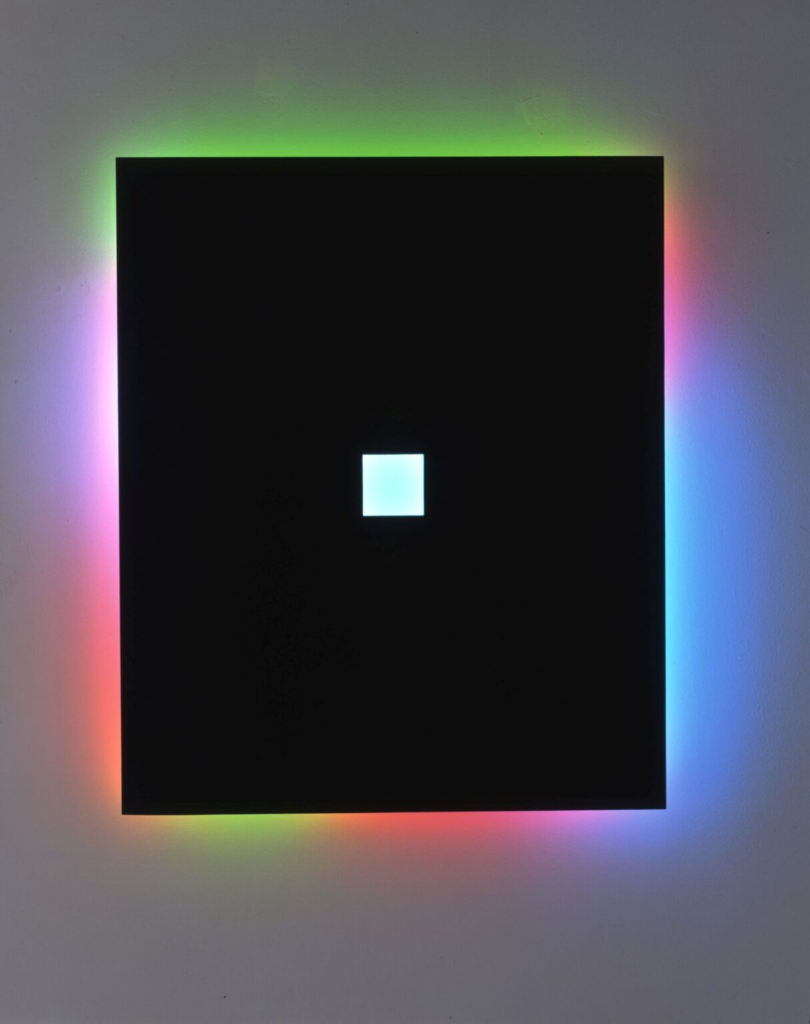
Neon is never entirely still. The emission of light results from the constant activation of particles within the tube, a movement that remains invisible yet perpetually present. This nearly imperceptible vibration becomes connected to the flow of time. To that small, elusive moment between before and after – the “interval” described by George Kubler.
A place where, seemingly, nothing happens, while in reality everything remains in motion. As the curator noted during the tour, time here is not an abstract concept but an experiential condition: the works demand movement and observation. The light shifts as one moves through the space, chromatic relationships transform, and the work itself is completed through the viewer’s experience.
These works are not confined to exhibition spaces alone. Sara Reisman’s first encounter with Stephen Antonakos’ work took place in public space, around 2012, during her tenure as director of New York City’s Percent for Art program. The occasion was a neon installation at the 59th Street Marine Transfer Station, a waste management facility receiving thousands of tons of paper daily, through which her first conversations with the artist’s wife, Naomi Antonakos, also began.
The project consisted of a composition of colored neon tubes created for the station’s renovation: red light alternately framed the windows of the building’s northern façade, remaining visible even from the highway, while simultaneously emphasizing the architectural elements of the western side, evoking forms of classical architecture. For Antonakos, creating works in public space held particular importance, as it allowed for an unexpected dialogue between art, architecture, and everyday life. Over time, the installation even gifted the site its unofficial nickname: “Disco Dump.”
It is worth noting that many of the neon works presented in the exhibition are not the original pieces, but reconstructions produced specifically for this presentation, in collaboration with neon craftsman Nikos Trifyllis, who had worked alongside the artist himself. After the exhibition closes, these works will be destroyed — a detail that adds yet another layer to the notion of time permeating the exhibition as a whole. They remain, ultimately, ephemeral forms.
Packages: Postscripts of Relationships and Time
In contrast to the clarity and rigor of the neon works, the Packages series is permeated by a deeply emotional charge. It may not constitute the most obvious entry point into Antonakos’ oeuvre, yet it functions as a crucial axis for understanding the second part of the exhibition’s title: the Postscripts.
The series began in 1971, when the artist invited more than ninety artists to mail him an object wrapped as a parcel. Rather than revealing their contents, he presented the packages themselves as artworks. Later, the process was reversed. Antonakos began sending packages to specific recipients, accompanying them with instructions addressed to the receivers, thereby incorporating those directives into the work itself. One package sent to the artist Robert Ryman bore the note instructing that it should never be opened. Others, such as the one addressed to his wife Naomi, carried the instruction that they be opened only after the sender’s death – something that, in reality, never occurred.
Among the works, one of the very few opened packages stands out: the parcel sent to critic Irving Sandler, unsealed after Antonakos’ death, revealing a drawing inside. A portrait of a man whose identity, and whose relationship to the recipient, remain unknown – even to the curator. Yet here too, the content itself is secondary. The sealing, the waiting, the temporal delay – and ultimately the mystery they preserve – become the work itself.
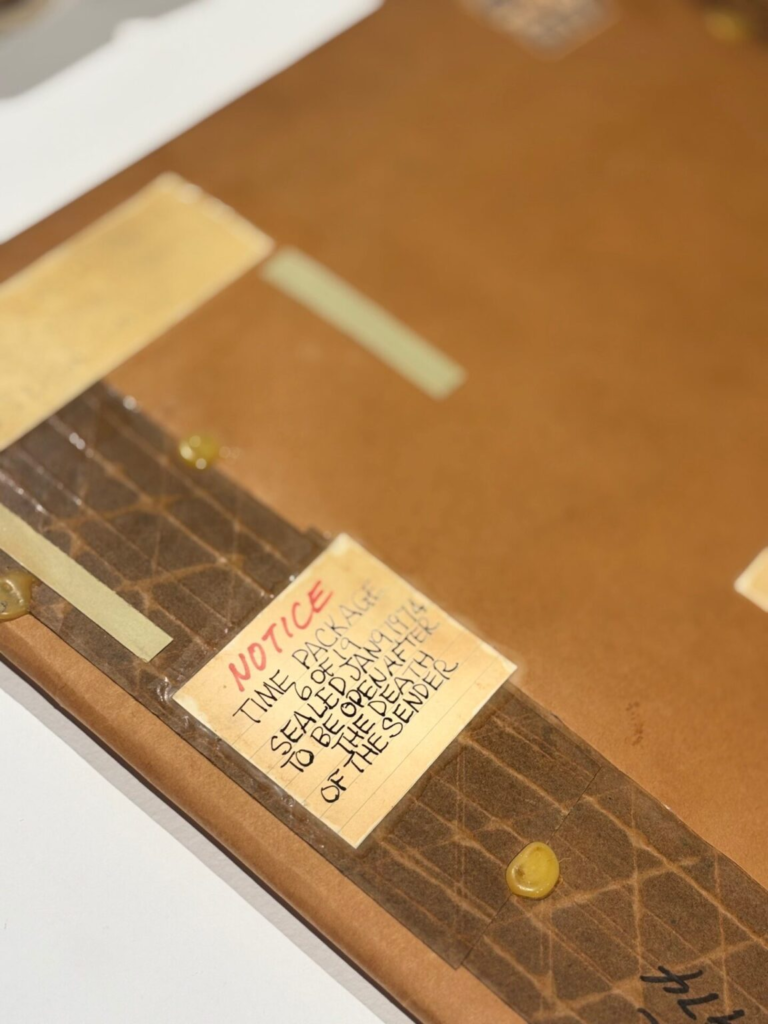

The Packages overturn the logic of the gift. Antonakos chooses to prolong the anticipation usually resolved through revelation, or even to suspend it entirely. To leave the parcel closed, preserving the possibility of what it might contain. In a world where exchange has become immediate and almost immaterial, these objects acquire a particular gravity. They carry the traces of their journey, seeming to continue traveling through time itself.
The role of the recipient also shifts – from the original addressee to today’s viewer. What began as a private exchange transforms into a public experience. The packages no longer belong solely to those who received them, but to everyone who encounters them. This body of work also reveals a more tender side of the artist, standing in contrast to the severity of the neon works. On one side, the “vectors” of geometry and space; on the other, the “postscripts” of memory, intimacy, and human connection.
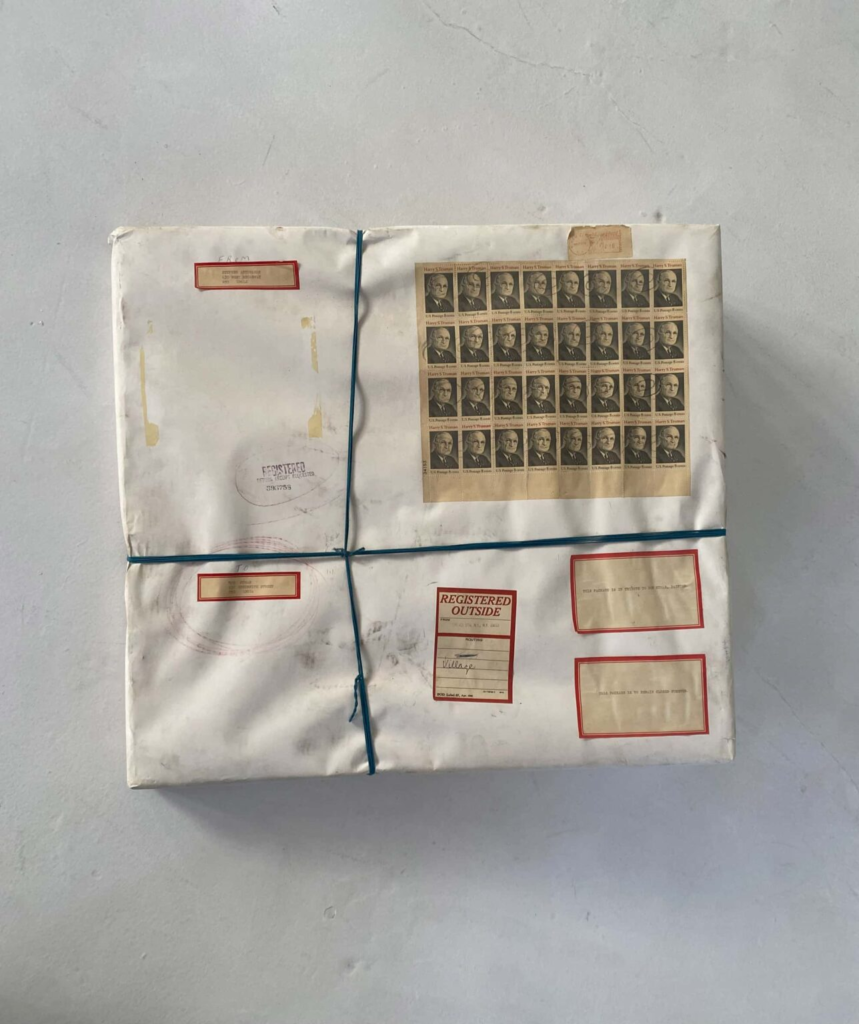
Like invisible threads running through time, the Packages connect people, moments, and places. And just as in Antonakos’ incomplete geometric forms, the work here too remains open, waiting for someone either to complete it – or perhaps to choose never to open it at all.
The series also enters into subtle dialogue with works by other artists, such as a wrapped book by Christo, which reintroduces the idea of concealment and obscuring.
Recording the Ephemeral
Elsewhere in the exhibition, near the Packages series, my attention is drawn to small, humble objects placed within strict white frames: branches, leaves, fragments gathered during walks once taken by the artist.
Stephen Antonakos collected these findings during his walks, carefully recording the place from which each originated. What initially appears simple and immediately graspable is, in fact, a contemplative act of observation that transforms the ephemeral into evidence. In this way, a peculiar archive of the world – of the everyday – is constructed. A quiet cartography of the relationship between human beings and nature. Points connecting a person to a place, a moment, an experience.
Marina Miliou Theocharaki refers to these works from the very entrance of the exhibition, noting that within this process of documentation she even discovered traces of her own neighborhood. Each small object becomes a carrier of memory, a tiny remnant of a journey. A moment preserved so as not to disappear. As with the Packages, what matters is not only the object itself, but the framework surrounding it: place, time, intention.
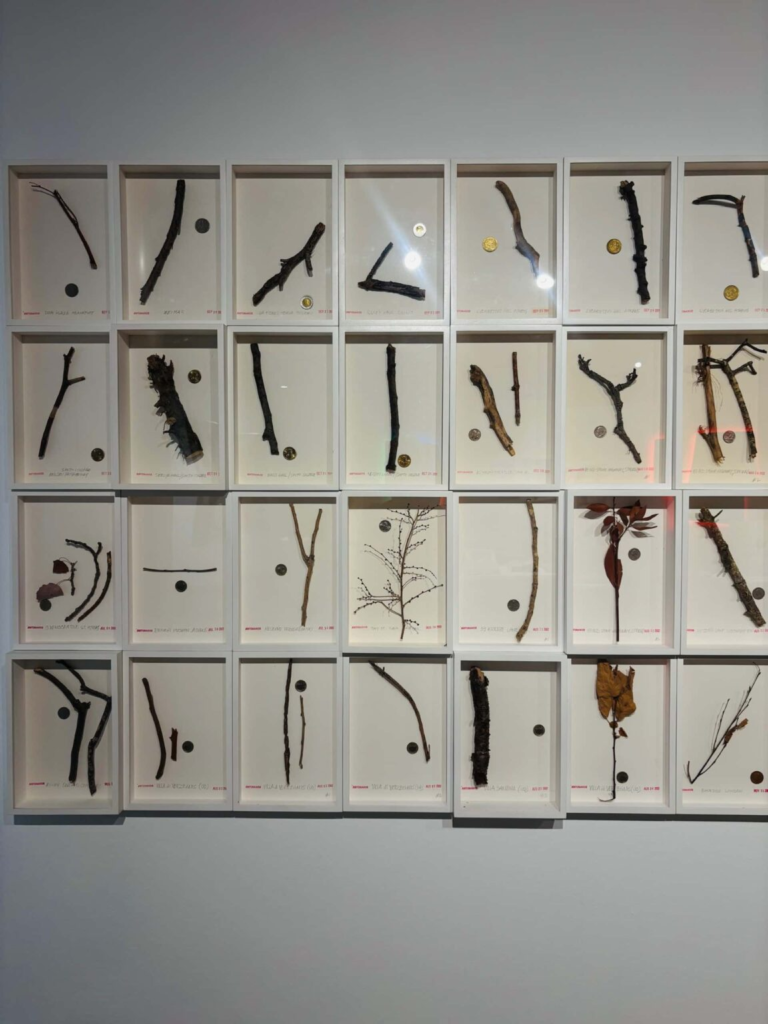
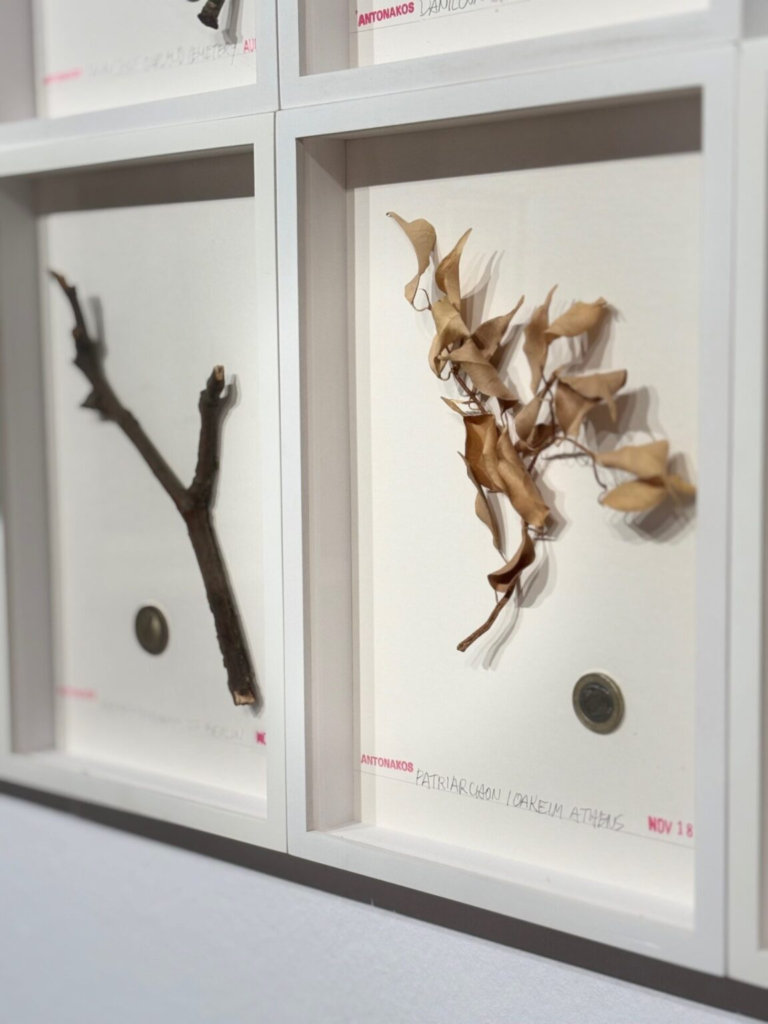
The strict presentation of the works clashes with the organic nature of the forms themselves. Even here, within this tension, Antonakos balances between two worlds: control and chance, abstraction and lived experience. As Sara Reisman explains to me, the exhibition will be accompanied by a bilingual catalogue featuring texts that attempt to capture the breadth and multiplicity of readings within Stephen Antonakos’ work. And yet, even there, something seems to escape. “There are things that cannot be fully translated onto paper,” she remarks.
As I leave, I think again of the neon works I encountered – those replicas created specifically for the exhibition, destined to be destroyed once it concludes. There is something paradoxical about them: while their light appears constant, their existence and presence are temporary. I share this thought with Sara Reisman and Marina Miliou Theocharaki – how much I would love to see these works transferred into public space, continuing to exist within the city itself. They smile. They seem to like the idea. Perhaps…
Info
Info Box
Opening: March 18, 2026, 20:00
Exhibition duration: March 18, 2026 – July 19, 2026
Opening hours: Monday–Sunday 10:00–18:00,
Thursday 10:00–20:00 (March–May)
Location: B. & M. Theocharakis Foundation for the Fine Arts and Music