 ELENI KOUTSILAIOU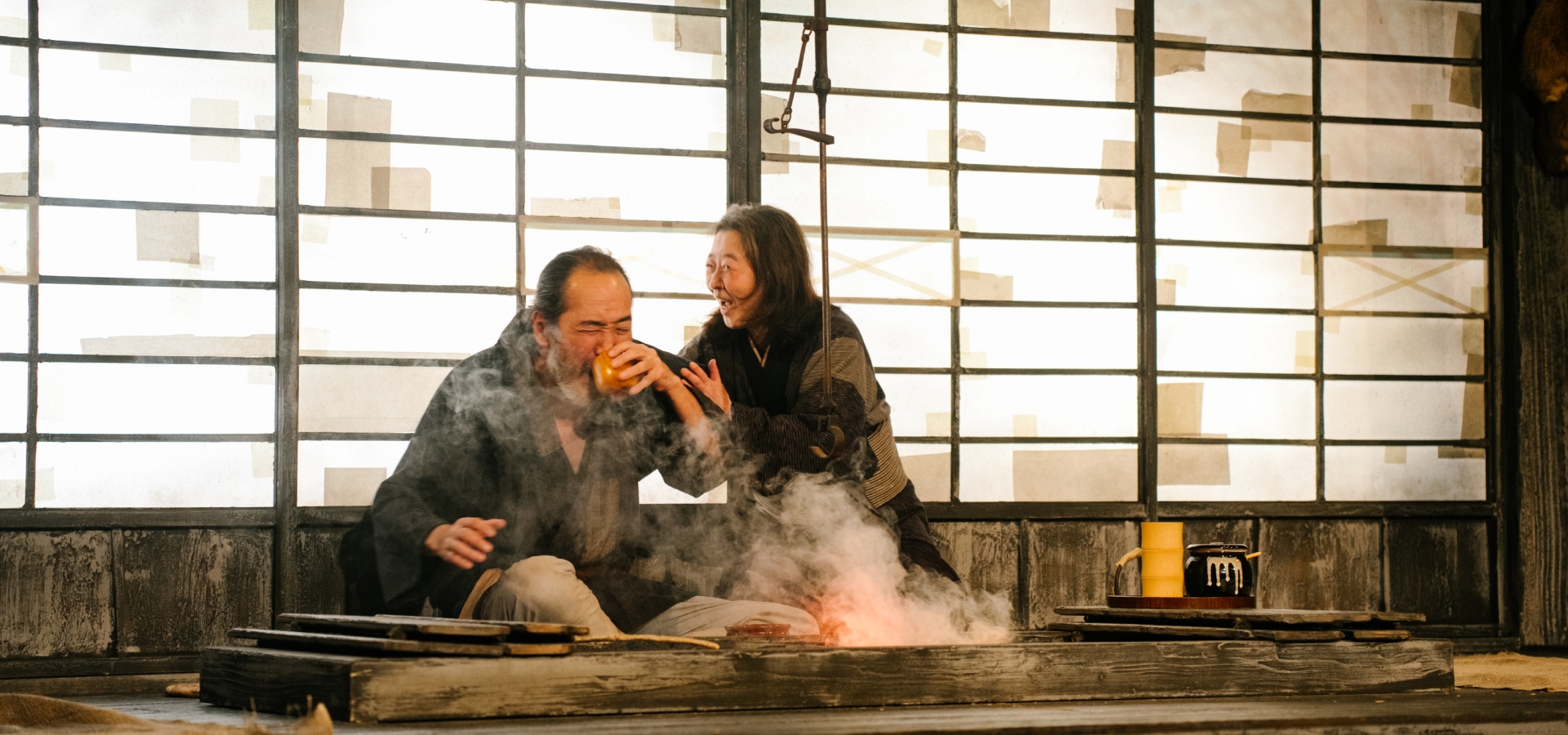
Thoughtful, gentle, poetic, and profoundly insightful, Japanese director Kurō Tanino, whose production Sleeping Fires will be presented at Pireos 260 as part of the Athens Epidaurus Festival, gave the following interview to elculture. His answers reached me while he was travelling between airports, long-haul flights, and jet lag. Yet, despite the distance, he created the conditions for a vivid and deeply engaging conversation, dissolving every sense of separation through the poetic sensitivity, tenderness, thoughtfulness, and intellectual clarity of his responses.
His words are marked by remarkable subtlety and a profound affection for what makes us human: beauty, trauma, cruelty, and fragility-the very contradictions that shape our existence. Perhaps this comes as no surprise, since before turning to theatre, Tanino practised psychiatry, following a long-standing family tradition.
A multidisciplinary artist, Tanino writes and designs all of his own productions. He is also a painter and sculptor. As critic Kyoko Iwaki observes, “Tanino enjoys creating miniature models of his productions and carrying them with him. He conceives his sets and theatrical works as fully formed images, arranging the performers as elements within an installation or tableau.” (*)
I remain deeply grateful for the mesmerising and transcendent world he revealed to me through this conversation.
I would like to begin with the beautiful poetic passage from your director’s note for Sleeping Fires:
“Once, in a country long ago, there lived a woman
who traced the contours of the world with eyes that could not see.
She replaced light with sound, listening to melodies,
guided by the traces of scent,
and reading truth through the touch of skin.”
Beneath its poetic language, I sense a clear position on issues of inclusion, feminism, and equality that resonate strongly with today’s world. Could you speak about these themes as a citizen of the contemporary world, as an artist, and as a psychiatrist?
As you observed, this work certainly resonates with contemporary issues such as inclusion, feminism, and equality. However, I did not begin by setting out to create a work whose explicit subject would be any of these ideas. What I initially wanted to explore was how a blind woman experiences the world. How does she form relationships with others? How does she survive within a human community?
In contemporary society, the rights of people with disabilities are certainly protected more systematically than in the past. At the same time, however, I sometimes feel that we are gradually losing the complex everyday relationships in which disabled and non-disabled people naturally encounter one another. They come into conflict, they help one another, and sometimes they drift apart. Protection and separation can, at times, exist side by side.
As an artist, I am not interested in portraying people with disabilities as beautiful symbols or as vehicles for social messages. They possess desire, anger, jealousy, love, and the ability to make mistakes, just like everyone else. What matters to me is that they appear on stage as complete and equal human beings.
The two blind women at the centre of this production are not portrayed simply as victims or vulnerable figures. They are undoubtedly wounded, but they are also strong, dangerous, and free. In that sense, perhaps the work can indeed be considered feminist. I believe it is important not to deprive women of their anger, their desire for revenge, or their desires themselves. Their complexity should remain intact.
My experience as a psychiatrist has also taught me that human beings cannot be understood through a single name, diagnosis, or identity. Society constantly seeks to classify people. Yet within those categories are individual lives that are contradictory, ambiguous, and rich. I believe theatre is a place where everything that falls outside these stereotypical categories can return to visibility.
For me, equality does not mean treating everyone in exactly the same way. It means allowing people with different bodies, different wounds, and different memories to coexist within the same time and space. That is where equality begins.

You set the story around 1840, a pivotal period of change for Japan and its relationship with the Western world. Could you tell us why you chose this particular historical moment?
I chose the period around 1840 because I was interested in the moment just before Japan began to change dramatically. The end of the Edo period was approaching, and contact with the West was gradually becoming inevitable. Yet in remote mountain villages, the forces of modernisation had not yet arrived directly. I wanted to place this story in such a setting-a kind of historical fissure.
At that time, there were no modern healthcare or welfare systems. Of course, this could be harsh. At the same time, however, people were forced to engage much more directly with one another’s bodies and lives. Illness, old age, disability, childbirth, death, labour, sexuality, and violence existed as visible and immediate parts of everyday life in ways that are far less apparent today.
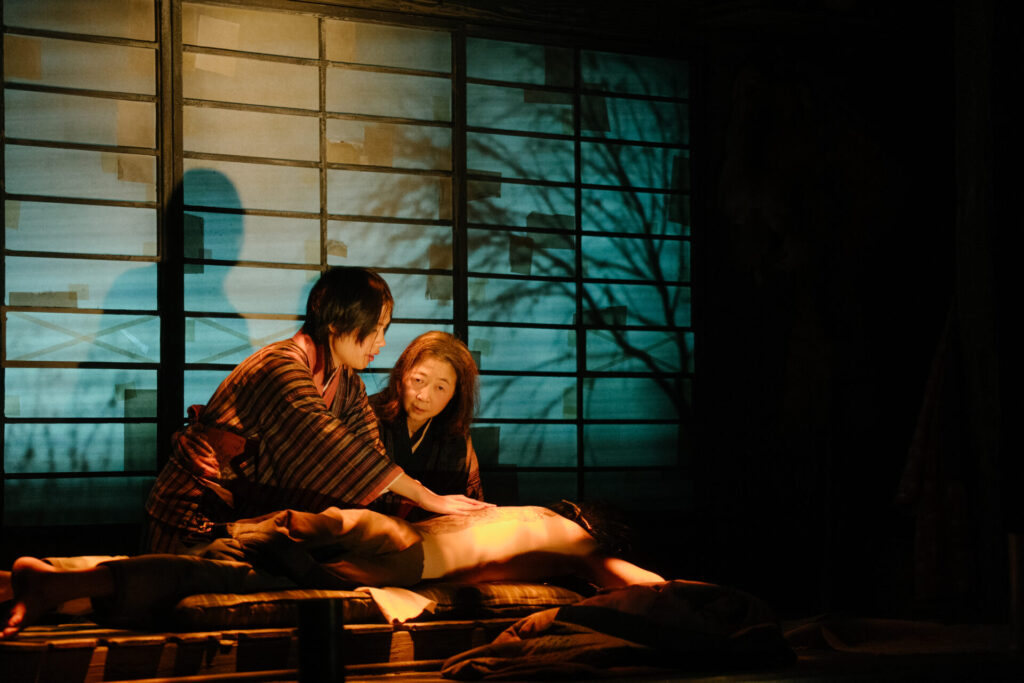
There was also a culture in which blind people could earn a living through professions such as massage, acupuncture, and music. At the same time, discrimination and social restrictions certainly existed. People with visual impairments occupied specific roles within society. I do not wish to idealise that period. Rather, I wanted to explore both its particular hardships and the kinds of human relationships that may have been lost in contemporary society.
Around 1840, just before the arrival of modernity, Japan still possessed a different perception of time. By setting the story in that era, I hoped to cast new light on our contemporary bodies, perceptions, and social structures through a different historical perspective.
The sensory perception of the world seems to run throughout your work-I am thinking, for example, of Dark Master. Could you speak about this aspect of your artistic practice?
My work has long been concerned with senses beyond sight, and, as you point out, this was also true of Dark Master. In that piece, the protagonist hears the voice of an invisible master and obeys it while cooking. Voice, smell, taste, physical gestures, and ritualised actions gradually transform his life. There, the senses functioned both as sources of pleasure and as gateways to dependence and control.
In Sleeping Fires, sensory perception emerges in a different way. Blindness does not signify the absence of the world. Sound, scent, temperature, touch, the movement of air, and the breathing of others allow another world to come into being.
Theatre itself is an intensely sensory art form. Audiences do not experience a story through thought alone. They encounter a performance through darkness, sound, smell, the actor’s body, silence, distance, and the flow of time. I have always been somewhat sceptical of the dominance of vision in contemporary culture.
Today, seeing, being seen, and displaying oneself possess enormous power. Yet human beings do not understand the world through sight alone. Sometimes, what remains invisible, untouchable, or difficult to articulate contains a deeper truth about human existence. I believe theatre is one of the few artistic forms capable of approaching such truths.
The title of your work, Sleeping Fires, immediately reminded me of the Greek philosopher Plato. In Timaeus, he proposes that the soul contains an inner fire aligned with the visible light of the sun. In wakefulness, this fire extends outward into the world, interacting with objects to create perception. His idea of the soul withdrawing from external stimuli into an inner, private state seems to resonate remarkably with your production-with its absence of sight and its creation of an inner vision, a transcendent reality. Given your background as a psychiatrist, I imagine you have read Plato. Was such a connection consciously present in the work? If not, would you tell us about the symbolism behind the title?
I found your observation about Plato’s Timaeus extremely interesting. To be honest, however, I was not consciously thinking about Plato’s ideas when I wrote this work. The Japanese title of Sleeping Fires is Uzumibi.
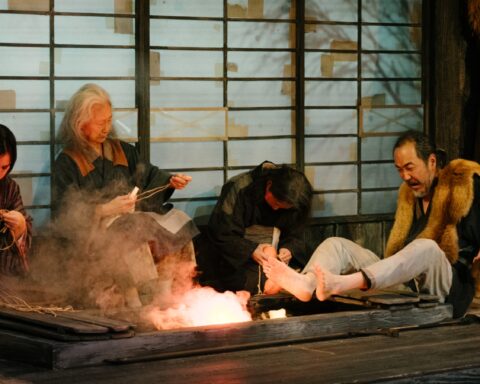
An uzumibi is a charcoal fire buried beneath ashes. From the outside, it appears extinguished. Yet beneath the ashes, the heat remains. With a single breath, the flame can come back to life. I have always been deeply drawn to this image.
In this work, fire represents anger, memory, desire, and the vitality of life itself. Within Iku, Saya, and Mankichi there are fires that seem to have gone out, yet continue to burn.
Human wounds and anger do not simply disappear with time. Even when the surface appears calm, heat can remain deep inside. Then, at a certain moment, the fire flares up again. It can be destructive, but it is also a source of vitality.
Returning to Plato, the idea that there is a fire within the soul that connects human perception with the outside world does resonate with this work in an unexpected way. For me, however, that fire is not something purely spiritual or sublime. It is something far more physical, fluid, impure, and visceral. Pain, shame, anger, tenderness, revenge, desire-these are the things that sleep beneath the ashes.
The title Sleeping Fires refers to something that sleeps but is not dead; something invisible yet undeniably present; something that appears quiet, yet may one day burst into flame once again.
You seem deeply moved by Western culture. Would you say that the performance we are about to see is a fusion of Japanese tradition and Western theatre? In your view, is there a fundamental point where these two remarkable, yet very different, cultures truly meet?
Rather than saying that I am fascinated by Western culture, I would say that I have been profoundly influenced by the forms and ways of thinking found in Western theatre. At the same time, deep within my body and memory remain the landscapes of Japan: old houses, humidity, darkness, scents, folklore, and everyday life. For this reason, I do not consciously try to combine Japanese tradition with Western theatre. Instead, these elements have naturally become interwoven within me.
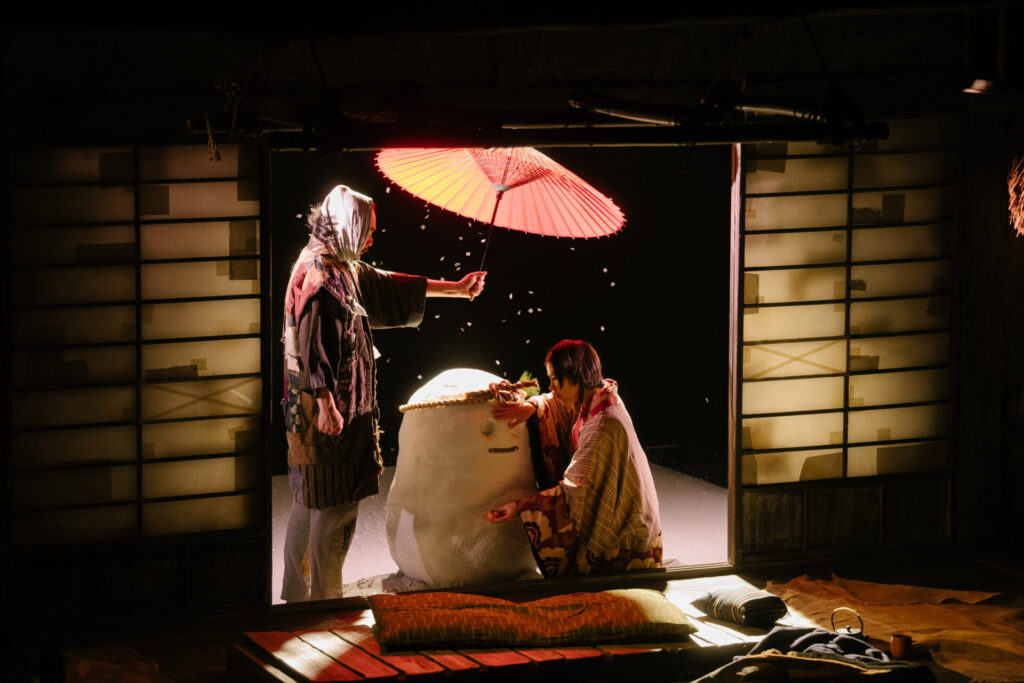
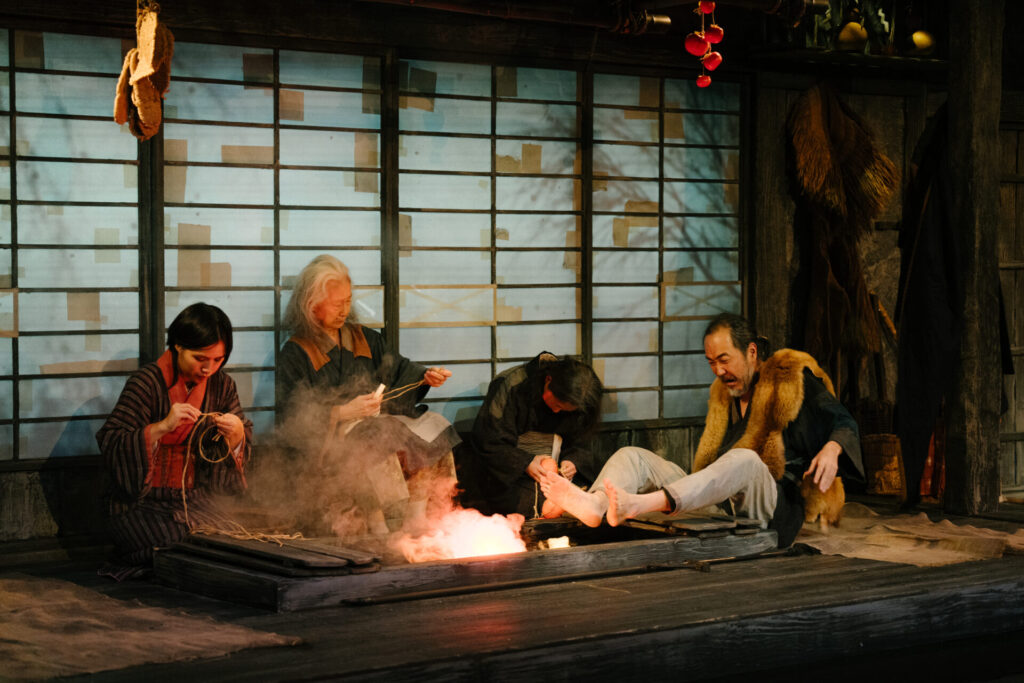
Sleeping Fires contains many distinctly Japanese elements: life during the Edo period, blind massage practitioners, the hearth, snow, mountain villages, the shamisen, and traditional wooden houses. Yet I do not wish to present them merely as cultural heritage or as a traditional performance. Rather, I seek to incorporate them into the structure of contemporary theatre—as a space where audiences encounter the actors’ bodies in the present moment.
If there is a place where Japan and the West truly meet, I believe it is not primarily on the level of ideas or differing aesthetic traditions, but at the most fundamental level of the human body.
Regardless of the culture we belong to, we grow old, we fall ill, we desire, we suffer, we long to touch others, and we move towards death. Faced with this finite condition of the body, East and West do not seem so different.
Theatre is an art form in which finite bodies appear together within the same time and space. Actors and audiences breathe the same air, listen to the same silence, and gaze into the same darkness. I believe there is something there that can be shared beyond cultural differences. For me, this is one of the greatest strengths of an international theatre festival.
(Kyoko Iwaki, Tokyo Theatre Today – Conversations with Eight Emerging Theatre Artists, 2011, pp. 226–241.)
Info
Sleeping Fires
Written and directed by: Kurō Tanino
Performed by: Niwa Gekidan Penino
Dates: 27 & 28 June 2026
Venue: Pireos 260 (Space H)
Presented as part of the Athens Epidaurus Festival
Set in the mountains north of Edo, Sleeping Fires follows Iku, a woman blind from birth whose life is transformed by the arrival of Saya, a young massage apprentice. Inspired by the history of blind massage practitioners in Japan, the production explores exclusion, intimacy, memory, and the body’s capacity to perceive the world beyond sight. Combining poetic realism with an immersive sensory experience—and featuring performers with visual impairments—Kurō Tanino’s latest work marks the acclaimed Japanese director’s first appearance in Greece.