
 KATERINA PARRI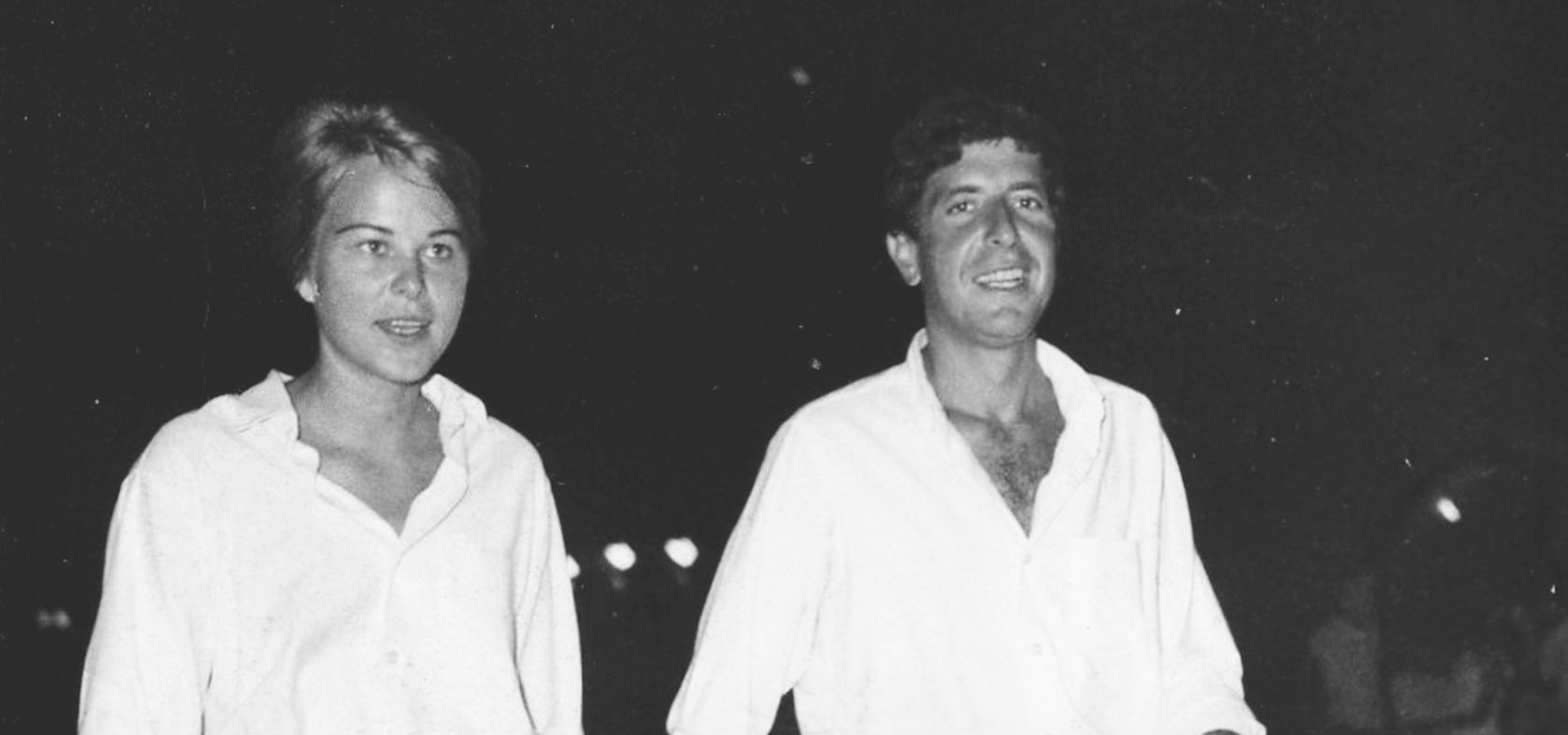
By Myriam Paraskevopoulou
A cinematic love story spanning 66 years: Leonard Cohen and Marianne Ihlen, from Hydra’s bohemian days to a final letter of farewell that sealed their eternal bond.
Somewhere I once read that if, in this perhaps first life, an artist happens to fall in love with you, you become immortal-because your spirit never truly leaves any “present.” And immediately my mind wandered to some of those eternal love stories, tormented by the same physical desire, the same emotional pain, the same spiritual chaos, until every cell aligned in perfect compatibility-if only for a few hours. My first thought was Leonard Cohen and Marianne Ihlen.
In their case, Marianne Ihlen would remain forever in the history of art as one of the great muses, while Leonard Cohen would be remembered as the mortal who followed his beloved into their shared infinity. Their story is deeply romantic-cinematic from beginning to end.
They met on the island of Hydra, where the young Leonard had become a permanent resident, trying to discover his poetic identity. The term “muse” may sound outdated-perhaps even a beautified version of the erasure of female presence in the arts. Yet I continue to use it, because for Leonard Cohen, Marianne was the person who helped him find his path, even if in the most difficult way. The first time he saw her, he said she was the most beautiful woman he had ever seen. Their first dates followed soon after-initially as friends, then as lovers.
Life on Hydra was harsh. They lived in a house without electricity or running water, with very little money. Cohen wrote three pages of his novel devoutly every morning, and at night he played music within a makeshift artistic collective that had settled on the island. As he later described it:
“It was as if everyone was young and beautiful and full of talent-covered in some kind of gold dust. Everyone had distinct and unique qualities. That is, of course, the feeling of youth, but in the glorious setting of Hydra, all these qualities were magnified.”
When Marianne was once asked what her art was, she disarmingly replied that her life itself was her art. She was twenty-five, he was twenty-six-deeply in love. Completing the pure hippie frame of their life together was Marianne’s son, Axel Junior, the result of her turbulent 13-year marriage to writer Axel Jensen. Cohen cared deeply for the child and used to lull him to sleep with his songs.
Marianne struggled greatly as a single mother during that time and eventually decided to send her son back to Norway to live with his grandmother. She then moved in with Cohen, who, at twenty-six, bought a house on Hydra. During their long cohabitation, he completed two novels, The Favourite Game and Beautiful Losers, works imbued with a strange, mystical fiction. But Cohen suffered a nervous breakdown, realizing that he would never be able to fully support himself-let alone anyone else—through literature. He turned his attention to music.
In 1966, Judy Collins recorded a song Cohen had played for her, “Suzanne,” along with the much later “Hallelujah,” which would become his most famous song. He began writing, recording, and performing at festivals. He decided to return to Canada to earn money, while Marianne went back to Norway to reunite with her son. They drove together to Norway, and then the aspiring international musician flew to Montreal. It was the first of many separations.
This was, of course, an era when telephones were rare and communication happened through handwritten letters. That sweet agony of separation-unbearable yet filled with poetic longing—feels almost unimaginable today, in an age of endless means of communication that somehow still leave us unsatisfied, perhaps even choosing solitude instead.
By the end of 1969, Marianne went to New York to try to rekindle their relationship. Cohen was living at the infamous Chelsea Hotel in Manhattan, socializing with figures like Janis Joplin, Joni Mitchell, and Nico of The Velvet Underground. With her son, Marianne moved into a crumbling apartment on Clinton Street. One evening, she was robbed at her doorstep. Cohen kept her at a distance, telling her the Chelsea Hotel was “not the place he wanted.”
In 1972, while Marianne still maintained ties to Hydra, returning every year, her stay ended unexpectedly when a young woman knocked on her door holding a baby and asked when she would be moving out. That woman was Suzanne Elrod, who-depending on the version-met Cohen either in the elevator of the Chelsea Hotel or at a Scientology meeting in 1969. They had two children together before separating bitterly in 1978.
Cohen later discovered Zen Buddhism and lived for years in a monastery retreat. He lost all his money to a manager he trusted and only rebuilt his fortune late in life by touring the world. Yet he continued sending money to Marianne and her son long after their separation.
Marianne returned to Norway, where she worked as a secretary for an oil platform construction company. She married an engineer with three daughters from a previous marriage. They remained together-though in separate apartments within the same building-until his death.
Shortly before her death in July 2016 from leukemia, her friend Jan Christian Mollestad contacted Cohen to inform him that Marianne had only a few days left to live. As he later told CBC Radio, just two hours after the call, a beautiful letter arrived from Cohen:
“Dearest Marianne,
I’m just a little behind you, close enough to take your hand.
This old body has given up, just as yours has too, and the eviction notice is coming any day now.I’ve never forgotten your love and your beauty. But you know that. I don’t have to say more.
Safe travels, old friend. See you down the road.
Love and gratitude,
Leonard.”
They brought the letter to her the next morning. She was fully aware of her surroundings and deeply moved that Leonard had written to her. As her friend read the line, “if you reach out your hand…,” Marianne truly reached out her own.
Two days later, she lost consciousness. When she passed away, her friend whispered “Bird on the Wire” to her-her favorite song-kissed her forehead, and as he left the room said, “So long, Marianne.”
Four months later, Leonard Cohen died after a fall at his home in Los Angeles.