 Pepi Nikolopoulou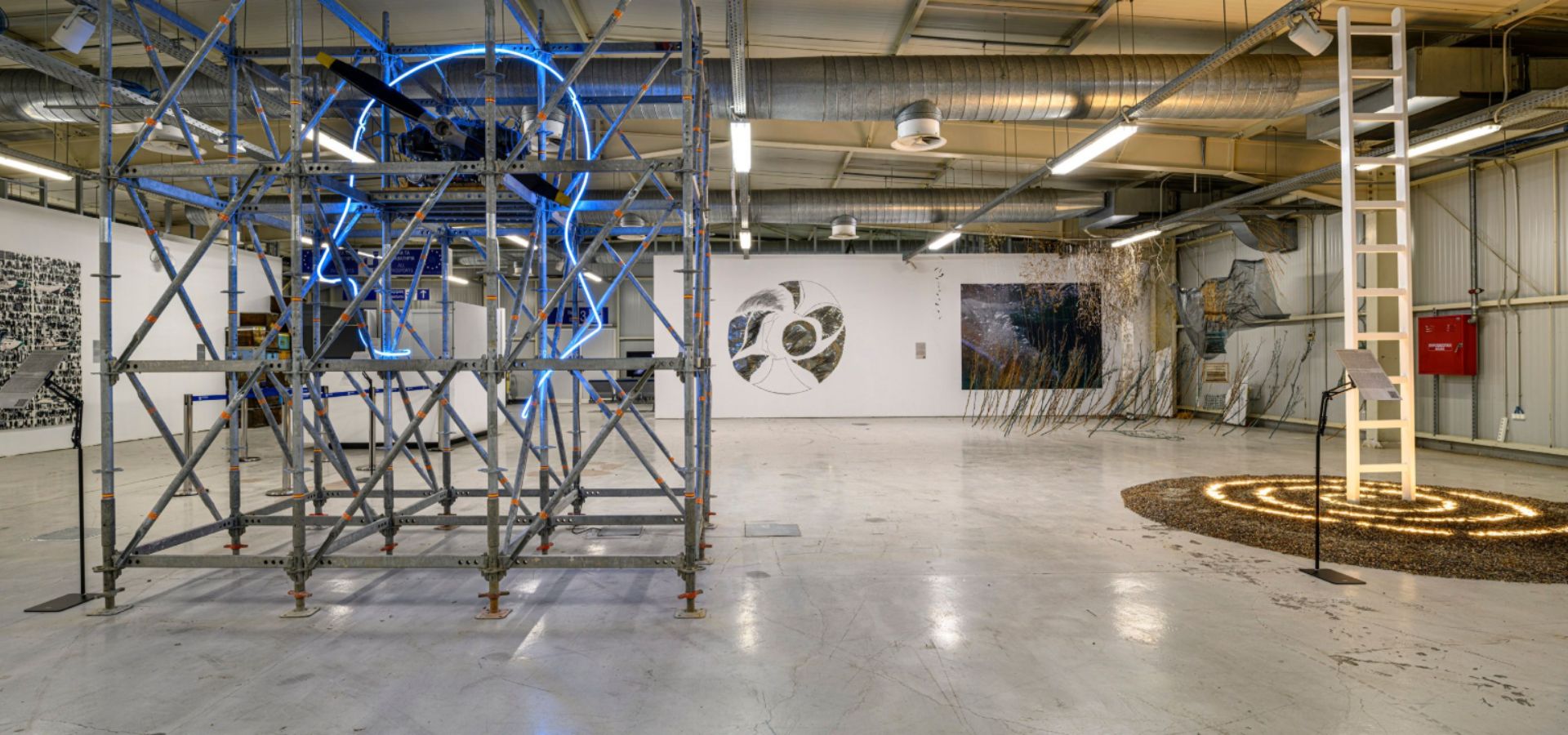
A journey inward, where art transforms waiting into experience and the in-between time into a space for reflection
The contemporary art exhibition all aboard, curated by Kostas Prapoglou, has opened its doors at the Express Facility of Athens International Airport “Eleftherios Venizelos.” With the participation of 40 artists from different generations and countries, it marks the first project in Greece – and one of the very few worldwide – where a large-scale art exhibition unfolds inside an operating airport.
all aboard is a bold artistic venture, not about travel itself but about transition – that delicate moment when you are no longer where you came from, yet not quite where you’re going. In a space that once served as a gateway for thousands of passengers and now reopens as a site of art, the participating artists rewrite the experience of waiting.


Among installations, sounds, light, and materials, the airport transforms into a mirror of our inner journeys. Each artwork becomes a stop, each stop a possible return. That’s also how I experienced the exhibition: as a journey. Every work feels like a waypoint, every room an in-between place – between installations, photographs, and video works, between personal geographies and shared memory. Each piece, a scene. Each scene, a short, invisible flight – from departure to a return that is never quite the same.
Scene I – The Entrance
The path to the exhibition. The sounds of airplanes, the footsteps of visitors, the air itself. We enter a space that feels alive yet motionless – as if time had stopped counting, holding its breath instead. Signs in large letters announce: Departures – Arrivals. Looking at them, I think of the many times I’ve stood before such words – moments of parting and reunion, those in-between states of excitement or hesitation, unsure which path to follow. No, there is nothing to declare. We enter the space with a clear mind.
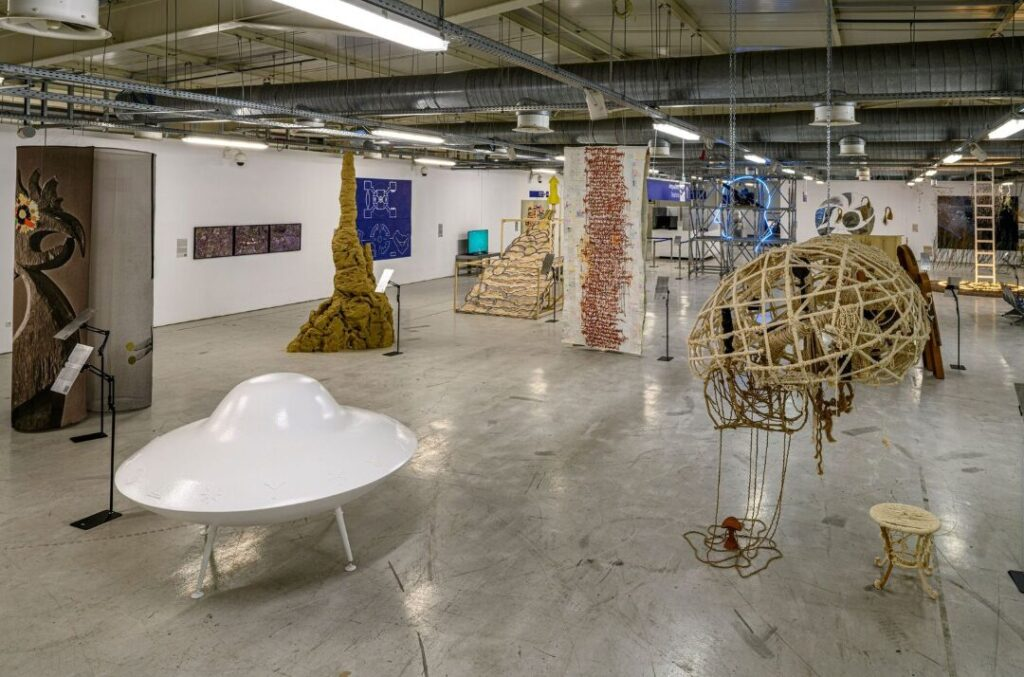
The voice of curator Kostas Prapoglou echoes before we even see the artworks. He speaks about the Express General Facility, the building we are in, opened in 2004, briefly active during the Champions League and the Athens Olympics, then closed. A place of abandonment, now reopened after twenty years to host art. “It’s a neutral space,” he says. “You don’t stay here long. It’s a place of transition, but also of psychic charge. How does each person respond to that? With joy? With anxiety? With anticipation?”
I think airports are like the mind – fields of constant movement. Nothing stays for long; everything departs, lands, returns. His voice continues, speaking about the sound of a boarding call, the waiting, the anxiety of not missing your flight. “It’s a place of emotional alternations,” he says – a phrase that somehow condenses everything around us. If you close your eyes for a moment, the distant engine hum blends with footsteps, voices, the tension and excitement of transition.
Art surrounds you. Installations are placed like stations, transmitting messages of familiarity. One work reflects the light; another hovers like lost luggage that never reached its destination. There’s a sense that someone – or something – just passed through, leaving an invisible trace that connects you to travelers everywhere.
Scene II – Memorabilia, Anna Amparioti

The doubt of travel. All that we carry, even when we think we’ve left it behind. The inability to detach completely – from places, from people, from the memory that has already mapped us.
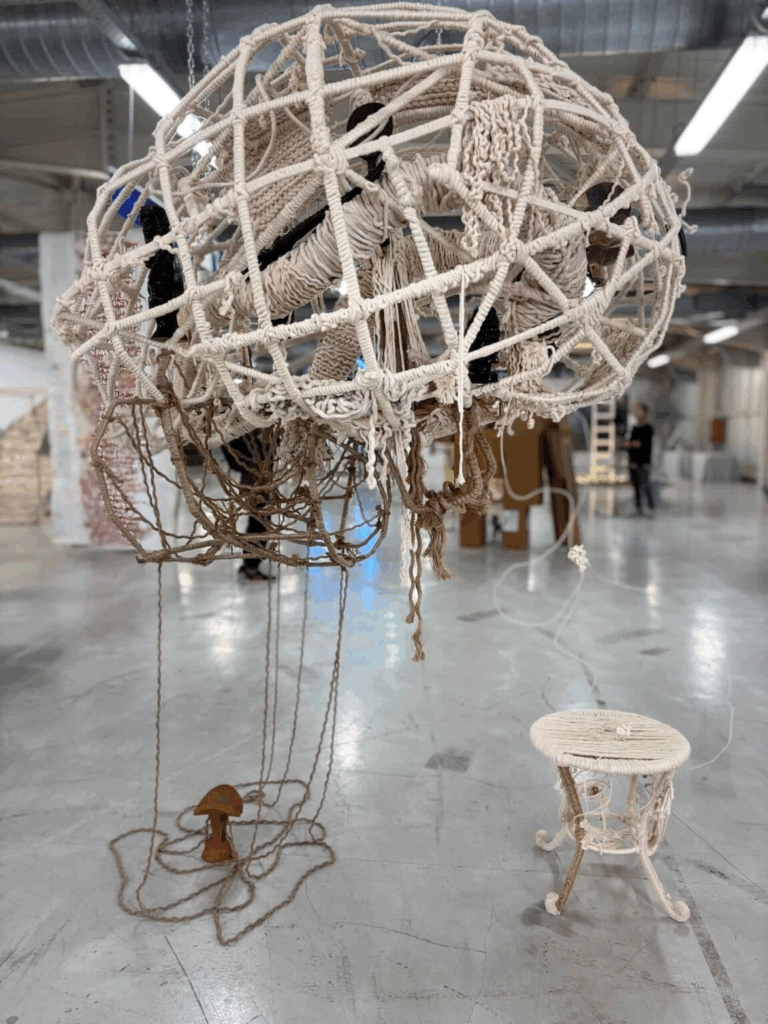
In front of me stands Amparioti’s brain, a sculptural mechanism of memory trying to breathe.
An open brain, forged from cold metal and bound with coarse rope, filled with recollections.
Embedded within it are African artifacts – family heirlooms brought back when the artist’s relatives visited Africa in the 1960s. They came as gifts, tokens of distant connections with those who lived and moved across that continent.
The rope tightens around the metal; the embedded objects resist. You can’t help but wonder: how much do we carry unconsciously? How many memories inhabit us still?
Memorabilia stands like a totem, a reminder that nothing is ever completely forgotten.
Scene III – Diary of Unspoken Words, Eleni Zouni
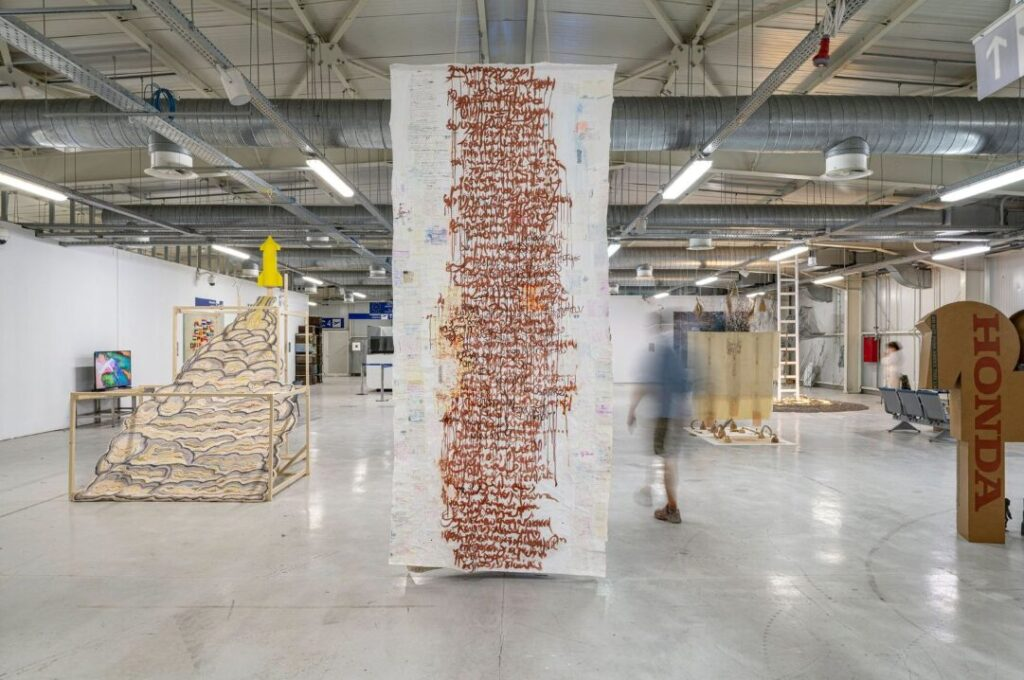
I have always carried a small notebook and a pencil. I write quickly, clumsily, incoherently – words that seem disconnected to others, yet for me they are the only way to balance what I think with what might slip away. Pages filled with tangled words and thoughts. Notes, not as a means to remember, but as a way not to forget.


Zouni’s Diary of Unspoken Words weaves precisely that moment – when thought no longer has language. Her markings echo my own urgency to hold on to the ephemeral. I lean closer and read her notations: hours, stations, people, encounters, fragments of time. Writing, like travel, is often a way to prove that we still exist.
Scene IV – Rites of Passage: A Talismanic Tunic, Irini Gonou

In every journey, there comes a moment when the path ceases to be external. Everything begins to unfold within. The body starts remembering things the mind has forgotten – small, scattered, primordial seeds transforming into something new.
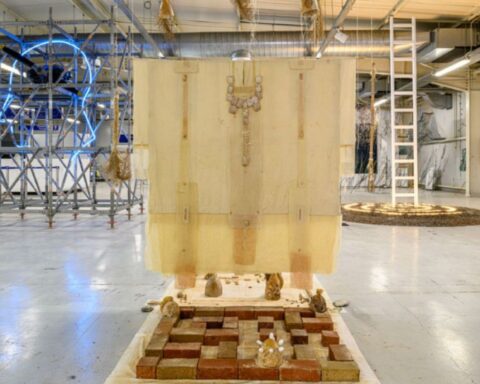
Irini Gonou’s installation Rites of Passage: A Talismanic Tunic (2025), a large-scale robe, seems to breathe.
It resonates with ritual practices from diverse cultures where birth, initiation, belonging, and departure from life are marked by materials that both protect and transform. Calabash seeds from West Africa, palm leaves from South Asia, reeds used in Shinto ceremonies and the traditions of the Nile — all inscribed within the fabric, forming an inner map of orientation.

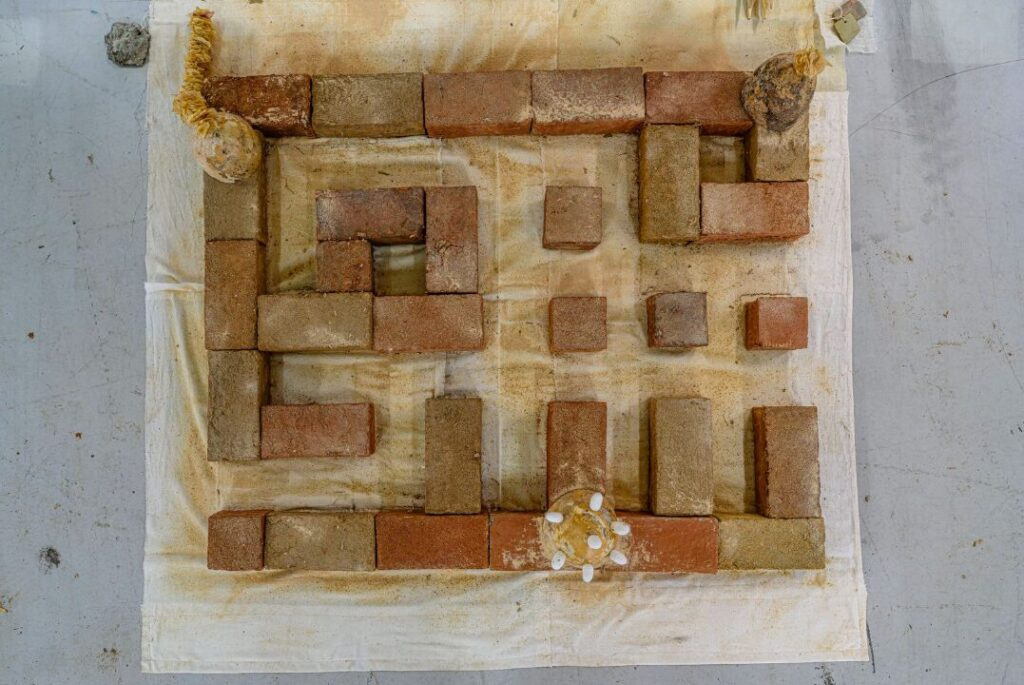
On the floor, the word kokouli (“cocoon”) is formed with sun-dried mud bricks, written in Kufic script – one of the oldest styles of Arabic calligraphy, originating in the city of Kufa (modern-day Iraq), known for its geometric, linear structure. It stands as a whispered sign of regeneration — a quiet breath of becoming.
Scene V – Metavasi (Transition), Lina Pigadioti

I turn to the right. An installation playing with the light of the runway – the only point in the building with a direct view of takeoffs. Mirrors, translucent panels, a structure that invites you to step inside. Light refracts, and you see not only outward, but also yourself within the light. Lina Pigadioti’s Metavasi (Transition) (2025) reveals a constellation of temporal disorientation. Rotating surfaces act as sensory triggers, overturning static perception. Everything feels fluid.
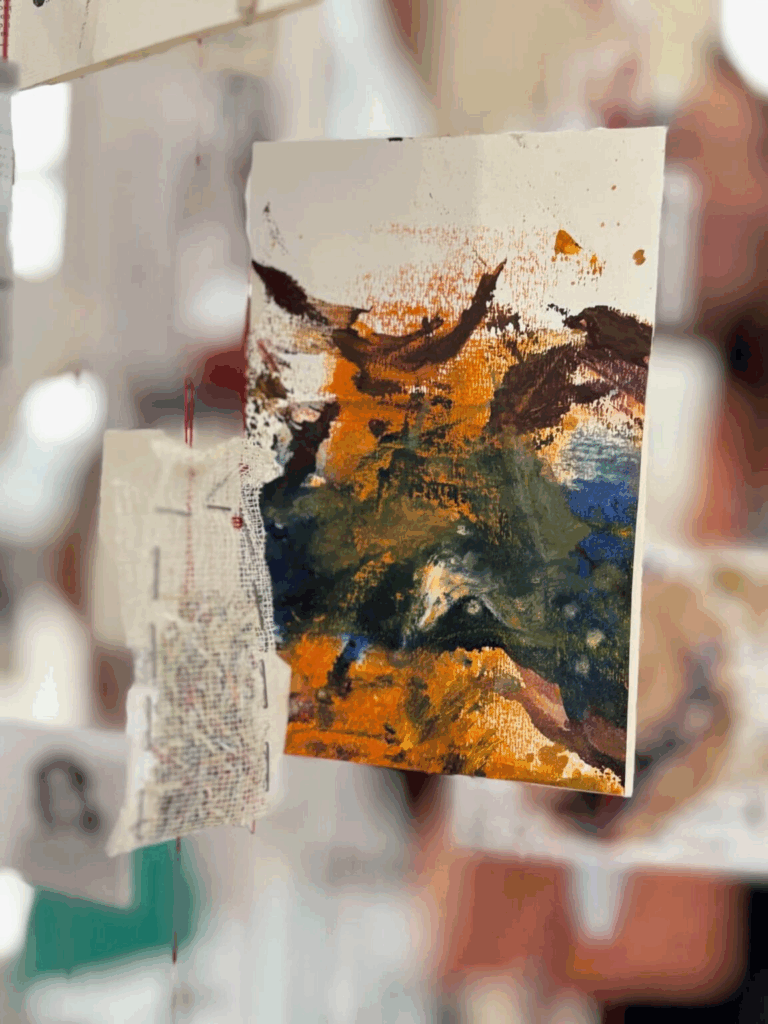

Waxed threads, embossed monotypes, archival fragments, worn papers, small mnemonic symbols – together they form a network of lived details. And everything moves, each time you approach. It feels as if you’re walking among your own moments, trying to balance your gaze between unstable images from your past. A fragile web of memories. What you see shifts; what you remember breathes.
Memory pulses like a substance changing shape – and within it, for a brief moment, you rediscover your form. Everything you see returns to you, and light – like travel – never has a single direction. A scene of self-awareness and inward observation.
“We live in fragments,
but sometimes the fragments align
and we remember who we are.”
– John Burnside
Scene VI – The Reunion of Erotokritos and Aretousa, Theophilos Chatzimichail

In an age where meetings translate into notifications and images into pixels, a scene of tender closeness resurfaces. Theophilos Chatzimichail’s Erotokritos and Aretousa (1932) – folk in technique, existential in essence – captures the most grounded moment of love: recognition. In 1932, Theophilos painted the revelation of love – the instant when the hero returns, disguised, to see if love has endured. “She doesn’t look at him,” the curator says. “She smells him.” That remark, almost cynically tender, is perhaps the truest definition of recognition I’ve ever heard.
Today, disguise is no longer a garment; it’s an avatar, a profile. We log into networks, hide behind screens, waiting for a meeting that may never come. And when it does, the soul senses the other before seeing them. The need for contact coexists with the need for concealment. Our modern mask – the avatar – is a defense mechanism. In the airport, a place of meetings and partings, the painting stands as the ghost of another kind of intimacy. Aretousa smells, feels, remembers. Reunion becomes an act of pure memory.
Scene VII – Without Borders (2025), Alexandra Athanasiadi

Wooden doors and windows, uprooted and orphaned. Athanasiadi’s installation stands like an antechamber of souls that haven’t yet decided whether to leave or stay. The objects have lost their utility, and yet some echo of function persists – a promise of passage, of opening. As you approach, you imagine sounds: the creak of wood, the wind breathing behind a shutter. The surfaces bear the patina of time – fingerprints, seasons, lives. The doors lead nowhere; the corridors have no end. And yet, there is something liberating in their stillness.

Among the worn frames and shifting light, you pass through a threshold belonging to no geography – a space without borders. An amorphous landscape where you move like a timeless traveler, slipping through cracks of memory and air.
“For I am the wind that passes
through the narrow streets of the city,
making the closed windows tremble.
For I am the evening breeze,
a pure and living breath,
that makes the fallen leaves rustle.”
– Dimitris Panagopoulos
Scene VIII – Remember: You’re Not Leaving, You’re Going!, Dimitra Skandali

There are journeys that never begin – and yet, never end. They have no destination, only a slow, descending motion – inward, deeper still. Dimitra Skandali’s site-specific installation Remember: You’re Not Leaving, You’re Going! (2025) forms a psychic seabed – a space where memory takes bodily form.
Seaweed from the Pacific, wilted flowers, copper-plated traces of organic life – all compose a landscape of reverie. Emotions surface from the unconscious.
A female figure sinks within the photograph: she is the traveler’s soul, the viewer in free fall into the unknown self. The installation feels like an archipelago of the mind, where plant and human coexist in a fluid equilibrium. In her work, you don’t leave – you simply go deeper within.
“We shall not cease from exploration,
and the end of all our exploring
will be to arrive where we started
and know the place for the first time.”
– T.S. Eliot, Little Gidding
Scene IX – Scala Paradisi, Klairi Tsalouchidi–Chatzimina

Every journey needs a pause – a place where the body can rest while the soul continues. A moment in between. A white staircase floats in midair, without support. At its base, a luminous spiral traces words from the Hymn of Love by Apostle Paul (1 Corinthians 13): “If I speak in the tongues of men and angels but have not love, I am only a resounding gong or a clanging cymbal… Love bears all things, believes all things, hopes all things, endures all things. Love never fails.”
The words strike you like current. Tsalouchidi speaks not of the divine, but of the human miracle of loving without return. The staircase remains in limbo, suspended between earth and sky – a symbol of inner ascent. Love, like light, has no direction – only duration. The reference to The Ladder of Divine Ascent (Climax or Scala Paradisi) and Jacob’s Ladder functions here not as theology, but as a symbol of spiritual elevation – of the human desire to transcend its limits, to move from the tangible to the immaterial.
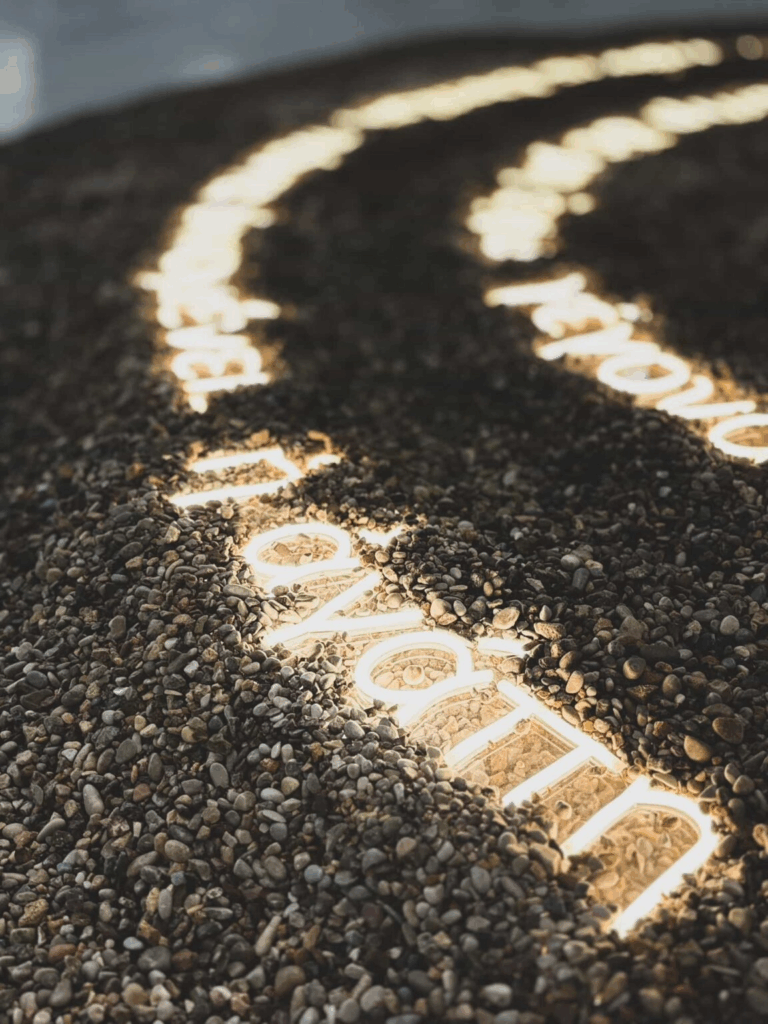
More than a theological notion, it becomes a psychic archetype: an invisible axis connecting matter and spirit, the mortal and the infinite. And so the journey ends – not with arrival, but with a lingering resonance within the body: the passage that reminded you that you exist.
Info
Opening: October 8, 2025 | 19:00–23:00
Exhibition dates: October 9 – November 9, 2025
Opening hours: Wednesday – Sunday, 12:00–19:00
Venue: EXPRESS FACILITY, Athens International Airport “Eleftherios Venizelos”
Curator: Kostas Prapoglou
 www.artefact-athens.org
 facebook: artefact_athens
 instagram: @artefact_athens
 TikTok: @artefact_athens
Free admission with ID card, driver’s license, or passport.
HOW TO GET THERE
 BY CAR
Drive toward Long-Term Parking P3 and follow the signs to the all aboard exhibition.
At the entrance of the parking area, before the barriers, turn left and proceed to the designated parking spaces.
Upon departure:
-
Drive toward the Long-Term Parking P3 entry barriers.
-
Collect a ticket from the machine and follow the exit signs.
-
At the exit, insert your ticket into the machine and leave free of charge within 20 minutes.
 BY PUBLIC TRANSPORT
Metro or Suburban Railway: Exit at the Main Station on the Departures Level, cross the road at Entrance 2, where you’ll find the special shuttle bus stop to the all aboard exhibition.
KTEL or OASA buses: Go to the outer road on the Departures Level, at Entrance 2, to reach the same shuttle bus stop.
 AIRPORT SHUTTLE SERVICE TO THE EXHIBITION
To the exhibition: Buses depart every 30 minutes (12:00, 12:30, 13:00, etc.).
Return: Buses depart from the designated stop outside the exhibition area, also every 30 minutes, at quarter past and quarter to the hour (12:45, 13:15, etc.).