 STELIOS PARRIS
By Stelios Parris
When artists live and create together in the same place, something happens that goes beyond research and art.
The Anargyros Art Residency programme was launched as a pilot initiative last year and proved to be a success. This year, I visited Spetses and, upon arriving at the grounds of the Anargyrios and Korgialenios School of Spetses (AKSS), I can only put it simply: I was amazed. A former boys’ boarding school that operated from 1927 until 1983 now offers artists the opportunity to spend their daily lives there, study, work and connect both with one another and with the local community of Spetses.
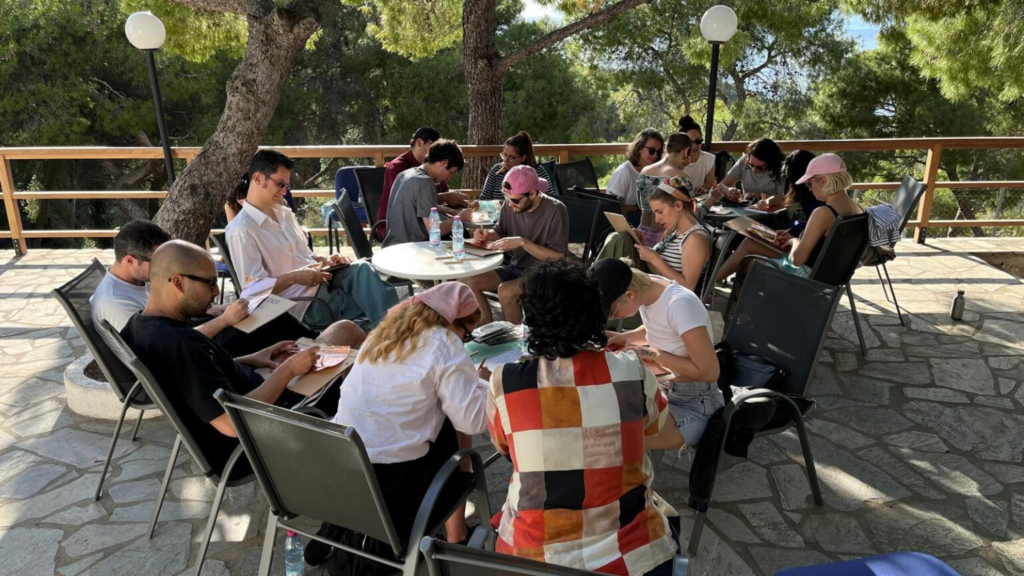
At the heart of the programme are its artistic director and curator, Eva Vaslamatzi, and its coordinator and production manager, Simoni Niarou. Simoni took me by the hand and showed me around the grounds, telling me that Building B, where I would be staying, once housed the dormitories of the “good” students. The following morning, I woke up in a sweat from a dream in which I had failed to study for my lessons. The anxiety quickly faded, however, when I arrived at breakfast and found artists gathered around the table, eating together and discussing their plans for the day.
The AKSS carries a sense of history and energy that inevitably inspires. Its grounds stretch across a vast landscape, with three imposing buildings, a lush green hillside rising behind them and the sea unfolding in front. Eva Vaslamatzi explained what takes place there, introduced me to this year’s participating artists, and spoke about the ideas behind residency programmes, curating and animism, the central theme of this year’s edition.
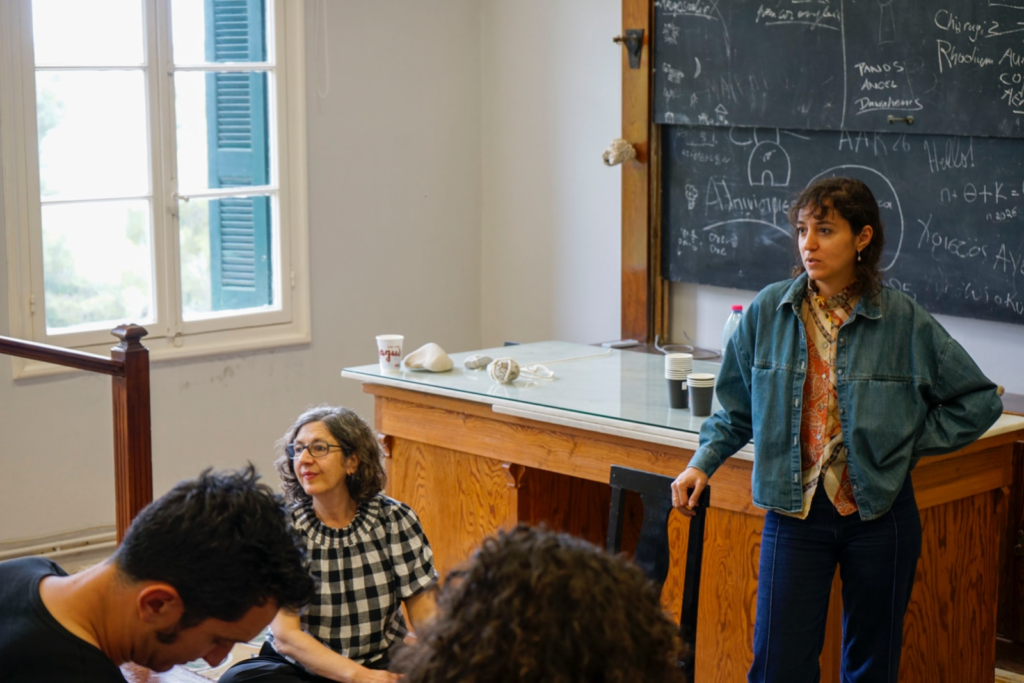
Eva Vaslamatzi, for those who may not know you, who are you?
I am a curator. I would say I followed a fairly classic path within the arts. I studied art history and completed postgraduate studies in philosophy of art and curatorial practice in Paris. Curating emerged for me as a way of resolving an ongoing tension between theory, practice and artistic processes. I worked extensively with photography and video, mainly through analogue media, while also pursuing academic studies. At some point, however, I became exhausted by academic discourse, especially in France, where there is a very specific way of approaching things. For me, curating is primarily about space, architecture, history and the in situ experience. I am deeply interested in archives and collections. Writing and theory are also part of the process, but they come second. They are never the starting point.
How did the Anargyros Art Residency begin?
The School’s new Board of Directors and its president, Giannis Aisopos, proposed the creation of an artist residency because the site is ideally suited to such a programme. All of the students’ rooms are still intact. Nothing has been reconfigured, no walls have been removed, so the possibility of accommodating a large number of people is immediately apparent. They approached several curators and invited us to submit proposals, including a theme and a budget.
Your proposal was selected. What was it called?
Last year’s theme was School of Transitions. In fact, I proposed having no specific theme at all, because the school itself already constitutes a theme. I wanted to work directly with that reality. The project was inspired by Jacques Rancière’s The Ignorant Schoolmaster. In my proposal, I wrote that I wanted to revisit the hierarchical relationship between teacher and student, which must have been particularly strong at the Anargyrios and Korgialenios School of Spetses, through artistic works and approaches.
And what did you propose this year?
Island Animisms.
How did that theme come to you?
Ideas usually find me in unexpected places. I try to avoid simply reading a book and adopting a theory from it. The idea emerged while I was preparing my residency proposal last year. I had come across an exhibition online titled Animism, curated by Anselm Franke. I was fascinated by the texts, the artworks, and especially by the way the exhibition approached the subject. It examined how animism emerged alongside the Enlightenment, which introduced distinctions such as body and soul, culture and nature. Before these divisions, everything existed as part of a unified whole. Once those separations were introduced, concepts such as a tree possessing a soul became conceivable. I have long been interested in metaphysics, magic and related themes.
The school’s spaces are large and, in some places, empty. Yet beyond the furniture and infrastructure, they seem to hold the energy of another era, almost something magical. I noticed the marble staircases worn down by generations of students. Is your intention to bring that condition back to life in the present?
Yes, although last year we focused much more on the School itself. This year that was not our primary goal. That is why the word “island” is important. We wanted to explore what stories, myths and unusual narratives we could uncover about the island we are engaging with. We looked into the folk culture of Spetses and discovered many fascinating elements.
What is animism, in simple terms?
It is a way of relating to the non-human world. In many non-Western cultures, as ethnography teaches us, humans and nature are not understood as separate entities but as parts of a single, interconnected whole. One particularly interesting thing we learned in Spetses is that local fishermen often used to have nicknames derived from fish species. Someone might be called “The Snapper” or “The Red Mullet.” On an island, the relationship between people, the sea and the landscape becomes so intimate that people symbolically merge with their environment.

Last year, how many artists participated?
Last year there were four participants: Rowena Hughes, Konstantza Kapsali, Natalia Manta and Ioanna Paraskevopoulou. This year there are six.
The number has increased because you realised you had plenty of space to fill?
I think this residency could host many more people. Anyone who has visited the Cité Internationale des Arts in Paris, where around 300 artists are accommodated, can imagine a similar model here. If you know the residency landscape in Greece, one of the biggest challenges is not only funding but also accommodation. Artists are usually scattered across different locations. Here, however, the conditions are exceptional. Living in the same place where you create fundamentally changes the experience. It is not simply a matter of convenience or transportation. What stands out most is the sense of coexistence. The artists live together, share the same environment and develop common points of reference. They observe the landscape collectively and absorb the rhythms and energy of the place together.
I can feel it myself as a visitor. Generations of children grew up here, living as boarders from the age of eight until adulthood.
Among them was Iannis Xenakis. Many remarkable figures passed through this school, which was truly pioneering for its time.
How did you choose the artists?
The first year was a pilot edition, so we worked by invitation. I invited four artists, some of whom I knew better than others. My aim was to include cinema and dance. Although my background is in the visual arts, I have experience with residencies abroad and I believe the interaction between different disciplines is what makes them truly interesting. A musician may help a filmmaker with sound. A dancer may perform in a filmmaker’s work. A filmmaker may help document another artist’s process. These exchanges happen naturally and often would not occur within a purely visual arts environment. This year we added sound as another discipline. The selection process took place through an open call, which received 500 applications. The final participants were chosen by a five-member jury.

Receiving 500 applications suggests the residency was very successful last year.
We worked extremely hard to create the best possible conditions for artists. As I mentioned, many residencies do not cover accommodation or meals, while some even require artists to pay. Here we can provide lodging, food, an artist fee and production support, within reasonable limits. That alone is highly attractive. The fact that we received 500 applications shows that people have already recognised the seriousness of what is happening here.
Did you expect 500 proposals?
No. What I did expect, however, was the incredible feedback from the artists who participated. Even months later, some of them still write to me saying it was one of the most meaningful experiences of their lives. Of course that has to do with the programme and our team, but it also has to do with the place itself. For last year’s four artists, the residency was transformative. For different reasons in each case, but transformative nonetheless.
How did you choose the six artists who would spend six weeks here, from 27 April until 7 June?
Together with the jury, we approached the selection process much like composing an exhibition. I tend to think of it as assembling a puzzle. I usually begin with a strong central piece and then build around it. In a thematic exhibition, some works need to engage more directly with the core concept. These works provide an anchor, allowing the rest of the exhibition to expand more freely around them. This creates room for unexpected approaches, even works that initially appear somewhat outside the theme but ultimately find their place within the larger composition.
Meet the Artists of Anargyros Art Residency 2026
Myrto Vratsanou
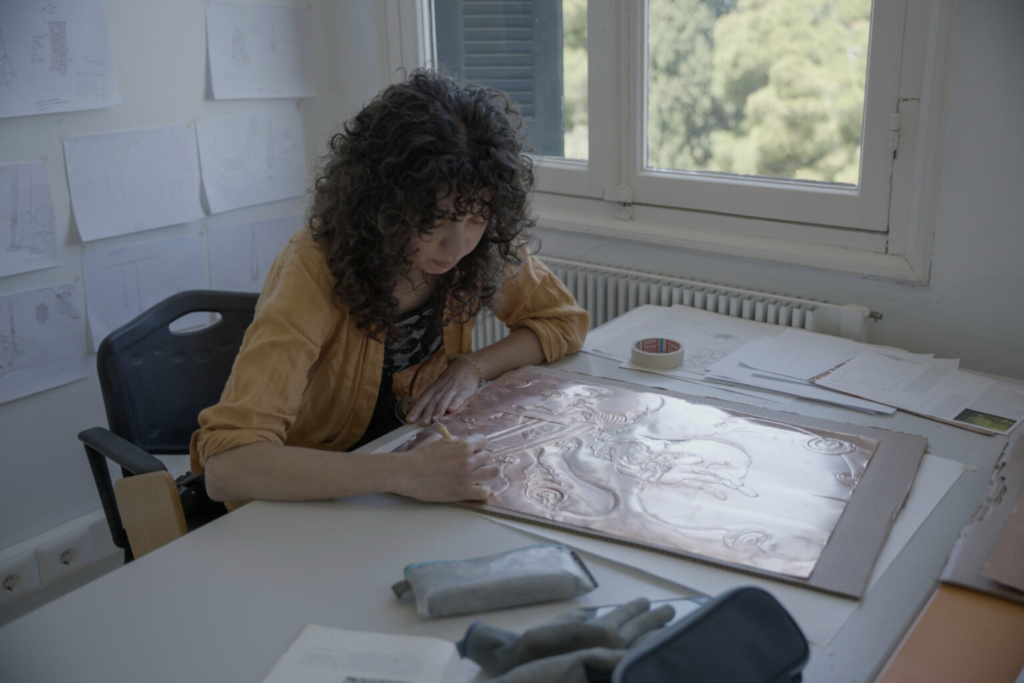
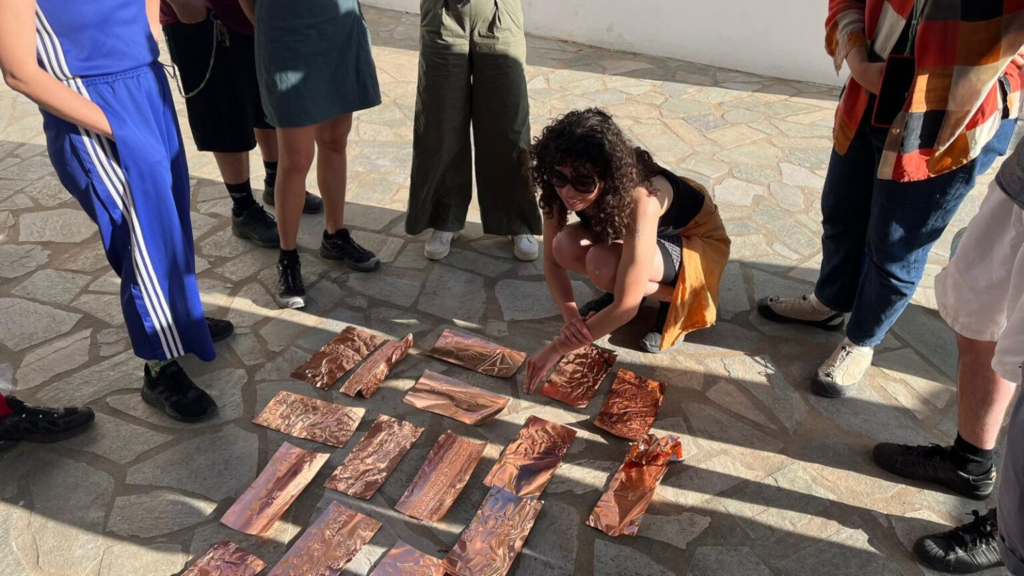
One of the visual artists we selected is Myrto Vratsanou. Her practice revolves around two central themes. The first concerns nautical charts, not in the conventional cartographic sense, but from the perspective of someone at sea looking toward the shoreline. This fundamentally shifts how we understand mapping, orientation and spatial experience. The second focuses on the modernisation of Spetses, particularly around the Daskalakis factory, one of the first places to bring electricity to the island. Through this lens, her work explores how infrastructures such as electricity, cables and underwater networks reshape both the landscape and the ecosystem. Materials such as copper play a central role in her practice. For the residency, she is creating an installation that begins with drawing on paper and is then transferred onto metal.
Nona Inescu
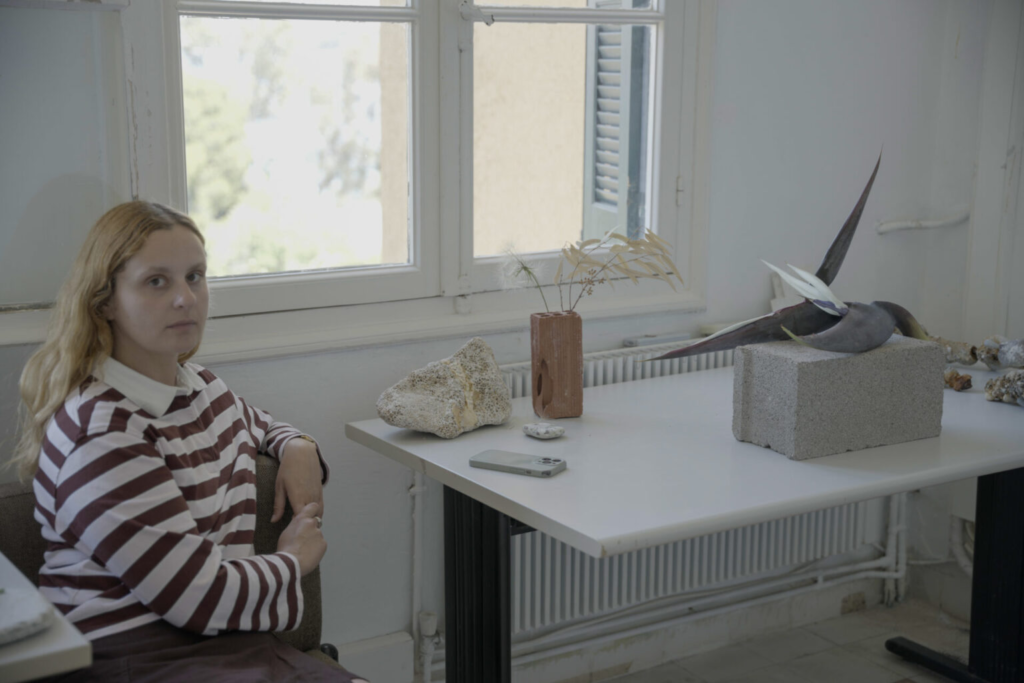
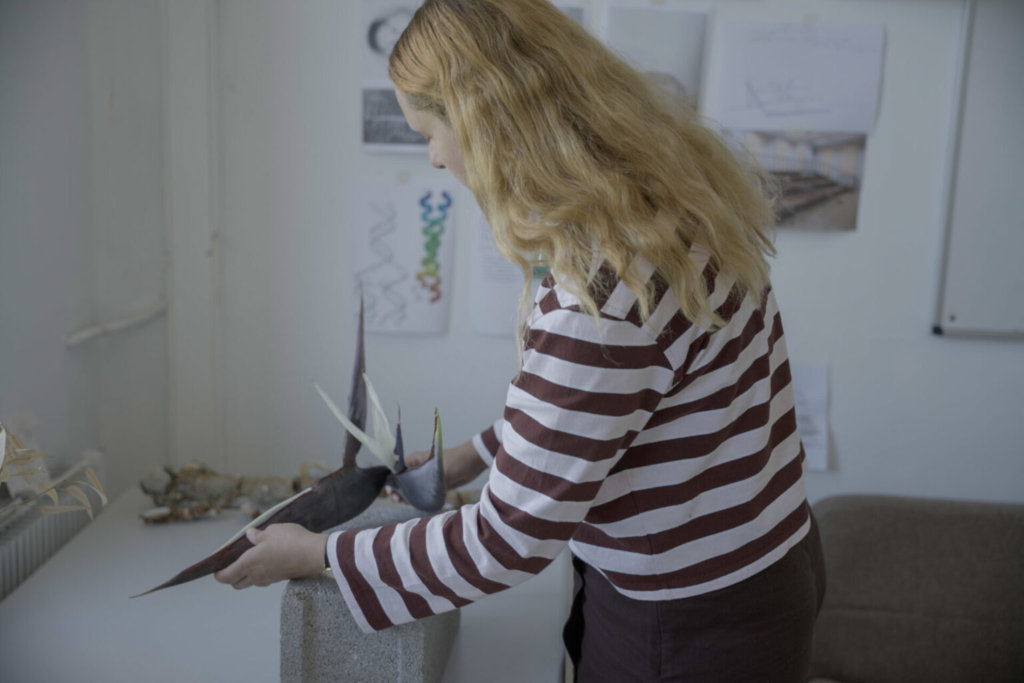
Romanian artist Nona Inescu comes from a family of geologists and grew up surrounded by minerals, stones and scientific research. During her stay, she became fascinated by an inscription in the Physics Hall stating that James Watson and Francis Crick once presented the structure of DNA there in 1966. Inspired by this discovery, she is developing a work that functions as a kind of “DNA of the island.” Into this structure she incorporates materials and findings from Spetses, with particular emphasis on the pine forest established by Sotirios Anargyros. The trees in this forest were deliberately planted in ways that made them unsuitable for shipbuilding, creating a distinctive landscape that continues to shape the island today.
Nabil Aniss
The third visual artist is Nabil Aniss, a video artist from Morocco whose work often revolves around his hometown of Meknes. For this residency, his research follows two parallel paths. One concerns a lost Mediterranean pirate lingua franca, a hybrid language blending Greek, Arabic, Turkish and Italian elements. The other explores a Moroccan ritual in which children are symbolically assigned an animal identity and later perform that role at different stages of life. His broader research focuses on childhood as a fluid state in which language and identity remain unfixed. In Spetses, he is collaborating with a local child to develop choreographies and experimental practices centred on language, rhythm and expression.

Mariangela Ciccarello
Italian filmmaker Mariangela Ciccarello works with 16mm and Super 8 film. Her project has already been filmed and sent for processing, as analogue production follows its own timeline ahead of the exhibition opening on 5 June. The film follows an Italian journalist who arrives at the School to investigate its history. Although initially told she cannot access certain archives, she eventually discovers a mysterious box linked to a “secret society of the sea,” a community of women who spoke a language connected to the ocean. The story weaves together mythology, the legendary figure of Bouboulina, her imagined love letters to a pirate lover, and the life of painter Eleni Boukoura-Altamoura, who disguised herself as a man in order to study art in Italy. The film unfolds between history, myth and personal involvement, with several residency participants appearing in the work themselves.
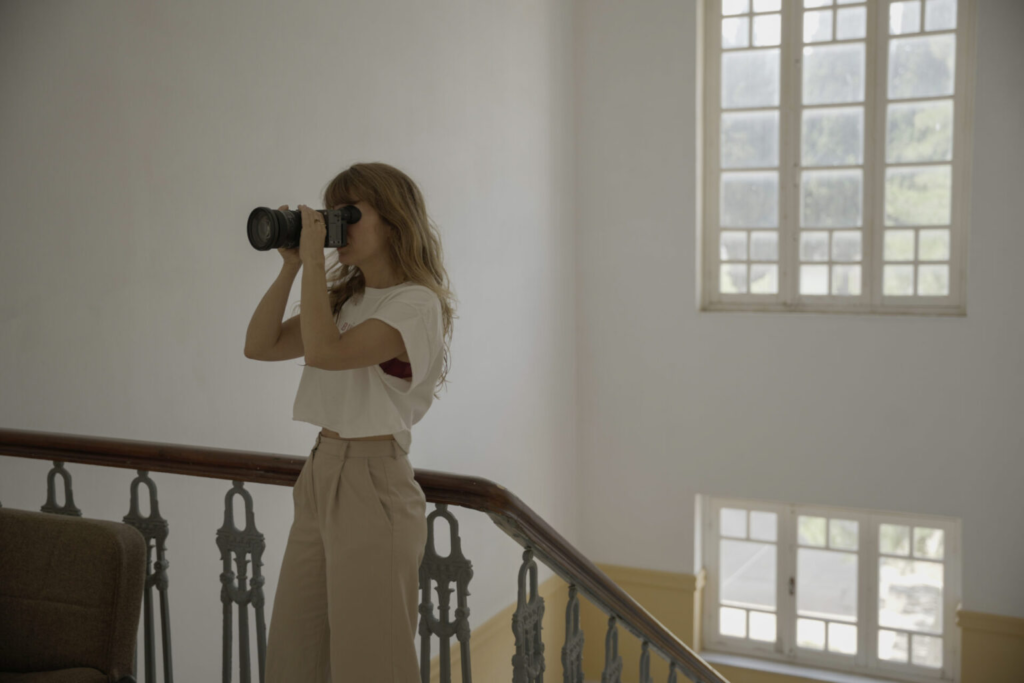
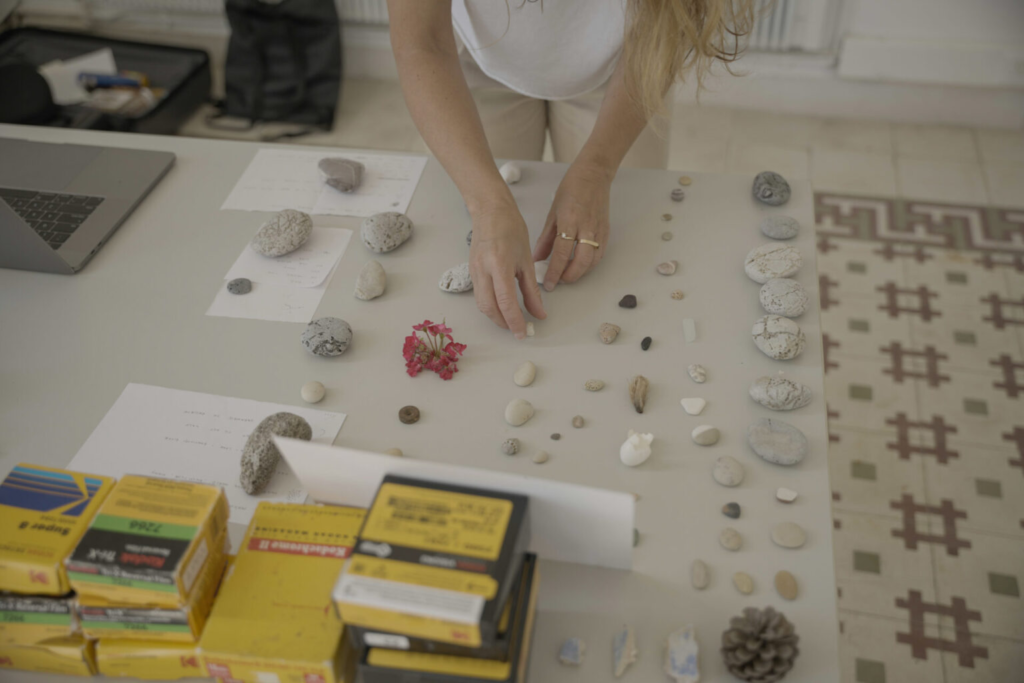
Mariangela Ciccarello’s project is also proof of something you mentioned earlier: when artists interact with one another, the exchange becomes an essential part of the process. They are not isolated in their own worlds but are in constant dialogue with each other and with the island itself.
Konstantinos Papanikolaou
Another participant is Konstantinos Papanikolaou, whose practice is deeply self-reflective and critical of his own profession. His work often takes the form of a lecture performance, combining theoretical discourse with live action. Through this format, he continuously questions the nature of choreography, exhibitions and artworks themselves.
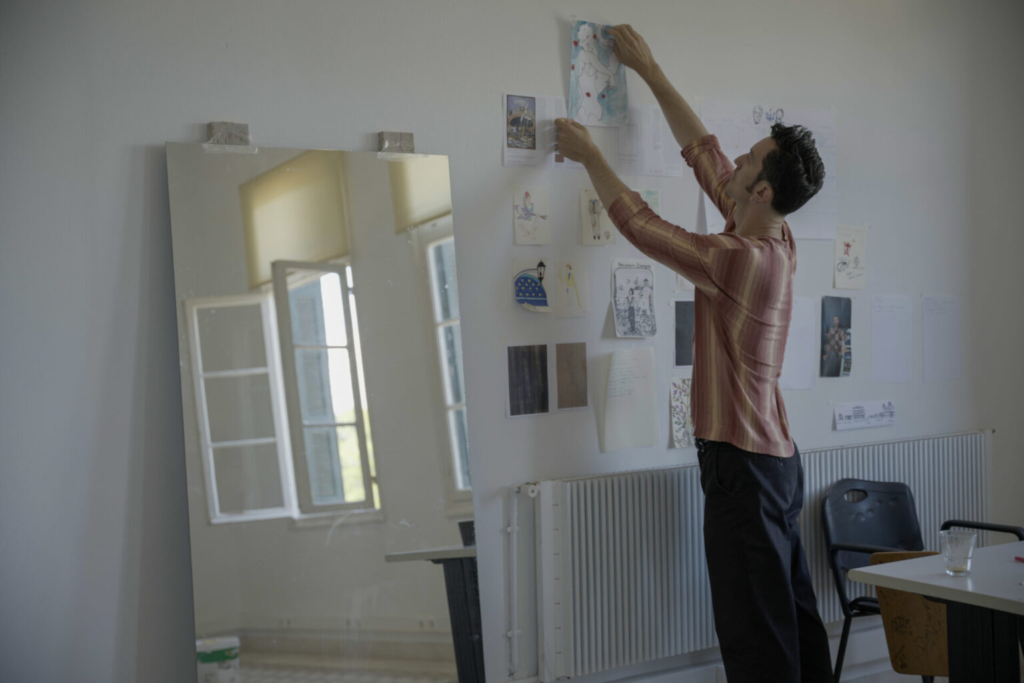
During our discussions about the residency, he expressed a desire to explore the idea of Greek identity, but through a broader and more complex lens. For him, animism operates as a counterpoint to what he sees as a dominant and “pure” image of Greekness, one associated with antiquity, Epidaurus, marble statues and a particular aesthetic canon that can feel static and restrictive. In response, he proposes a more hybrid, mixed and even grotesque approach that embraces folk traditions and vampiric imagery. Throughout his work, speech and performance coexist because he sees no separation between thought and action.
As we talk, it becomes clear that the artists’ original proposals have evolved significantly. Mariangela, for example, probably did not come to Spetses planning to cast you in her film. Everyone seems to have allowed the process itself to guide them.
Absolutely. The School itself encouraged that. So did Simoni and I. The final participant is Matilde Meireles, a Portuguese sound artist who has lived in England for many years. She is attempting to create a sonic map of the island.

The central question of her project is: What would the island say if it could speak? She works with hydrophones that record sounds beneath the sea’s surface, revealing an acoustic layer of the landscape that is usually inaccessible. She has also collected data on ferry routes, which she sees as forms of rhythm and movement through space. What interests her is not only the practical dimension of maritime traffic but also the traces that this constant movement leaves on the environment as part of the ecosystem itself. At the opening, she will present a performance that brings together this research, attempting to “listen to” and transmit the island as a living entity in perpetual motion and transformation.
From Research to Exhibition
You have essentially been working non-stop since 27 April in preparation for the opening on 5 June. How long will visitors be able to experience the works?
The exhibition will remain on view until 30 August, for nearly three months. This is important for two reasons. First, this is not a purely research-based residency. It certainly contains a strong research component, but it is also a production residency. Artists quickly move from research into exhibition-making.
There are residencies where no finished work is required and the focus remains entirely on thinking and exploration. Here, however, the creation of an exhibition is part of the process. I consider that extremely important because it also strengthens the residency’s relationship with the local community. From the beginning, the School wanted exhibitions to be an integral part of the programme.
Personally, I appreciate this combination of research and production. While I value theoretical reflection, I also believe in the power of making things happen. Last year we saw remarkable results precisely because there was a sense of concentration and momentum, almost like a creative race against time. Yet this never translated into pressure for artists to produce something outside their practice. Instead, it encouraged focus and commitment to their own processes.
So the goal is not to break records but to reach the finish line and witness the effort.
Exactly. The School and the island want to see that process materialise. A finished work can stand on its own in a way that research alone cannot, which is why we value that autonomy after the exhibition as well.
Engaging the Local Community
Since you keep mentioning the local community, do the people of Spetses understand what is happening here?
Not entirely. Last year it was easier because one of our mentors was Leda Papaconstantinou, who has lived on the island since the 1970s. She is deeply respected in Spetses. Before a screening of one of her films about the island and the Daskalakis factory, she gave a talk explaining what contemporary art is and why people should engage with it.
The audience listened because it was Leda speaking. She encouraged them not to close themselves off from things that might initially feel unfamiliar. After that event, many more locals began attending. We continue trying to build those connections, but everyone agrees that initiatives like this require time. They cannot take root overnight.

One advantage is that the exhibition remains open for three months. Residents and visitors alike have plenty of time to experience it. Just as this place once educated generations of students, it now becomes a place where artists learn and where the public learns alongside them. In a way, you are continuing the School’s legacy.
That aspect is especially meaningful to me. I enjoy working with new productions and emerging artists because you become part of their process. They are still searching for their methods and their voice, which gives the final result a particular vitality.
At the same time, this is not simply an exhibition venue. It is an institution with a long history and a specific educational mission. What we initiated last year, and continue this year, is a broader conversation about artistic practice, production and research. These concepts are not always immediately accessible to local audiences, and they require time and familiarity.
Many people have told us that the School functioned for decades as a relatively closed institution. Today, however, there is a conscious effort by the School and its Board to open it to the public.
What Makes This Residency Different?
Eva, are you happy to be part of this undertaking again this year?
Very much so. One thing I would emphasise is that this is a curated residency, which makes it quite different from many others.
What does the concept of a residency mean to you? What would your ideal residency look like?
Honestly, I feel that this is exactly what I would consider an ideal residency. Because it was not a pre-existing format handed to me to curate. I was invited to design it from the ground up, which allowed me to shape it according to my own vision.
And what, in your view, is the essence of a residency?
Many residencies allow artists to produce work without any real exchange or meaningful feedback. In a traditional exhibition setting, you might visit an artist’s studio two or three times before a project is completed.
Here the situation is entirely different because everyone lives together. Conversations happen constantly, not only during scheduled meetings. They emerge over coffee in the morning, during meals or in casual encounters. Often the most important ideas do not arise in formal discussions but in these everyday moments.
What happens here is genuinely collective. That is what distinguishes it from more traditional exhibition models, where artists work in relative isolation and only meet at specific points. Here, moments of encounter are continuous, and that fundamentally changes how ideas are generated and developed.
Do you ever envy the artists who get to participate?
I tell them all the time that I wish I could do the residency myself. I think residencies are incredibly important. Many artists do not even have studios. Some spend ten months of the year moving between residencies, which allows them to avoid paying rent and reduces their expenses significantly. It is certainly a demanding lifestyle, and I do not know how sustainable it is in the long term, but for many artists residencies are a crucial means of survival.

A Final Reflection
After our conversation, I wandered around the grounds on my own. The buildings, furniture and rooms felt like a journey through time, a time capsule waiting to be explored.
I watched Myrto Vratsanou, whose copper engravings shimmered in the light, and found myself wishing her delicate copper-wire embroideries could adorn my clothes. I watched Mariangela Ciccarello, hoping her short film would travel to festivals around the world. I saw Nona Inescu with her bright red hair working quietly in her studio, and Nabil Aniss sitting at his computer with headphones on. Matilde Meireles was considering how best to present her work on the School’s rooftop, while Konstantinos Papanikolaou, when not working on his laptop, could be seen carrying six-packs of bottled water on his shoulder like a modern-day water carrier.
I was hosted at the School and experienced first-hand the generosity of Eva Vaslamatzi, Simoni Niarou and Soula, who prepared breakfast, lunch and dinner each day. Cats wandered around our feet, children visited the grounds and students attending a parallel conference filled the campus with life. As the sun set and the light turned golden, I watched them from the second-floor window of the room once occupied by the “good students” as they gathered for group photographs and selfies.
Inside my room stood the original wardrobe with its mirror, the beds, bedside tables and washstand. I found myself wondering: could I have survived here as a boarder? Could my parents have left me here at eight years old and trusted the School to shape me into an educated adult by eighteen?
I am not sure.
What I can say with certainty, however, is this: like Eva, I would very much like to be one of the artists participating in the Anargyros Art Residency.
If your travels bring you to Spetses, visit the School and the exhibition, which will remain open for three months. If you happen to be there on 5 June, attend the opening. And if you are an artist yourself, think of an idea that is truly out of the box and hope that Eva and the selection committee choose you.
Because this is not simply an art residency.
It is an experience of life and art woven together.