 KATERINA PARRI
By Katerina Parri
For the summer of 2025, we’ve selected ten islands for their standout art offerings this season. Journey to: Hydra, Poros, Andros, Crete, Santorini, Ios, Amorgos, Lesvos, Chios & Rhodes.
When summer holidays on the Greek islands meet art exhibitions, the experience takes on a special sense of completeness. It’s that moment when you see something, encounter something, something small yet essential that adds to your days and becomes subtly imprinted in your memory – a spark that may resurface unexpectedly, like a flash from that summer which left its mark.
And if we consider it from the perspective of the “province,” where cultural events are often concentrated in urban centres, the presence of art exhibitions on the islands becomes even more significant. It’s when the “local” audience turns up – not by chance, but because something is happening in their own place. An audience that, to my eyes, seems open, receptive, and uniquely interesting.
What’s even more remarkable is that there are already -even if only a few- islands firmly established on the artistic map. Places where the annual exhibition is not only a cultural highlight but also one of the main reasons to choose that destination in the first place. A reason for the journey itself.
For the summer of 2025, we’ve selected ten islands for their standout art offerings this season. Journey to: Hydra, Poros, Andros, Crete, Santorini, Ios, Amorgos, Lesvos, Chios & Rhodes.
[1]
Hydra – “Apocalypse Now and Then” by Andra Ursuța at the Hydra Slaughterhouse
For years now, the DESTE Foundation has “marked” the island with its annual summer exhibition. It has succeeded in making each year’s show a unique presentation of internationally renowned artists — names that can be reason enough to travel to Hydra, especially considering the artistic dialogue or coexistence between the works and the singular setting of the former Slaughterhouse. This year, even the title Apocalypse Now and Then makes you pause, marking the first major exhibition in Greece by Romanian artist Andra Ursuța.
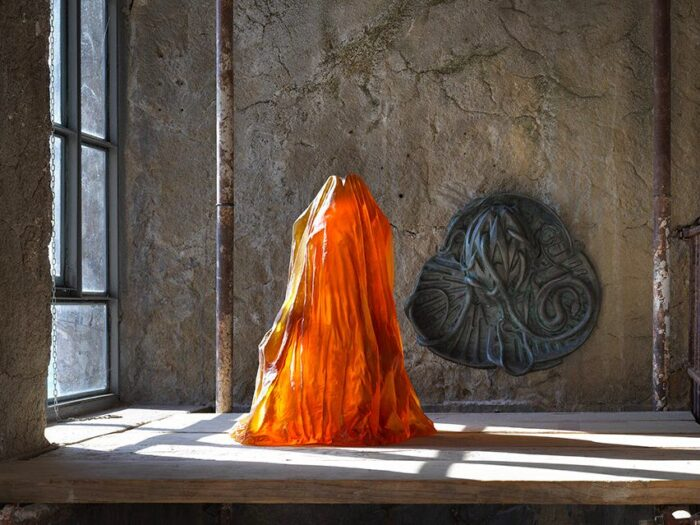
“Ursuța draws inspiration from the visual language and display strategies of archaeological museums to invent pseudo-historical artifacts belonging to a non-existent civilization, whose remnants seem to speak to the anxieties of our present. At once familiar and absurd, the artist presents fragments of sculptures and studio remnants, successively constructed and destroyed using both analog and digital tools. These works explore the history of object-making and sculpture, and the ways in which this manually produced system of knowledge and speculation has shaped our visual world. Apocalypse Now and Then immerses viewers in a truncated historiography, where fleetingly familiar ancient tropes, grotesque votives, and scarred bronze figures hover between archaeology and fiction.
The exhibition presents Desolation Ware, a new series of bronze sculptures cast in wax. Partly inspired by decorative art objects and interior ornamentation, these forms are the distilled accessories of existential uncertainty: a monstrous plate with snakes emerging from a bicycle helmet to invoke a Gorgon; a zoomorphic pitcher incorporating landscape elements from a pre-Renaissance desert – the kind of place where Saint Anthony might have been harassed by demons; a chair resembling both an orthopedic throne and the embrace of an iron maiden; a bodily-fluid carrier heralding organic failure. By doubling down on the clichéd artistic medium of green-patinated cast bronze, Desolation Ware also engages with art-historical misconceptions – such as the mistaken belief that classical sculptures were originally white, when in fact they were polychrome – and examines how such errors can become weighty, generative forces.”
Duration: June 24 – October 31, 2025
Opening hours: Daily 11:00–13:00 & 19:00–22:00
Closed on Tuesdays (except Tuesday, June 24, when it will be open)
[2]
Chios – Once We Were Gardens at Karavas Estate (Karaviko), Kampos of Chios
Thirty acres in a Kampos orchard opening to the public for the first time host a large-scale contemporary art exhibition titled Once We Were Gardens, featuring 12 internationally acclaimed artists and curated by DEO – the first contemporary art organization on Chios, celebrating its fifth year of activity. These elements alone guarantee a unique experience worth seeking out when visiting Chios.
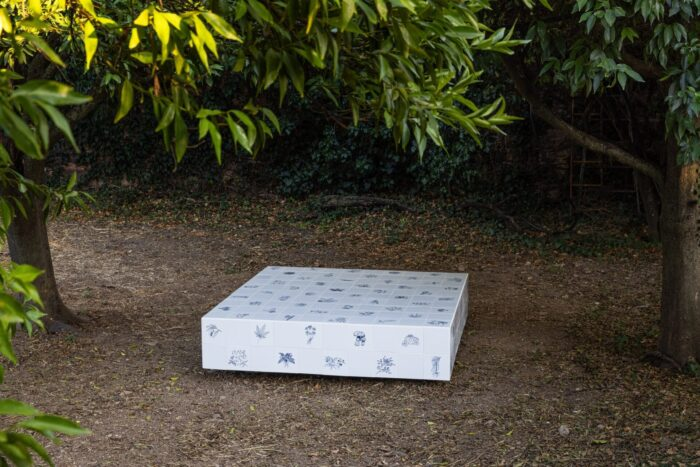
DEO projects on the exhibition: “Original works created especially for DEO, alongside existing pieces, form a polyphony of media -sculptures, ceramics, installations, and a unique garden recreation – presented in a 30-acre outdoor space, a typical orchard in the Kampos of Chios, opening to the public for the first time this summer. Marking its fifth anniversary, DEO presents Once We Were Gardens at the historic Karavas Estate (Karaviko) in the Kampos of Chios. The exhibition reflects on the inevitable cycles of growth and decay, exploring the deterioration of bodies, ideas, spaces, and relationships through the symbolism of the garden.
The exhibition features new site-specific works, alongside existing pieces and a horticultural recreation, by twelve international artists: Mohammad Alfaraj, Martha Dimitropoulou, Derek Jarman, Emre Hüner, Maria Loizidou, Anestis Michalis, Natalia Papadopoulou, Yaşam Şaşmazer, Socratis Socratous, Teresa Solar Abboud, Theo Triantafyllidis, and Adriana Varejão. Each examines how acts of care and trajectories of decay coexist, tracing shifting boundaries between flourishing, neglect, and transformation. Hosted at the historic Karaviko, one of the best-preserved estates in Kampos, the exhibition unfolds against a backdrop shaped by centuries of cultivation. Kampos, once a thriving mosaic of citrus orchards and architectural elegance, provides a poignant setting for the exhibition’s themes – a landscape where traces of past abundance and present stagnation converge, highlighting the tensions between legacy, beauty, and impermanence.
Through sculptures, installations, ceramics, a digital work, and a garden recreation, the artists reflect on the violence of systems — natural, cultural, and institutional — that dictate what is cultivated and what is left to wither. Decay, so often feared, is here redefined as a kind of beauty: a process of transformation rather than an end. Our bodies, our stories, and our relationships resemble a garden that requires constant care, yet is always subject to the forces of time.
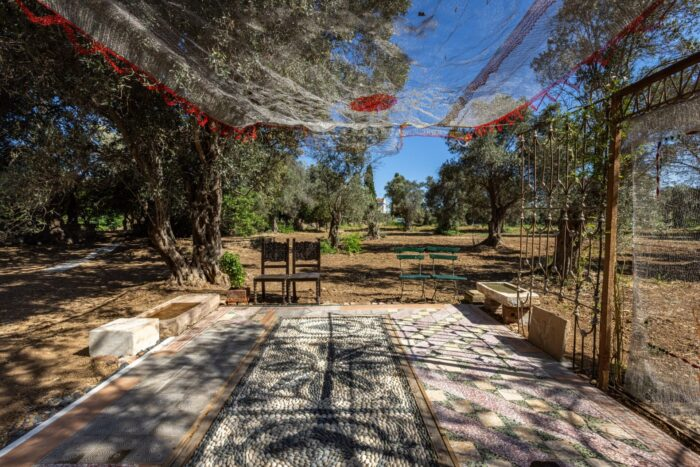
Ultimately, Once We Were Gardens is a meditation on acceptance. It offers no answers, but invites viewers to dwell on the questions: what remains when the body weakens, when an idea fades, when a space collapses? In the orchards of Kampos, as in the works of the twelve artists, we find a poignant reminder that to be alive is to exist in a constant state of becoming. A garden, like memory, is never static — it is a living entity, breathing and shaped by the hands that tend it and the forces that erode it. This exhibition is an ode to that fragile beauty, a testament to the dignity of what endures even as it fades.”
The exhibition is accompanied by a program of parallel events running throughout its duration, including educational activities for children, guided tours, walks in Kampos, talks, screenings, an open reading room, and various other activities in collaboration with local organizations, associations, and community groups.
DEO 2025: Once We Were Gardens
Art Exhibition | Karavas Estate (Karaviko), Kampos of Chios
July 5 – September 7, 2025
[3]
Poros – CITRONNE Gallery: Yiannis Boutéas, Stratifications – Metamorphoses at the Archaeological Museum of Poros & Yiannis Adamakos, The Intermediate Space at CITRONNE Gallery
Every summer, Poros has its own artistic landmark: the CITRONNE Gallery. For the past 12 years, in collaboration with the Ephorate of Antiquities of Piraeus and Islands, it has co-organized temporary exhibitions at the Archaeological Museum of Poros. This year, the collaboration features Yiannis Boutéas, whose distinctive visual vocabulary coexists alongside the museum’s archaeological finds from the greater Troezen area, and Yiannis Adamakos at the CITRONNE Gallery, where his work is being shown together with his collages for the first time.
For its summer 2025 exhibition program, CITRONNE Gallery notes: “A distinguished renewer of abstract painting, Yiannis Adamakos creates indeterminate landscapes — reflections of a sensory world refracted through memory.
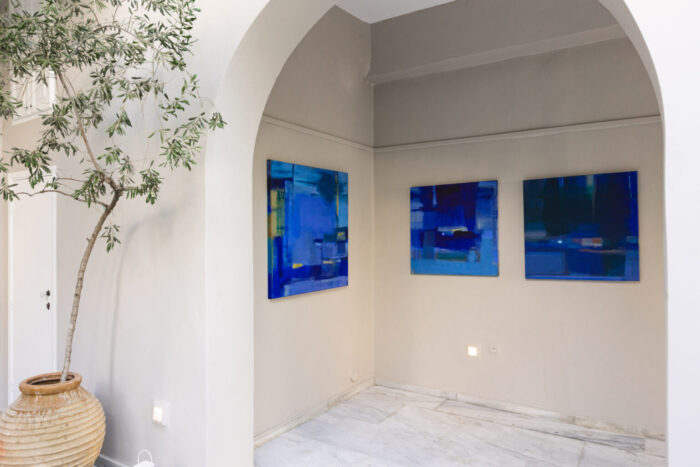
In The Intermediate Space, a new body of paintings and collages is presented. The works are based on vertical and horizontal axes that compose an imaginary grid. Adamakos is concerned with the expressive geometry of space, which conveys a sense of mental balance, poised between the calm of the horizontal and the uplift of the vertical. In addition, paper compositions form idiosyncratic collages that embody the process of destruction and emphasize the power of gesture. According to the artist, these works emerged ‘unexpectedly’ when, deconstructing older paper works, he noticed that the torn sheets generated new, dynamic compositions. These works are, in a sense, intermediate – between the old and the new, the accidental and the deliberate, destruction and creation.
Through these two bodies of work, The Intermediate Space reflects the contrasts inherent in Adamakos’s creative process and visual language. They are explosive creations – outcries that converse with calmness and dream.”
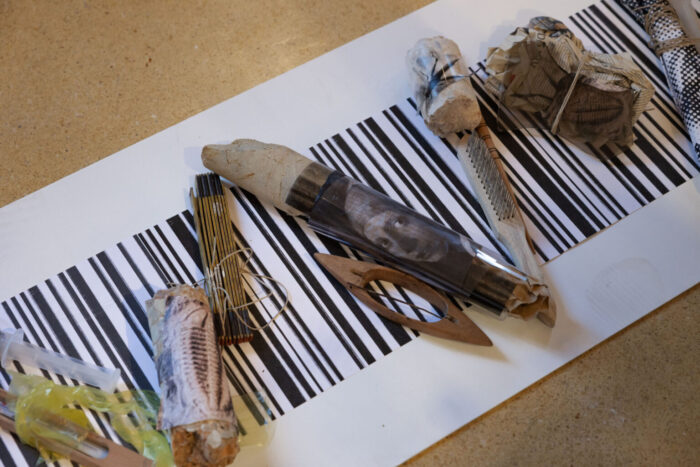
In collaboration with the Ephorate of Antiquities of Piraeus and Islands, CITRONNE Gallery co-organizes the temporary exhibition of Yiannis Boutéas Stratifications – Metamorphoses at the Archaeological Museum of Poros.
This installation focuses on the concept of diachrony, as captured and conveyed through the power of contemporary art. Boutéas challenges the widely accepted perception of time as a progressive reality, creating his own timeless museum. Fragmentary, oversized digital prints of images from ancient sculptures are placed among the museum’s archaeological exhibits, offering a hyper-analysed and distorted image of our past.
Utilitarian objects from present-day life and the recent past, together with natural rocks and geological strata wrapped in images of artworks, form a set of contrasting symbols with particular resonances, always grounded in a visual aesthetic. These are hosted within a barcode-like structure — a reference to the relentless digital reality that now dominates every aspect of our lives.
Boutéas’ symbolic objects, drawn directly from everyday life, may initially surprise visitors, prompting them to question whether such items belong in an archaeological museum. Yet, one might imagine a similar surprise for an ancient person, were they to see their personal belongings displayed today in a museum showcase, accompanied by scientific theories and interpretations — or even misinterpretations. Ultimately, Boutéas’ installation resembles an unexpected preview of an archaeological museum of the — perhaps not so distant — future.”
Yiannis Adamakos
The Intermediate Space
June 14 – September 14, 2025
Wednesday – Sunday: 11:00–13:00 & 19:00–23:00
CITRONNE Gallery – Poros
Yiannis Boutéas
Stratifications – Metamorphoses
June 13 – September 21, 2025
Wednesday – Sunday: 09:00–15:00
Archaeological Museum of Poros
Koryzis Square, Poros
[4]
Santorini – “Nelly’s: Santorini in the Interwar Period” at the Kastellana Center of Photography (Pyrgos)
A new exhibition opens in the height of summer, on Sunday, August 10, showcasing the immense legacy of Nelly’s and, this time, her photographs of Santorini in the interwar years. All this unfolds in the magical setting of Kastelli, Pyrgos.
On the exhibition “Nelly’s: Santorini in the Interwar Period” at the Kastellana Center of Photography:
“The exhibition presents a selection of images captured by the renowned photographer Nelly’s on the Cycladic island before the devastating earthquake of 1956. Organized by the Benaki Museum and the Kastellana Center of Photography, it is curated by Aliki Tsirgialou (Head of the Photographic Archives, Benaki Museum) and architect-museologist Tonia Nousia. The exhibition runs until October 20, 2025.
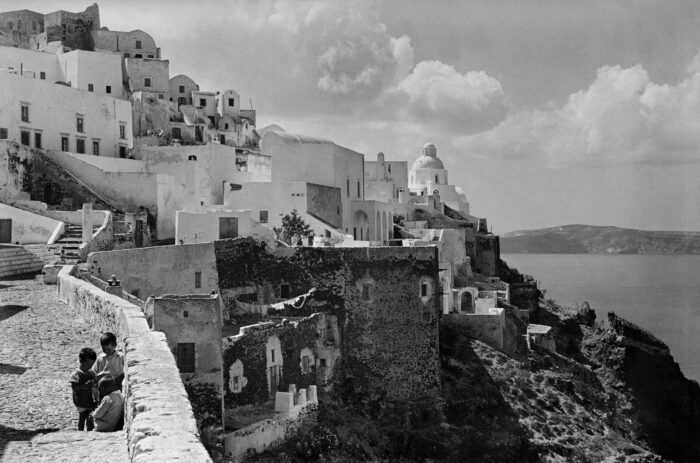

In the summer of 1956, a major earthquake in the Amorgos area struck Santorini, claiming dozens of lives and causing significant destruction to its built environment. The island’s pre-earthquake form owes much to the extensive documentation by Greek interwar photographer Elli Sougioultzoglou-Seraidari (1899–1998), known as Nelly’s. She first visited Thira in the summer of 1928, at the invitation of her sister Maro Sougioultzoglou and her Santorinian husband, Spyridon Al. Malaspinas. Starting from the medieval settlement of Pyrgos, where the family was staying, Nelly’s explored the island with her camera in hand.
The island’s dramatic volcanic landscape and distinctive architecture captured her imagination. In black and white, the dark shades of lava and the deep blue of the sea balance harmoniously with the dazzling Aegean light reflecting off the whitewashed houses. The curves traced by the shadows of buildings, the arches in the narrow alleys, the domes of churches, and the very morphology of the terrain take center stage in her compositions. Human presence is subtle, so much so that the settlements often appear deserted. The few elderly women and children who appear in her images are positioned scenographically, serving her visual narrative. Nearly a century later, these images (now printed in contemporary digital form) return to the place where they were created, engaging in dialogue with a changed island landscape.
Elli Sougioultzoglou-Seraidari donated her photographic archive to the Benaki Museum in 1984. Three years later, collector Dimitris Tsitouras edited the album Nelly’s: Santorini 1925–1930 (published by the Archive of Theraic Studies), revealing for the first time the images she had taken on the island in the pre-earthquake period.

At the exhibition’s opening, speakers on the photographer and her work will include:
- Aliki Tsirgialou, Head of the Photographic Archives at the Benaki Museum and exhibition co-curator
- Demosthenes Agrafiotis, Poet, Intermedia Artist, Emeritus Professor of Sociology at ESDS
- Dimitris Tsitouras, Lawyer and Collector
- Natasa Markidou, Associate Professor, Department of Photography and Audiovisual Arts, University of West Attica
The discussion will be moderated by the exhibition’s co-curator Tonia Nousia, Architect-Museologist.

In August and September, the exhibition will be accompanied by events and discussions on Nelly’s work and the role of photography in the study of cultural heritage, as well as workshops for children and adults.”
Nelly’s: Santorini in the Interwar Period
Kastellana Center of Photography, Pyrgos, Santorini
Opening: Sunday, August 10, 2025, 20:00
Duration: August 10 – October 20, 2025, daily 10:00–21:00
[5]
Andros – “Takis 1∞” at the Museum of Contemporary Art, Basil & Elise Goulandris Foundation
Takis 1∞ arrives on the island of Andros, with the Museum of Contemporary Art of the Basil & Elise Goulandris Foundation presenting a landmark anniversary tribute marking 100 years since the birth of Takis (Panayiotis Vassilakis, 1925–2019). The exhibition spans the artist’s entire creative journey and in fact unfolds across two museum spaces, as it also inaugurates the reopening of the newly renovated Old Wing of the Museum of Contemporary Art in Andros.
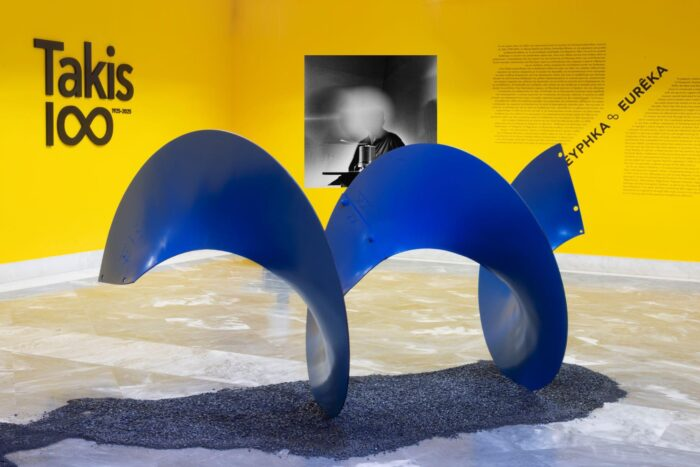
This unique show offers the chance to immerse yourself in Takis’ works, building an unforgettable, penetrating journey through his Spheres, Dials, Spirals, Magnetic Fields, and of course, his iconic Signals with movement and sound ever-present.
From the Basil & Elise Goulandris Foundation on “Takis 1∞” in Andros: “The aim of the Foundation is to showcase a more complete – and perhaps underestimated – side of his artistic path: his early works, revealing both his first influences and his ability to move beyond the limitations of an autodidact to excel. The Flowers and Idols, offering new perspectives on fauna and flora through the lens of metal. The Interiors, Magnetic Fields, and Spheres, which led him to further explore matter. The Dials and Electronic Reliefs, paradoxical works that highlight the constant presence of technology in our lives and the idea that every element of the everyday can conceal unsuspected artistic beauty. The Spirals, a mesmerizing journey into the aesthetic mysteries of geometry. And finally, his lesser-known Erotics, emblematic of the emphatic return of the body in his work.

These works, unprecedented in their variety – in both materials and concept as well as symbolism, are joined by the emblematic Signals, which first appeared in 1955 and went on to become one of the most recognizable groups of sculptures of the 20th century.”
Andros
June 22 – November 2, 2025
Wednesday – Sunday: 11:00–15:00 & 18:00–21:00
Monday: 11:00–15:00
[6]
Crete – WHAT YOU WEAR IS WHAT YOU ARE at the Museum of Contemporary Art of Crete (Rethymno)
The Museum of Contemporary Art of Crete in Rethymno presents a particularly intriguing exhibition: WHAT YOU WEAR IS WHAT YOU ARE, which explores the relationship between fashion and contemporary art. A highlight of the show is a special tribute to the late Rethymno-born fashion designer Sophia Kokosalaki, whose career brought international acclaim to Greece.

From the Museum of Contemporary Art of Crete on the exhibition: “With WHAT YOU WEAR IS WHAT YOU ARE, curators Maria Marangou, Maria Panagidou, and Stavros Kavallaris seek to highlight the reciprocal relationship between fashion and the challenges of our time, as expressed in and influenced by contemporary art and the innovative concerns it raises. From antiquity, clothing not only served basic human needs but also defined one’s position in society. Over time, it became a core identity marker, on both an individual and collective level. The exhibition aims to illuminate how this enduring identity element manifests within contemporary art.
The show examines the interplay between fashion and contemporary art through works by both Greek and international artists and designers — even in instances where clothing is absent. It is conceived as an ongoing project, aspiring to show how this identity element can be transmuted into works of art.
An integral part of the exhibition is the special tribute to the acclaimed Rethymno-born designer Sophia Kokosalaki, whose international impact honored Greece worldwide and whose life was cut tragically short. The tribute features twenty-four of her creations, as well as jewelry and sketches from her family’s collection.
On view throughout the museum’s spaces are works by twenty-nine artists and designers: Eleonora Antoniadou, Dimitris Antonitsis, Eugenia Apostolou, Vanessa Beecroft, BlindAdam, Antonis Volanakis, Hussein Chalayan, Dimitris Davis, Christos Delidimos, Stamatis Zannos, Bill Georgoussis, Rene Habermacher, Rebecca Horn, Travis Hutchison, Anestis Ioannou, Lefteris Kanakakis, Kanarek Yael, Kapurani Bros, Sophia Kokosalaki, Elli Komninou-Nenedaki, Sophia Kosmaoglou, Yiannis Bournias, Aliki Palaska, Angelos Papadimitriou, Maria Papadimitriou, Christiana Soulou, Efi Spyrou, Versaweiss, and Nikos Charalambidis.”
WHAT YOU WEAR IS WHAT YOU ARE
May 17 – October 31, 2025
Museum of Contemporary Art of Crete
32 Mesolongiou Street, Rethymno
[7]
Rhodes – A Blossom Unafraid of Time at the French Inn, Medieval City
A new exhibition centered on ceramic art blooms in the height of August: A Blossom Unafraid of Time is part of the program “Clay Commons – Bridging Heritage, Innovation & Community | CC_Vol.1,” featuring artists Giorgos Tserionis and Nasia Pavlidou in an artistic residency at the French Inn in Rhodes. From July 21 to August 15, the artists will create new site-specific works for this historic venue, to be unveiled at the exhibition opening on August 13, 2025.

On the exhibition: “The French Inn in Rhodes, one of the most emblematic monuments of the Medieval City, participates in the Artistic Residency Program, which encourages the intersection of cultural heritage with the contemporary challenges of ceramic art. During their residency, the artists will create works that engage directly with the space.
The title A Blossom Unafraid of Time reflects both the nature of the works and the spirit of the venue, a place where history, tradition, and contemporary expression coexist and quietly flourish beyond the bounds of time. Throughout the exhibition, the artists will activate the garden and courtyard, transforming the historic space into a site of reflection and poetic encounter.”
A Blossom Unafraid of Time
Artistic Residency: July 21 – August 15, 2025
Opening: August 13, 2025, 20:00
Exhibition Duration: August 13 – November 22, 2025
Location: French Inn, Medieval City of Rhodes
[8]
Ios – Cycladic Nexus, A Journey of Connections Across Time: Skarkos at the Archaeological Museum of Ios
For the first time, the Archaeological Museum of Ios presents contemporary art in dialogue with Early Cycladic culture through the exhibition Cycladic Nexus, A Journey of Connections Across Time: Skarkos. The starting point is the prehistoric settlement of Skarkos – one of the most complete testimonies of the Early Cycladic period (c. 2700–2400/2300 BC). Here, the Early Cycladic inhabitant enters into an artistic exchange with the contemporary human through themes of movement and communication.
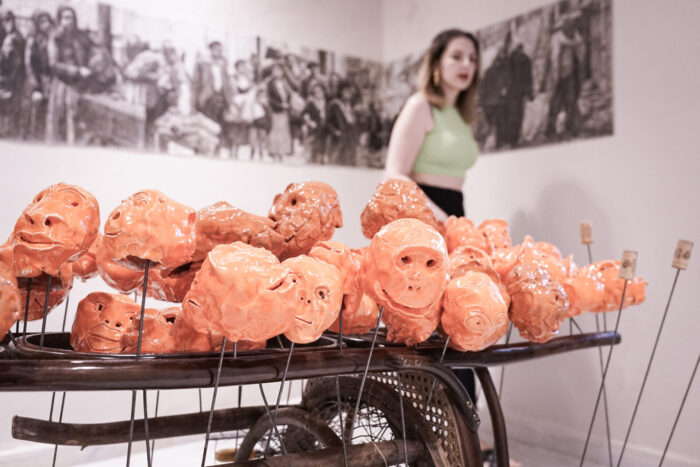
On the exhibition: “This project seeks to connect the vitality of this ancient community with contemporary art, exploring changes in how humans perceive the world. The dialogue between the ancient settlement and contemporary artistic practices centers on ‘connection’ as a cornerstone of cultural formation. Drawing inspiration from the ancient geography of exchange, the exhibition offers a contemporary meditation on memory, community, and identity as timely, lived experiences.
Artists from various disciplines investigate movement, communication, and human bonds through painting, sculpture, installations, embroidery, and digital prints. The human trace – presence or absence, path or wound – runs through the works, raising questions about collectivity and historical consciousness.
The exhibition does not simply reference cultural continuity. It approaches history not as an archive, but as a dynamic topography – a field of meaning that concerns us directly. In the meeting of the ancient and the contemporary, the viewer is invited to reflect on movement, transition, exchange, and collectivity, as fundamental lived experiences shared by both the Early Cycladic inhabitant and the modern individual.”
Cycladic Nexus, A Journey of Connections Across Time: Skarkos
Exhibition Duration: June 28 – October 31, 2025
Opening Hours: Wednesday – Monday: 8:30–15:30
Admission: Included in the ticket for the Archaeological Museum of Ios
[9]
Amorgos – Inland at Path 1 (“Old Strata” Route), Asfontilitis Settlement
Inland on Amorgos is more than an exhibition, it’s an experience. This site-specific outdoor installation by sculptor and performance artist Despina Charitonidi invites visitors to participate actively, following a walking route along Path 1 (“Old Strata”) through the semi-ruined settlement of Asfontilitis. As you walk, her works awaken the traditions of the place, drawing you into the history and ascetic way of life once led by the shepherds of the region. On August 23, 2025, Charitonidi will present a live performance in the setting.

On the exhibition: “The visitor’s navigation through the exhibition’s narrative mirrors the exploration of the island itself, emphasizing lived experience and cultural feedback. Charitonidi’s site-specific works focus on Amorgos’s pastoral heritage, treating sound as a vehicle for communication and cultural continuity. Using sculptural gestures that combine construction and prefabricated materials with ceramics, the artist addresses both the island’s history and human intervention in the environment, encouraging visitors to become active participants in the work.
The project draws on traditions of ritual walking and personal transformation through movement, with works that evoke the sense of wonder and magic found in a journey. With a minimalist intervention approach, walking and wandering become central artistic media. This performative element connects to ideas of autonomy and self-navigation, mapping, spirituality, and freedom.
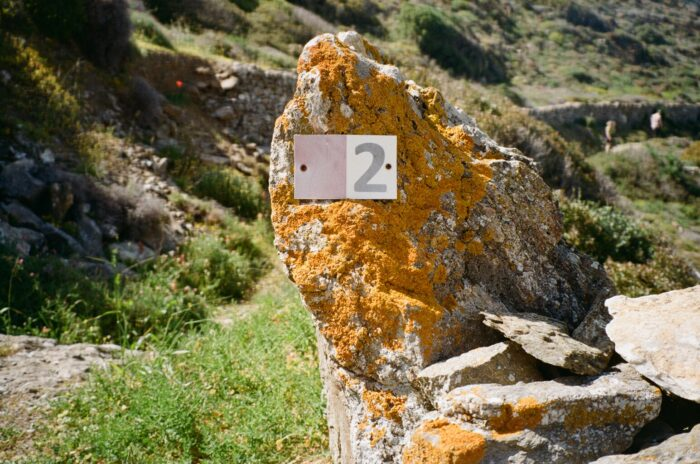
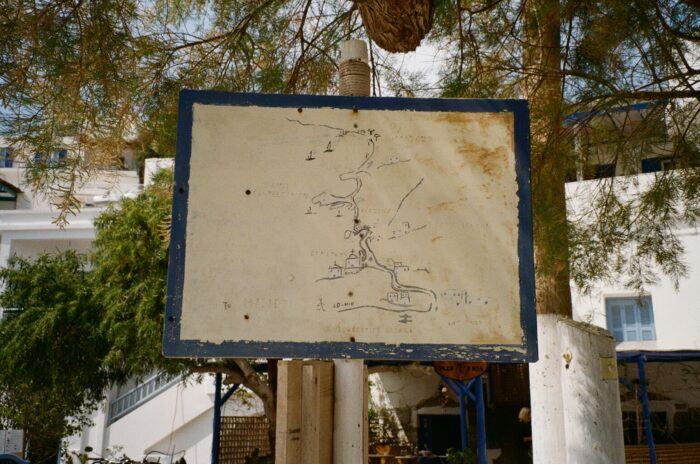
Choosing Asfontilitis as the exhibition site is rooted in the sacred character of the area and the ascetic lifestyle of the shepherds who once lived along the path. The installation emphasizes the link between historical memory and contemporary conditions, proposing new ways of reading and experiencing the landscape.”
Inland
Path 1: “Old Strata” Route – Asfontilitis, Amorgos, 840 08
July 12 – August 24, 2025 (daily; walking during midday hours not recommended)
Performance: Saturday, August 23, 2025, 20:00
[10]
Lesvos – Blue Moon by Yorgos Maraziotis at K-Gold Temporary Gallery
This summer, the façade of K-Gold Temporary Gallery in Lesvos bears a hanging banner in bold letters reading “YORGOS”, announcing Blue Moon, the solo exhibition by Antwerp-based artist Yorgos Maraziotis. Through diverse media, Maraziotis animates oral histories from former residents of the neoclassical house that now houses the gallery, blending the real and the imaginary into sculptural works centered on the building’s own architectural fragments.
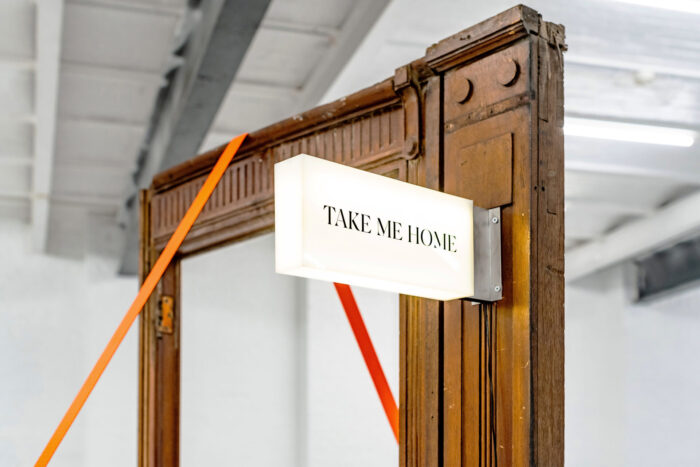
From K-Gold Temporary Gallery on Blue Moon: “An in-situ installation focusing on habitation and human relationships, presented through a new series of sculptures and interventions. Continuing his exploration of the identities of private space, Maraziotis creates works that move between the real and the imagined. The project delves into ideas of displacement and the tensions arising when objects are removed from their original context and reappear charged with new meanings, a shift that applies as much to material as to the experience of relocation itself.

The starting point is a collection of oral histories from former residents of the house, whose voices are transformed into dynamic works in neon, marble, metal, and mirror. Alongside these, the artist reintroduces architectural elements removed during the building’s renovation, reactivating them as carriers of memory and links to the past. The result is a hybrid landscape -both familiar and unexpected- where personal and collective testimonies weave together into a journey through fragments of stories and emotions.”
Blue Moon – Yorgos Maraziotis
July 12 – August 31, 2025
Opening hours: Friday to Sunday, 11:00–14:00 & 19:00–22:00
Free admission