 elc team
Cinematic Reflections: Exploring the Depth of German-Greek Relations Through Documentary
Three-day documentary film program on German-Greek ties to mark the tenth anniversary of the German-Greek Future Fund, the Embassy of the Federal Republic of Germany in Athens and the Goethe-Institut are organizing a three-day documentary film festival that will shed light on the complex, sometimes contradictory, sometimes complementary German-Greek ties.
How is intergenerational trauma transmitted in a place where National Socialists committed crimes? How relevant is the “Song of Asmata”, written by Iakovos Campanellis and set to music by Mikis Theodorakis? 79 years after the liberation of the Nazi camps? How are the concepts of home and foreignness signified in the biographies of people who move not only in space and time, but also between ideological and political systems? Are there different Greek-German identities, and what do they mean to the individuals who carry them? Can art shape the way we deal with the trauma of the Holocaust and how this changes over time?
From October 11 to 13, 2024, five documentary films will be shown at the Goethe-Institut in the presence of the filmmakers. The works were financed with funds from the German-Greek Future Fund by the German Foreign Ministry. Following the film screenings, there will be a discussion with the audience.
Program on Friday, October 11th
Reconciliation with the Martyr Cities and Villages
5:00 pm
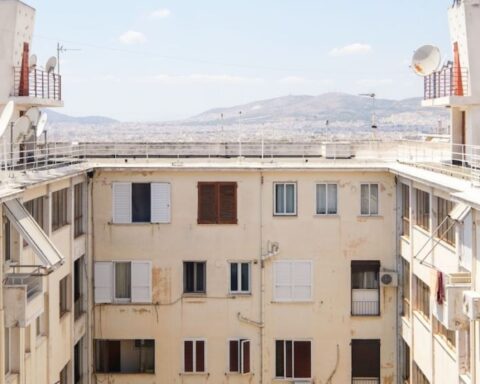
The Balcony – Memories of the Occupation
by Chrysanthos Konstantinidis, 2017
105 minutes (in Greek with German subtitles)
In the presence of the director
7:30 pm
Mauthausen
by Aristarchos Papadaniil, 2023
91 minutes (in Greek with English subtitles)
Film descriptions
The Balcony – Memories of the Occupation
10/03/1943: German mountain troops enter the village of Ligiades, indiscriminately killing babies, children, women and old people and setting fire to the houses. The next day, a 14-month-old baby is found alive by villagers, still suckling from its dead mother, despite having a stab wound in the back from a bayonet.
1989: German historian Christoph U. Schminck-Gustavus visits the village, records the testimonies of the five survivors and examines German archives.
2018: Post-war generations listen for the first time to the tapes with the testimonies of their ancestors who survived the Nazi crime. The documentary shows evidence, memories and grief and highlights the collective trauma left by the Nazi atrocities.
Mauthausen
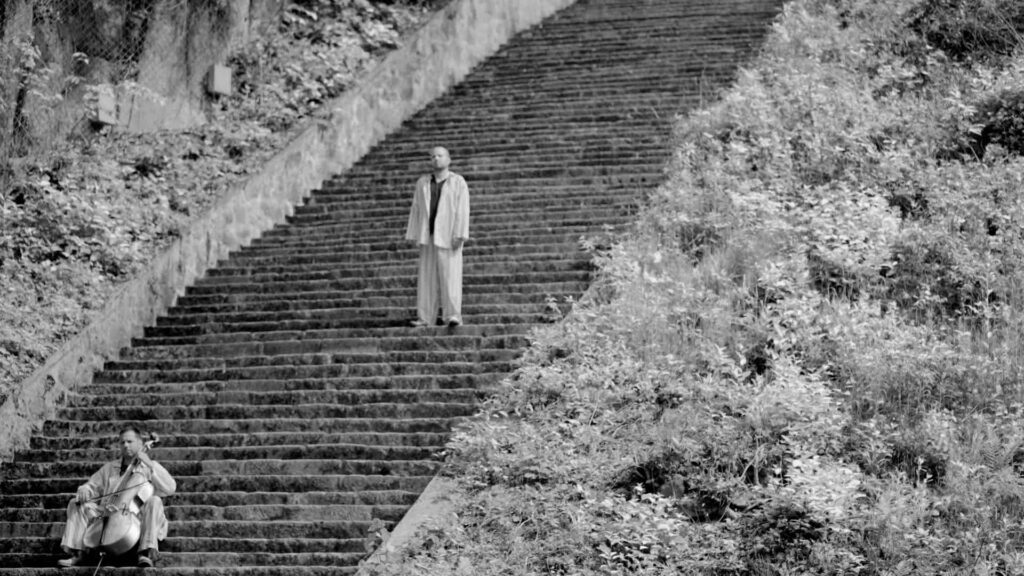
The film project by Mikis Theodorakis (music) and Iakovos Kambanellis (poetry), directed by Panagiotis Kountouras and Aristarchos Papadaniil and produced by Syllipsis, is a poetic feature-length film and unique musical. It presents a new interpretation of the Mauthausen Cantata, sung by Aristarchos Papadaniil (vocals) and accompanied by Aris Zervas (cello). This version was published with the permission of the eminent Greek composer and political activist Mikis Theodorakis (Zorbas, Z, Serpico) one month before his death.
The film also presents the unpublished text “Mauthausen Travelogue – May 1988”, the most personal script by Iakovos Kambanellis, a survivor of the Mauthausen concentration camp and a key figure in post-war Greek theatre. This work, which took its final form 35 years after its original conception, was created at both the place of suffering and inspiration, today’s Mauthausen Memorial in Austria, in the context of the International Liberation Remembrance Year.
Biography of directors
Chrysanthos Konstantinidis, originally from Ligiades in Ioannina, was born and lives in Athens. He studied cinema and art photography. He has been working in cinema and television since 2005. In 2018 he creates his first documentary “The Balcony – Memories of Occupation”. In 2020 he collaborates with the Free University of Berlin and creates the documentary “Memories of Occupation from Greece” on the platform “MOG”. In 2021, he collaborates with the Greek Scouts Corps to produce the documentary “With a Heart Full of Courage – Scouts in Occupation”. His film “The Balcony – Memories of Occupation” was shown in cinemas in Greece and Germany and on the TV channels “ERT”, “Cosmote”, “Ant1 plus”. It was selected among 200 films by DocsBarcelona for the “NEXTUS” platform and was screened in Spain, Chile and Colombia. It is included in the film collections of the “Bundeszentrale für politische Bildung in Deutschland”, the “Pädagogische Institut des Landes Rheinland-Pfalz” and the “Landesmedienzentrum Baden-Württemberg”.
Aristarchos Papadaniel is the author of the book “Greek Political Cartooning: The Serious Side of a Funny Art”. Co-creator of the first Greek educational animation series “A Letter A Story” (produced by Educational Radio and Television, Ministry of Education), about the Greek alphabet and language. Co-curator of the book “70 Years of Greek Animation Creation” (Greekanimation.com-ASIFA Hellas). Co-founder of the creative agency Syllipsis and founding member of ASIFA Hellas. Aristarchos set to music and performed Cavafy’s poetry in the audiovisual epigram “The City (Where My Eye Turns)”. In 2021, together with cellist Aris Zervas, he performed the “Mauthausen Cantata” with poems by Iakovos Campanelli, and was to be the last performer of a work published with the permission of our leading composer, Mikis Theodorakis, just a month before his death. The award-winning feature film “MAUTHAUSEN” (91′, 2023), co-directed with cinematographer Panagiotis Kountouras and produced by Syllipsis, was presented at the Academy of Athens and the Delphi Economic Forum, among others.
Program on Saturday, October 12th
Building a German-Greek culture of remembrance
5:00 p.m.
Between Home and Foreign
by Susanne Grütz and Kostas Kipuros, 2024
47 minutes (in German and Greek with corresponding Greek and German subtitles)
In the presence of the director
7:00 p.m.
With Two Suitcases
by Kostas Avgeris, 2022
66 minutes (in Greek with English subtitles)
Film descriptions
Between Home and Foreign
“Between Home and Foreign” is the title of a documentary film about the story of the political refugees of the Greek Civil War who fled to the GDR between 1949 and 1950. Around 1,300 refugees, mostly children and young people, found a new home there. Much has been written and spoken about these people and the political background to their migration. However, the two filmmakers Susanne Grütz and Kostas Kipuros not only wanted to tell their story, but also talk to them about their lives between home and foreign.
The focus of this largely unknown chapter of German history is the personal story of these people: their life in their old homeland, their experiences in the civil war, their arrival in Germany/Saxony and their life in their new homeland, as well as their later return to Greece. The film is a moving document of very personal memories of the people of that time, who tell their story in interviews. The conversations are supplemented by photos, film clips and the relevant historical context. The picture is rounded off by the memories of the children of the civil war refugees.
Biography of directors
Susanne Grütz is a freelance artist and educator based in Leipzig, Germany. As well as singing in various music programmes, she works as a documentary producer and graphic designer. She travelled with Kostas Kipouros to Athens, Patras and Alexandroupolis to film and photograph this documentary.
Kostas Kipouros, the son of a Greek political refugee from the civil war, was born in Bucharest in 1956. He grew up in Leipzig, where he studied journalism at university. From 1979 until his retirement, he worked as foreign affairs editor for the Leipziger Volkszeitung newspaper, for which he wrote numerous articles, commentaries and analyses. He has travelled regularly to Greece since 1977. He is the author of the book ‘Zwischen Heimat und Ausland’, in which political refugees from the Greek civil war tell the story of their migration from Greece to the GDR.
With two suitcases
A documentary film of elc productions with stories of people sharing their personal experiences of the interaction of Greek and German culture in their lives. The documentary uses the stories, experiences and life stories of the interviewees to shed light on the influence that modern Greeks from Germany and vice versa Germans have received from Greeks living in Germany. These stories simultaneously shed light on various aspects of the history of both peoples, migration, education, work and language. They are stories of friendships, fears, cooperation, coexistence, relationships, stereotypes and their deconstruction.
Many Greeks attended German schools, studied or worked in Germany and later returned to Greece to pass on the experiences and knowledge they acquired. Others stayed in Germany or now live and work in both countries, enriching the cultures of both nations. Many of them have achieved outstanding achievements in their respective fields, left a personal mark and made a difference. This personal impression is largely based on the coexistence of the two cultures, on the combination and mutual complementation of elements from two cultures and two different systems that have encountered each other both negatively and positively throughout history.
Program on Sunday, October 13th
Reconciliation with the Jewish Communities
5:00 p.m.
The Art of Remembering (special screening)
by Annetta Papathanasiou, 2024
80 minutes (in Greek with English subtitles)
In the presence of the director

Film description
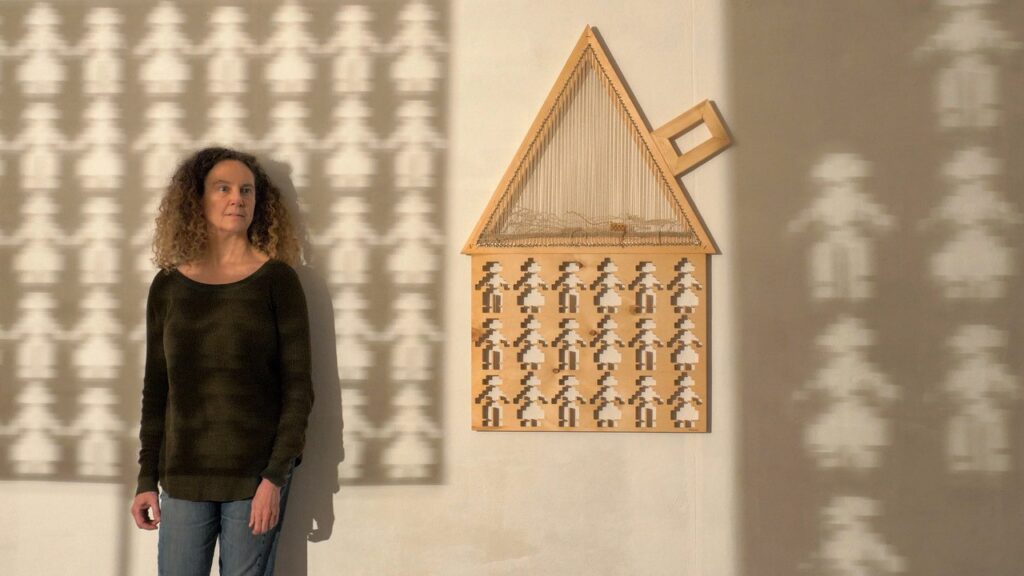
The Art of Remembering is a documentary film about the work of the Greek-Jewish artist Artemis Alcalay and her 30-year artistic career. It is an investigation into trauma, memory, healing and reconciliation. Artemis Alcalay presents her works, tells the story of her family and shows how in recent years she has artistically processed, consciously or unconsciously, explicitly or implicitly, the collective trauma, the hidden family histories and the commemoration of the genocide of the Greek Jews. An artistic journey, an intangible place of encounter between love and healing the trauma of Holocaust history.
Biography of the director
Annetta Papathanasiou is an actress and director. She is a graduate of the Athens Faculty of Law (Economics Department) and the E. Chatzikos Drama School. She studied theater at HB Studio and New York University (NYU), and film at the E. Chatzikos Film School. She works as an actress in theater and television and has collaborated with many theaters, including the National Theater and the Regional Theaters of Greece (DIPETHE). She is a co-founder of the Eliart Theater in Athens. She has published books on theater, including Lights, Please and Theater Games (Kedros Publishing House). She is a member and former president of the Greek Documentary Film Association.
She has directed both in theatre and cinema, with her documentaries focusing mainly on human stories. Her films have been screened in many countries and have won international awards in Italy, Spain, China, the USA and other countries. A selection of her filmography: Laughter in Afghanistan, Europe, the Dream, Playing with Fire, The Nymphs of the Hindu Kush, After the Tsunami – Sumatra, Qadir, an Afghan Odysseus, I Will Grow Wings.
Info
Cinema to remember | October 11-12-13, 2024 | 5:00 PM – 10:00 PM
Goethe-Institut Athen | Omirou 14-16 | 100 33 Athen
Language: Greek, with German or English subtitles
Price: Free admission
210 3661044
Kultur.Athen@goethe.de