 MIRIAM PARASKEVOPOULOU
Ahead of his July 6 concert at Lycabettus Theatre and the 50th anniversary of I Want You, José James reflects on Marvin Gaye, Leon Ware, vulnerability in contemporary music, and why jazz continues to challenge itself.
I am convinced that if Marvin Gaye had lived the lifespan of a modern human being and had not been taken from this world so tragically by his father’s gun just one day before his 45th birthday, music today would have evolved very differently. Black music, in particular, might have been spared some of the populist lightness that later emerged. I begin with this thought because José James, who kindly agreed to answer a few questions, is far more than another contemporary artist making exceptional tribute albums. He is an artist who, I firmly believe, carries something of the Motown DNA within him.
After his concert at the Herodion in 2023, one of the most memorable performances of the decade for me, I wrote that José James is an extraordinary blend of Black musical traditions, deeply rooted in admiration and love for his heritage, while possessing a remarkable ability to create original work that never feels imitative or reliant on nostalgia. The music James creates feels like a natural continuation of the legacy of great figures such as John Coltrane, Marvin Gaye, and Billie Holiday. Soul, jazz, funk, R&B flow seamlessly through his work. He is a true chameleon of Black music in an era defined by speed and uncertainty.
Now, in 2026, carrying with him his twelfth album, 1978, a superb record infused with the spirit of the legendary Leon Ware, James returns to Athens for a second time. At the Lycabettus Municipal Theatre, in an intimate setting close to the audience, he will present a tribute to the 50th anniversary of Marvin Gaye’s I Want You, one of the most sensual and groundbreaking albums in music history.
Created by the legendary Leon Ware for Motown Records, I Want You remains a landmark of jazz-infused R&B, influencing generations of artists from Prince and D’Angelo to Mary J. Blige, Sade, and Kendrick Lamar. If you have never listened to it, you owe it to yourself to do so. It belongs among the great classics, alongside Abbey Road, The Dark Side of the Moon, A Night at the Opera, and Let’s Dance.

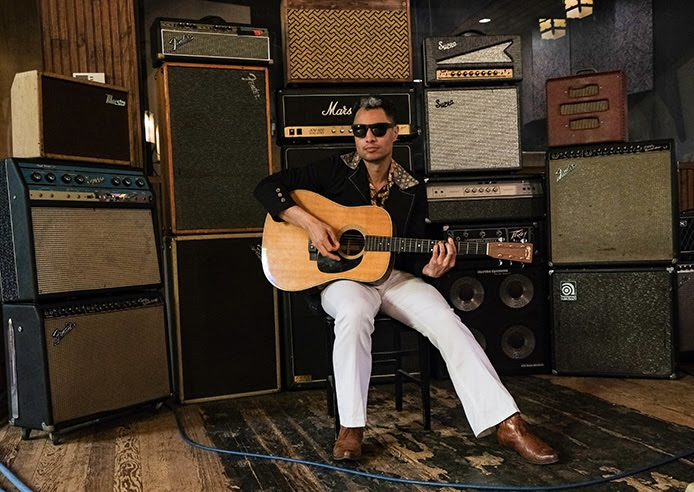
Photo: José James by Janette Beckman
Ahead of José James’s concert on Monday, July 6 at the Lycabettus Municipal Theatre, a performance I already anticipate as one of the magical moments of this summer, we spoke about balancing tradition with innovation, the ever-evolving nature of jazz, and vulnerability in contemporary R&B.
Looking back on your journey, was there a moment when you realized the artistic life you had dreamed of was becoming reality?
There absolutely was. That moment came when I received an email from the legendary DJ and tastemaker Gilles Peterson. He wrote to tell me that he wanted to release my song The Dreamer through his new label, Brownswood Recordings. Shortly afterward, he offered me a record deal and gave me the opportunity to produce my first album, which became a major success in the jazz world. It was truly magical, and I feel grateful that nearly twenty years later I am still making music for listeners around the world.
Have you noticed a common trait or spark that connects artists like Bill Withers and Leon Ware?
That’s a great question. Honestly, that generation of artists was truly special because they served as a bridge between jazz and R&B. Marvin Gaye, Stevie Wonder, Aretha Franklin, Al Green, Leon Ware, and Bill Withers all sang or knew jazz standards from very early on. I believe that profoundly influenced their songwriting and musicianship, especially their harmonic language. They followed in the footsteps of Ray Charles and Quincy Jones, combining gospel with jazz harmony. It’s incredibly sophisticated and nuanced. Above all, though, I think that generation loved music for its own sake, not for fame or recognition. It was a calling, a spiritual mission aimed at uplifting humanity. You can hear that in their music.
In your view, what distinguishes a singer from a crooner?
For me, a crooner delivers the melody largely as written, without much melodic, harmonic, or rhythmic improvisation. I think of people like Perry Como or, today, Michael Bublé. Jazz singing, on the other hand, is deeply personal and unique. It’s a broad umbrella that includes artists such as Billie Holiday, Frank Sinatra, Nat King Cole, and Samara Joy.
When you hear a great vocalist, what is the first thing you notice?
A great singer impresses me when everything feels completely natural. That can come from exceptional technique or, sometimes, from a complete lack of it. More often, though, it’s because they have a beautiful voice and feel at ease within the song. I love singers such as Maria Callas, Nina Simone, and Laura Marling, even though their voices and repertoires are entirely different. There is no single criterion for judging a great vocalist. Some are brilliant storytellers, some simply possess a gorgeous sound, and others transmit joy. I try to appreciate what each singer offers and ask myself: “Are they giving everything they possibly can?” That’s what makes someone great.
Do you feel a greater responsibility today to preserve tradition or to challenge it?
Excellent question. I think the answer is that I feel compelled to do both, often at the same time. That is essentially what jazz is. Miles Davis understood that every time he picked up his trumpet. On one hand, he kept the jazz tradition alive. On the other, he constantly overturned the rules that came before him. That is exactly what a great jazz artist does.
What continues to move you about I Want You fifty years later?
The songwriting. It’s fascinating, angular, unpredictable, and deeply jazz-oriented. At the same time, it’s unapologetically sensual in a way that celebrates both love and desire. Leon Ware’s production remains one of the greatest achievements in Motown history. This album also marked the first time a single producer completely shaped an artist’s sound at the label. Without this record, there would be no Erykah Badu, D’Angelo, Sade, or even me.
How important is it today to consciously choose love over hate?
I think the most important choice of our time is to love ourselves. That seems to be the greatest obstacle for most of us. Every other choice stems from that realization.
What led you to address issues such as racial violence through your music?
I think all people encounter these issues, whether they feel responsible for addressing them or not. They are part of life and reality. Personally, I don’t judge artists for speaking out or for choosing not to. It’s deeply personal. For me, writing about Trayvon Martin and George Floyd came from two places. First, I’m from Minneapolis and grew up very close to where George Floyd was murdered. Second, I see myself in Trayvon Martin. Every Black person I know has experienced being watched by strangers or targeted because of racial prejudice in their own neighborhood. So for me, it’s less about politics and more about telling a personal story.
Do you think artists today are less willing to show vulnerability?
No, I don’t think so. If you look at artists like Frank Ocean or Kendrick Lamar, they are extraordinarily vulnerable and honest. What has changed is the level of access that vulnerable and talented artists have to the mainstream.
How do you see the evolution of jazz today in relation to other forms of Black music?
I think it’s impossible right now to fully grasp the scope of jazz’s evolution. There are countless forms of it around the world. In the United Kingdom alone, the past decade has seen an incredible explosion of different expressions of jazz. Today, jazz feels more like an endlessly expanding galaxy, and the listener is fortunate enough to travel from planet to planet, enjoying each one in its own way.
What kind of conversation would you like to have with the Athens audience this summer?
An honest conversation. We are living through a period of transition for global society, and music has always been a conduit for emotions, sensations, and truth. By exploring the music of Marvin Gaye and Leon Ware, and above all what it means to love, I hope people will find some answers before the evening ends. And perhaps, who knows, they may even find someone special.

Info
José James | Monday, July 6, 2026, 9:00 PM | Lycabettus Municipal Theatre
More Here