 elc team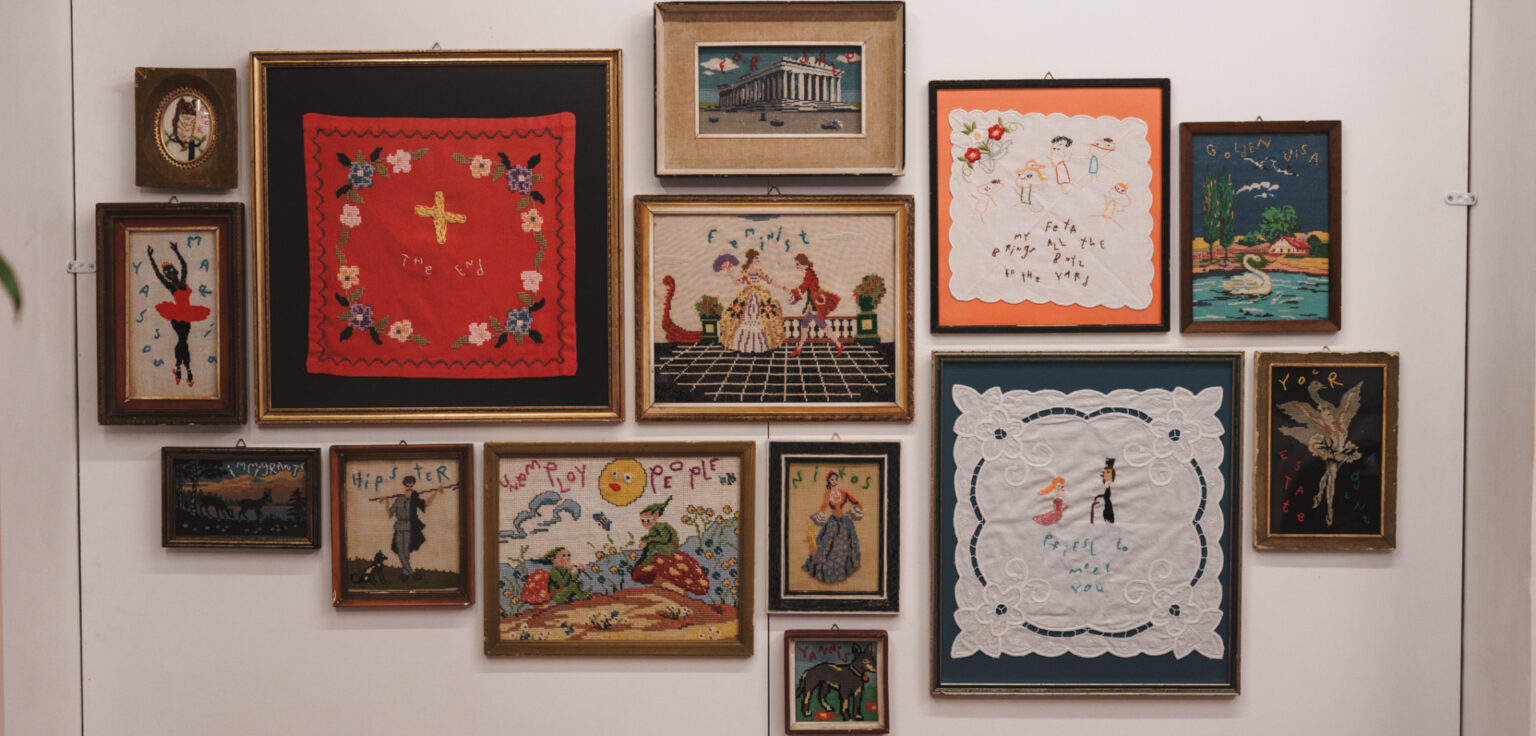
By Stelios Parris
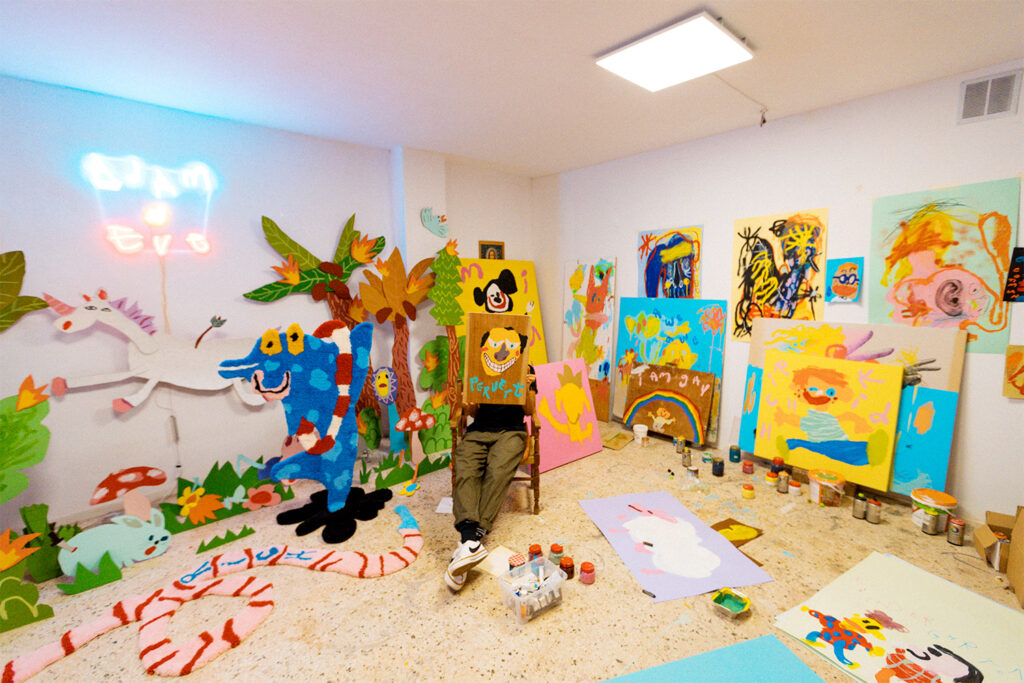
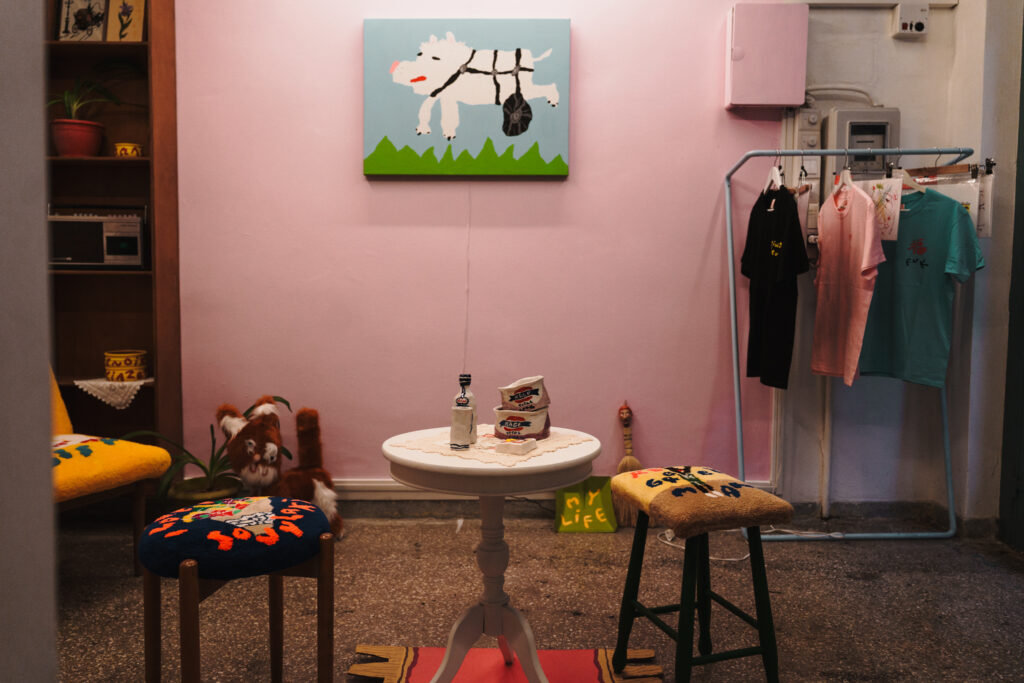
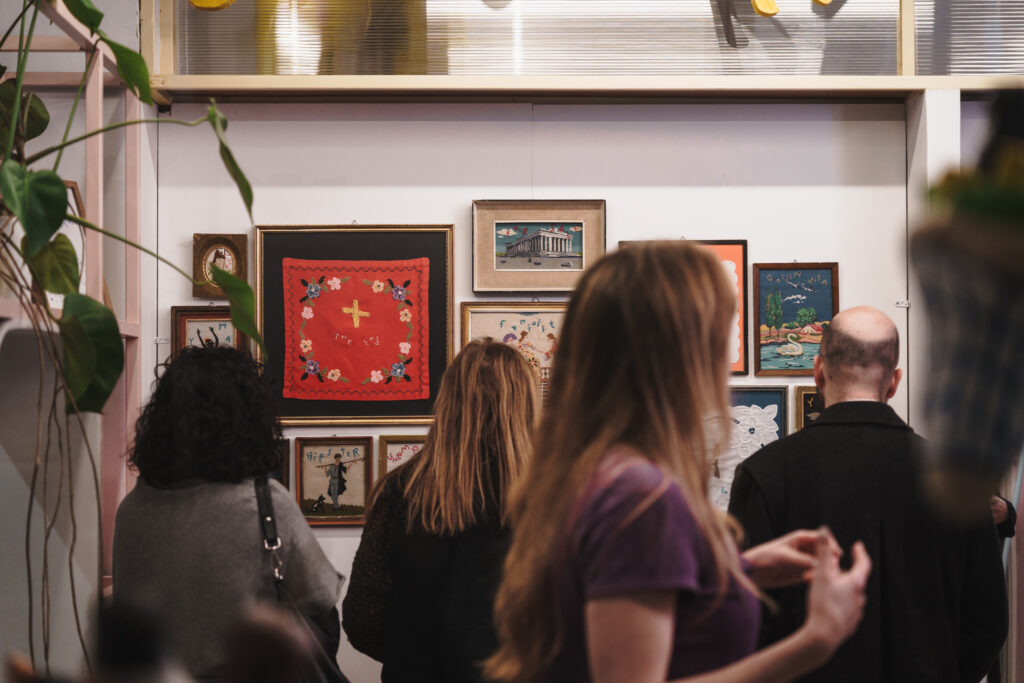
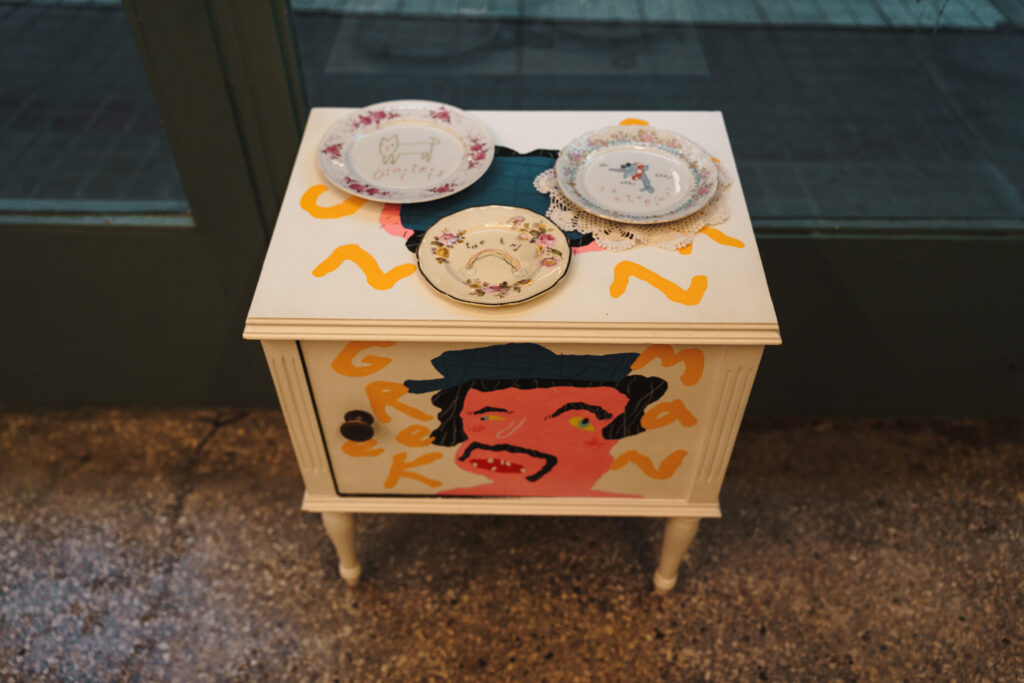
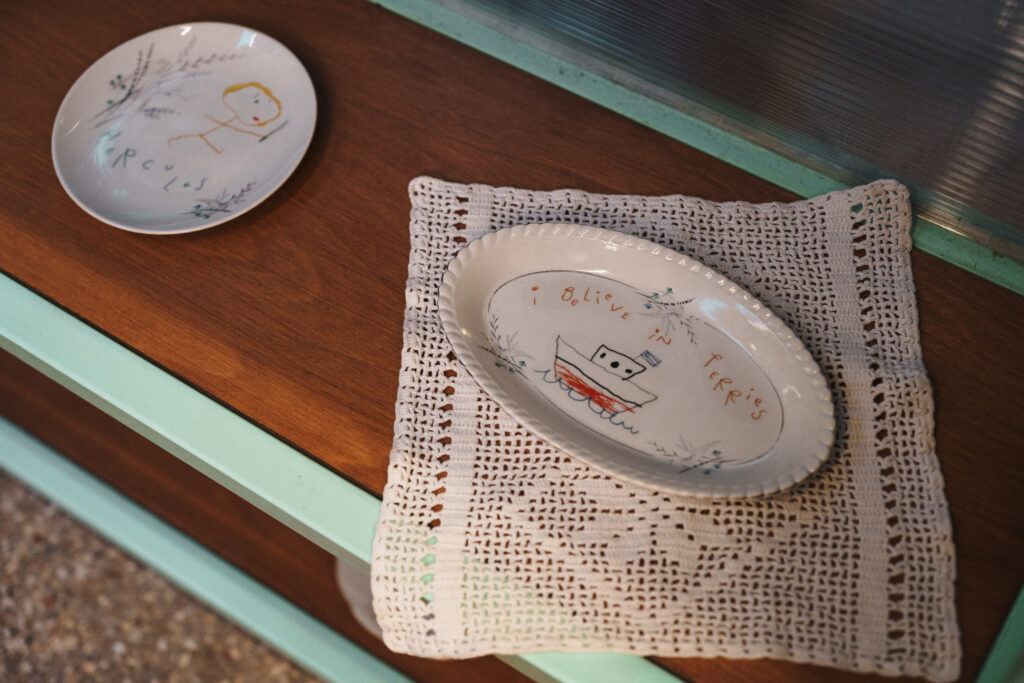
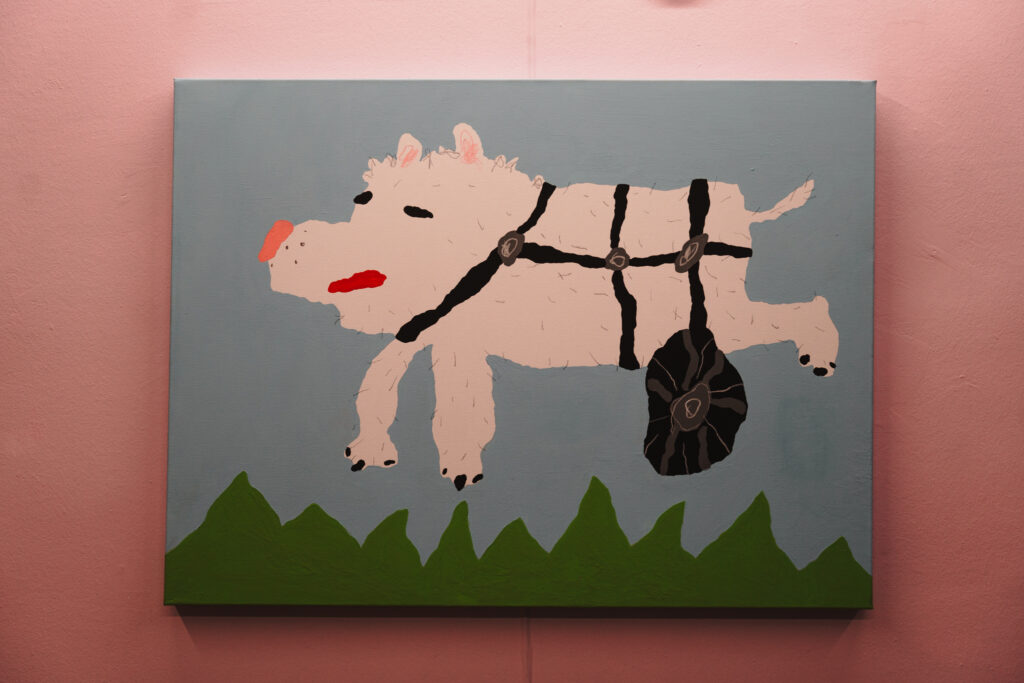
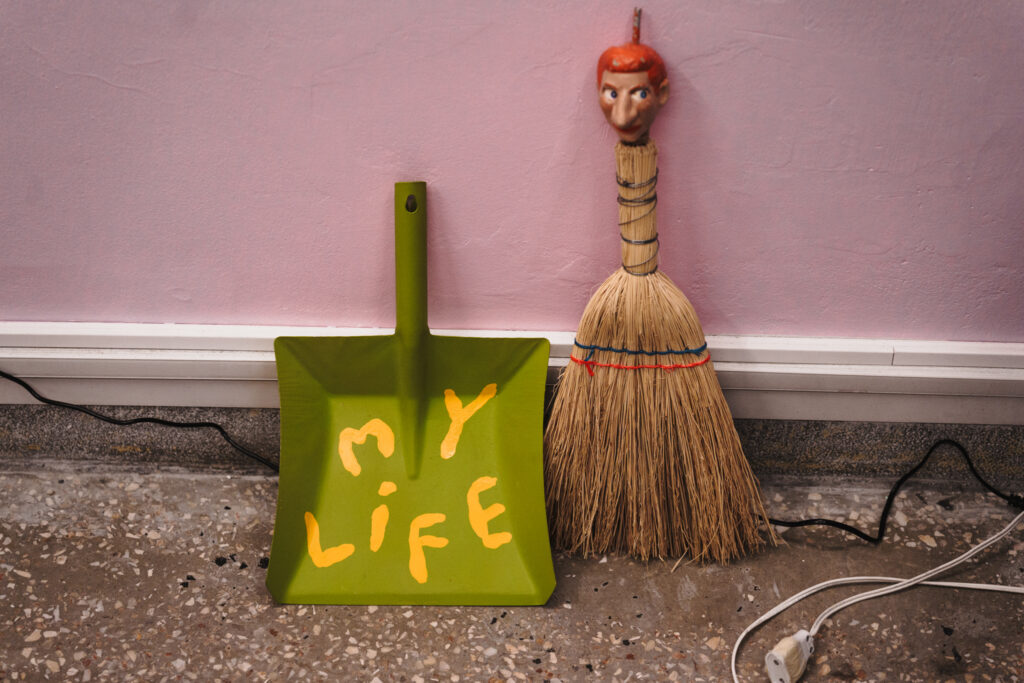
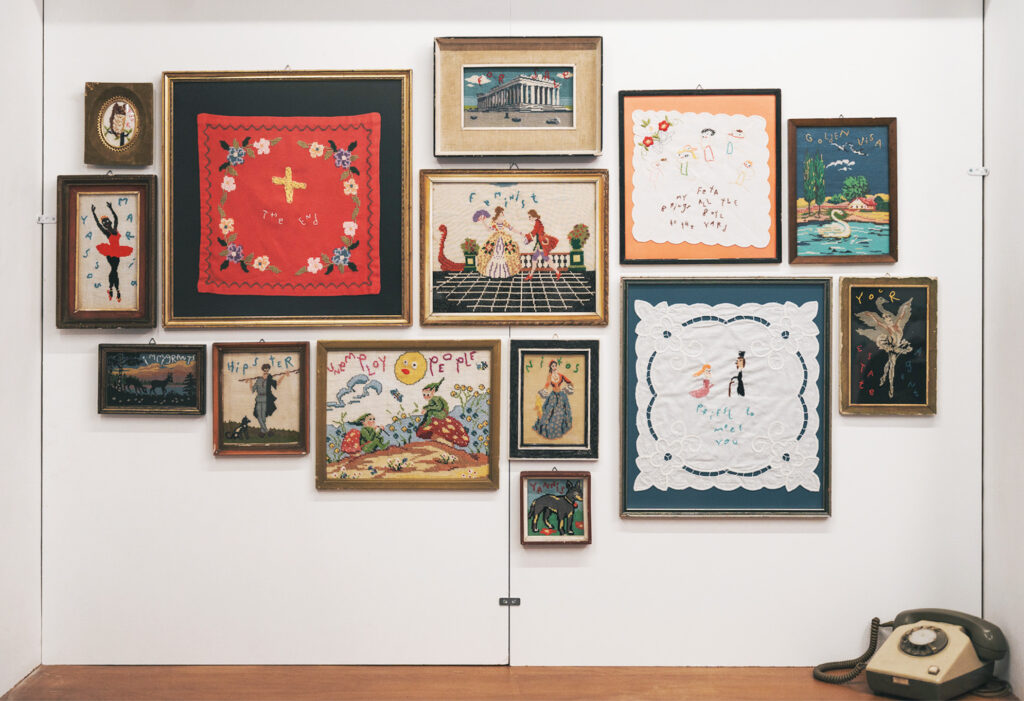
There is a place in Kypseli called KICK, at 26 Sporades. It was there that I noticed an exhibition with a poster embroidered with the Parthenon and a SALE. It was called ELLADA 2.0 and I immediately thought that the creator must have a sense of humour. Seeing the exhibition, I felt a sense of familiarity, a little lounge upstairs with elements of the urban homes of our childhood. The little cheddars are teased with patterns sewn onto them. The porcelain plates looked as if someone had taken a crayon and written their motto. As if I had been transported to my aunt’s house, where we had to be careful, and I had taken markers in my hands and filled the place with drawings. Who is HIN, who has taken me on this journey through time, in broad daylight, in a crowded café?
To my surprise, HIN is not Greek. Yet, despite that, he has managed to capture the essence of our Elladara in his works, while adding a touch of comic relief to his present-day perspective. Born in Hong Kong in 1981, raised in England, and living in Greece for the past four years, HIN feels like a Greek-Chinese friend with a sharp sense of humor and keen social insight.
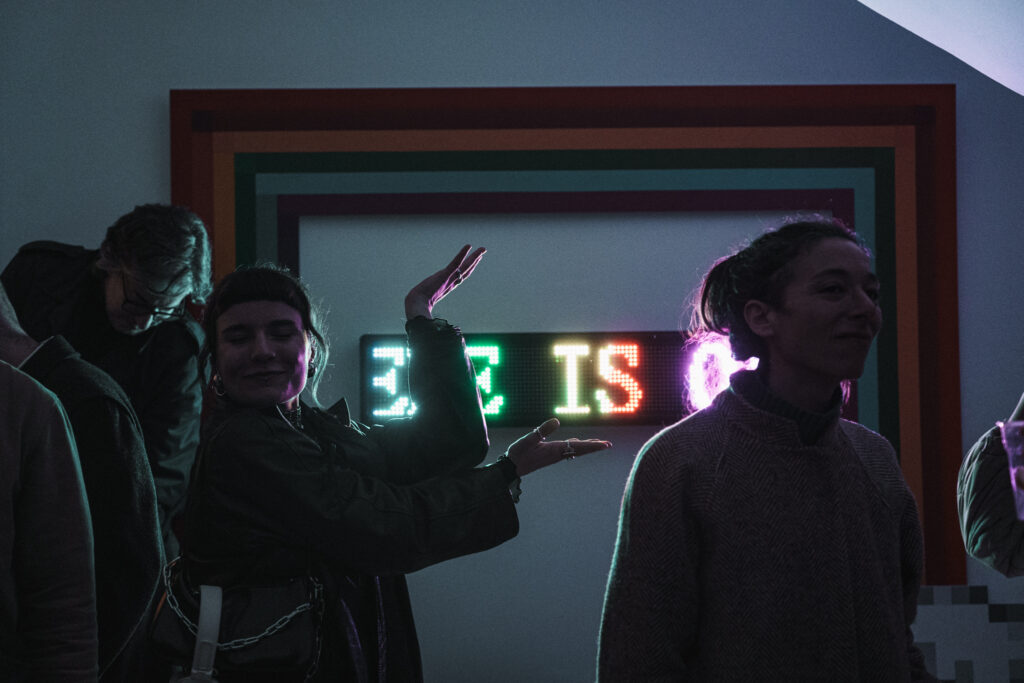
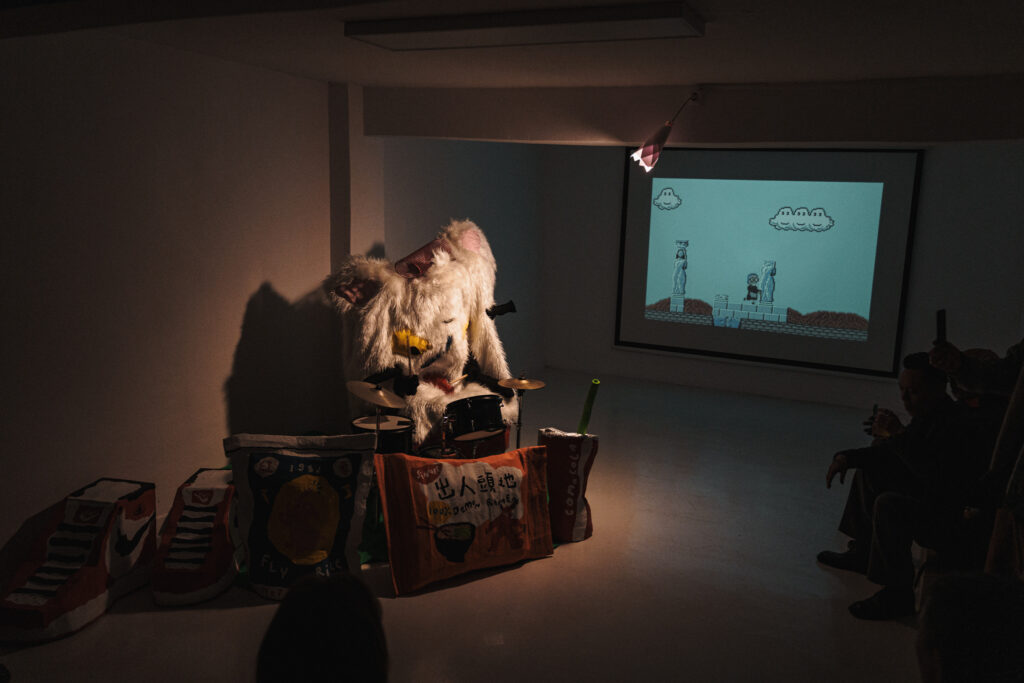
His multimedia installation is filled with elements that invite you to pause and take a closer look. The embroidery, ceramics, and papier-mâché sculptures upstairs evoke a sweetly bittersweet and nostalgic smile. Meanwhile, descending to the lower level reveals an entirely different, white-dominated world. Neon lights take center stage, featuring a retro installation with a “coma cola” and a figure resembling shiny flokati. What truly captivated me, though, was the projection of the video game ELLADA 2.0, accompanied by traditional Greek sounds.
HIN, does your name have a specific meaning?
It means inn in Chinese—like Holiday Inn—a place where people gather.
To my eyes, your ELLADA 2.0 exhibition looked like a retro house. It was like visiting my grandmother’s house, but with a twist.
Exactly. It’s like your grandmother’s house with the cheddar.
But you didn’t destroy Grandma’s house at all, you gave it another dimension, a new perspective.
From your point of view I didn’t destroy it, maybe from your grandmother’s point of view I destroyed it. From my point of view I felt like I was giving a second life to something that was already dying. I think a lot of these traditional things – and it makes me sad – people don’t appreciate them anymore, when they have great value and importance. And the only way for people to appreciate them again is to put them back into a modern context.
How can a Chinese person appreciate the culture of a Greek grandmother?
Every grandmother is similar, no matter where you are. All cultures are not so different, I think the modern world is like that. What makes it very difficult for me in China is that they move so fast and they believe in change. I don’t believe in change. Change for me is taking something away and creating something completely new. I believe in evolution. I believe in removing something negative or less from the past and adding something or improving something that is there. That to me is more sustainable than erasing the past and creating something new.
What’s your story?
I grew up in Hong Kong and moved to England when my parents made me leave because in Hong Kong we were British and China was going to take over in 1997. So before ’97 all the people in Hong Kong were afraid that suddenly, overnight, we were going to become communists. They sent their children away from a very young age as a precaution in case the worst happened, so a lot of people our age were sent to England.
So you are an immigrant in a way.
No, in a way I’m 100% immigrant. When I was young I didn’t understand myself and my place. I was like someone thrown into a tornado and trying to survive. I actually wanted to be a footballer when I was there. That was my first goal in life, to become Hong Kong’s first Premier League footballer. I played for a football team and in the Premier League, Coventry, until I tore my ACL when I was 16 or 17.
And art came to your rescue?
My father takes credit for that. I started studying maths and economics after my football career ended and my dad said: “Why are you studying maths? You suck at it. Why don’t you do something you’re good at?” Which is quite rare for an Asian father. But what do I know? I don’t know how to do anything. I only know how to do sports. Until something happened. We used to borrow books at school because books were very expensive at boarding school in England. Each book had its own number, so we paid a deposit and when we returned it, we got our money back. So I had a big book on economics. It cost about 60 euros, which was a lot of money in those days. But I lost it because I’m useless at keeping things. I had no money and I thought I would steal my classmate’s book by changing the number. Mine was 26, his was 6 and I put a 2 in front. I stole it, changed the number and gave it back to my teacher. My teacher threw it back and said, “It’s not your book. I said to her, “What do you mean, it’s 26! It’s mine. And she says, “You never listen to me. You always draw on every page of your book. I’ve seen your drawings. I like your drawings, but this is not your book. And then I thought, God, my parents are going to kill me. But then I thought, OK, that’s probably the other thing I could do, that I could do something with art. So I got into graphic design. And I slowly realised that it sucks. It’s not art for me, so I slowly moved on to illustration, to painting.
What did you know about art before you got involved?
I only knew Japanese manga. Which I think is absolutely art, just like video games. I learned to draw from Dragon Ball. I never drew as a child.
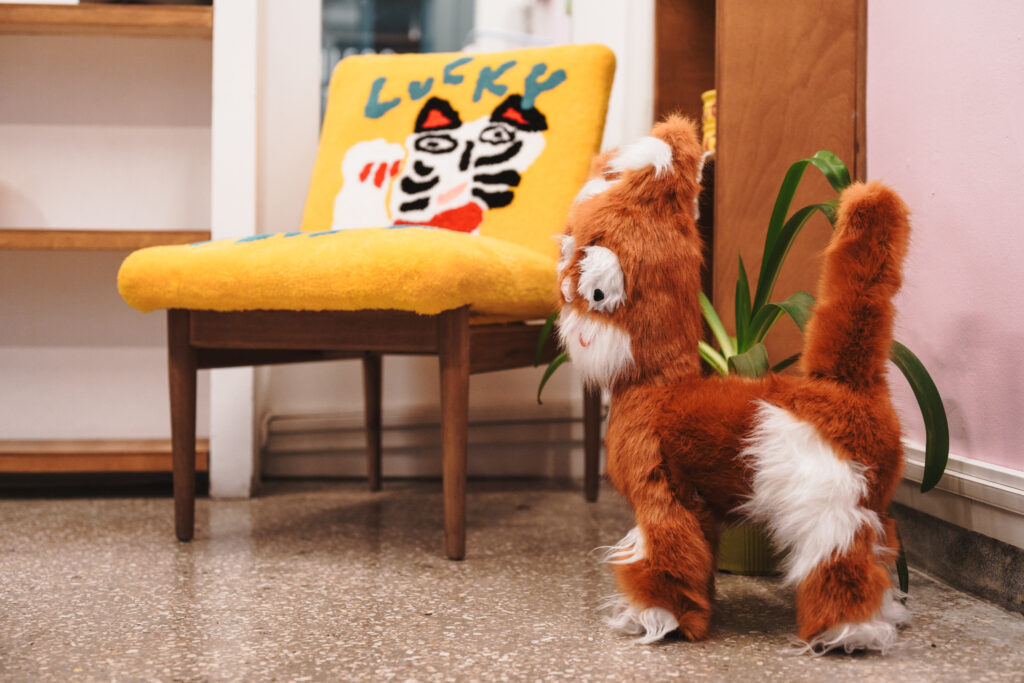
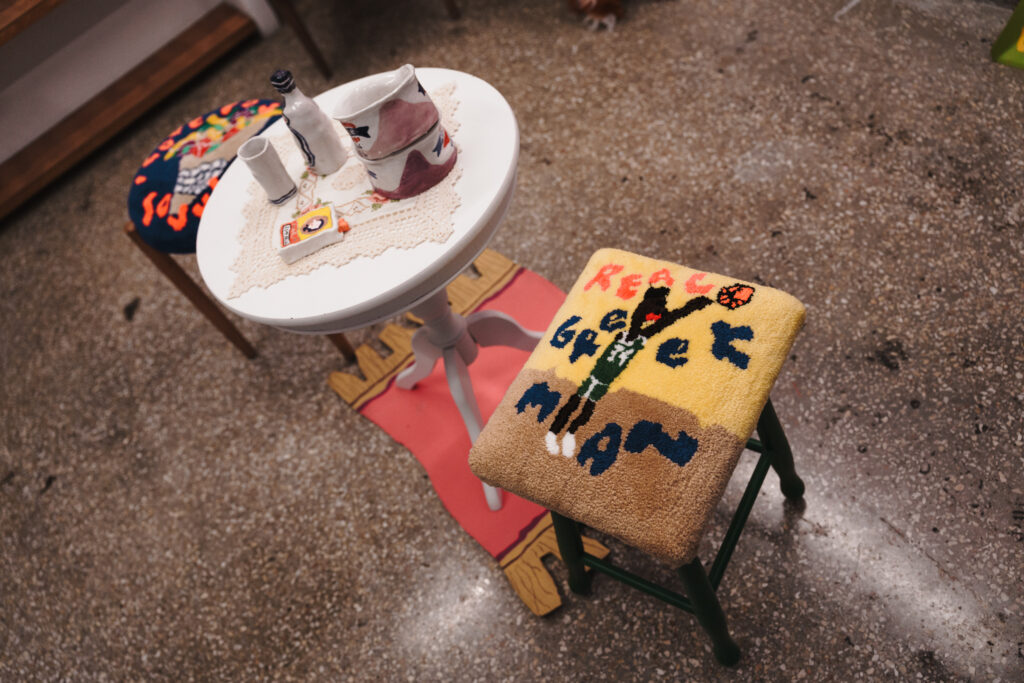
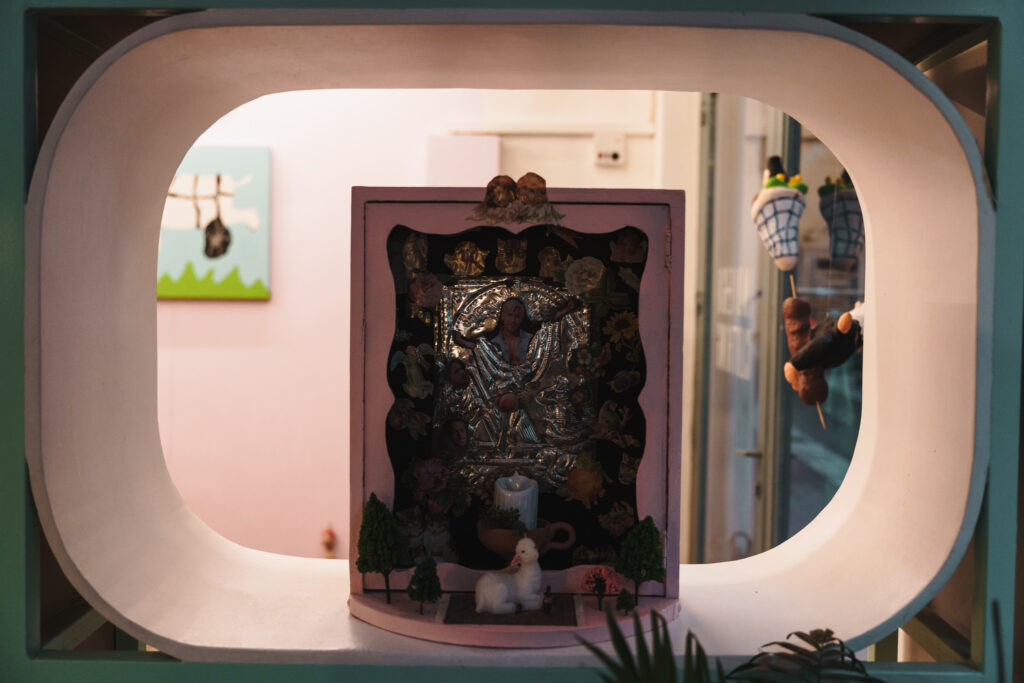
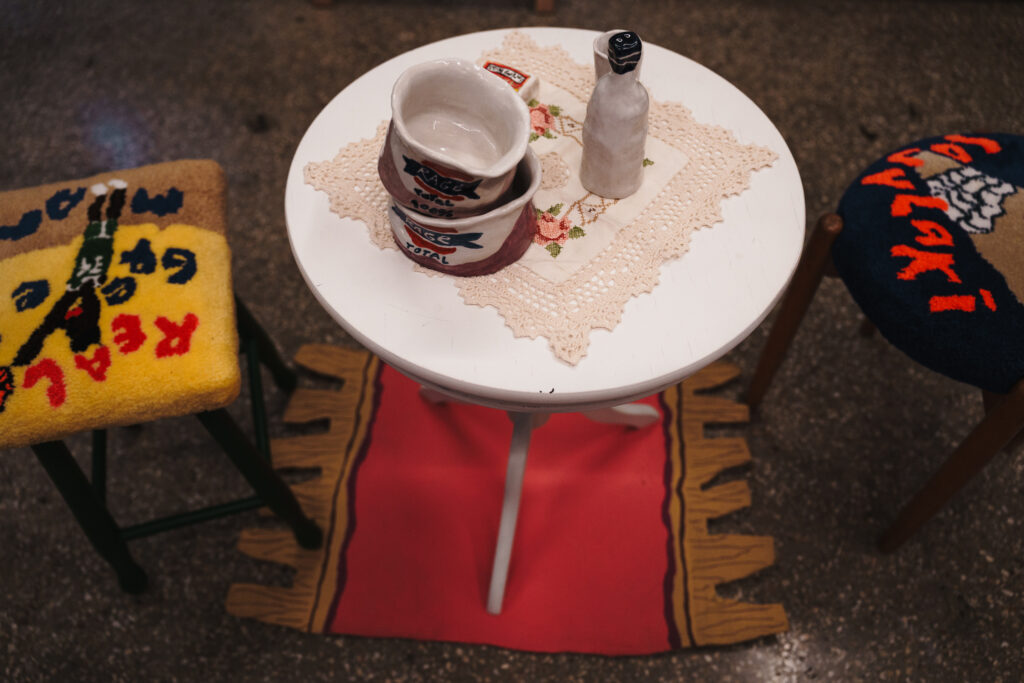
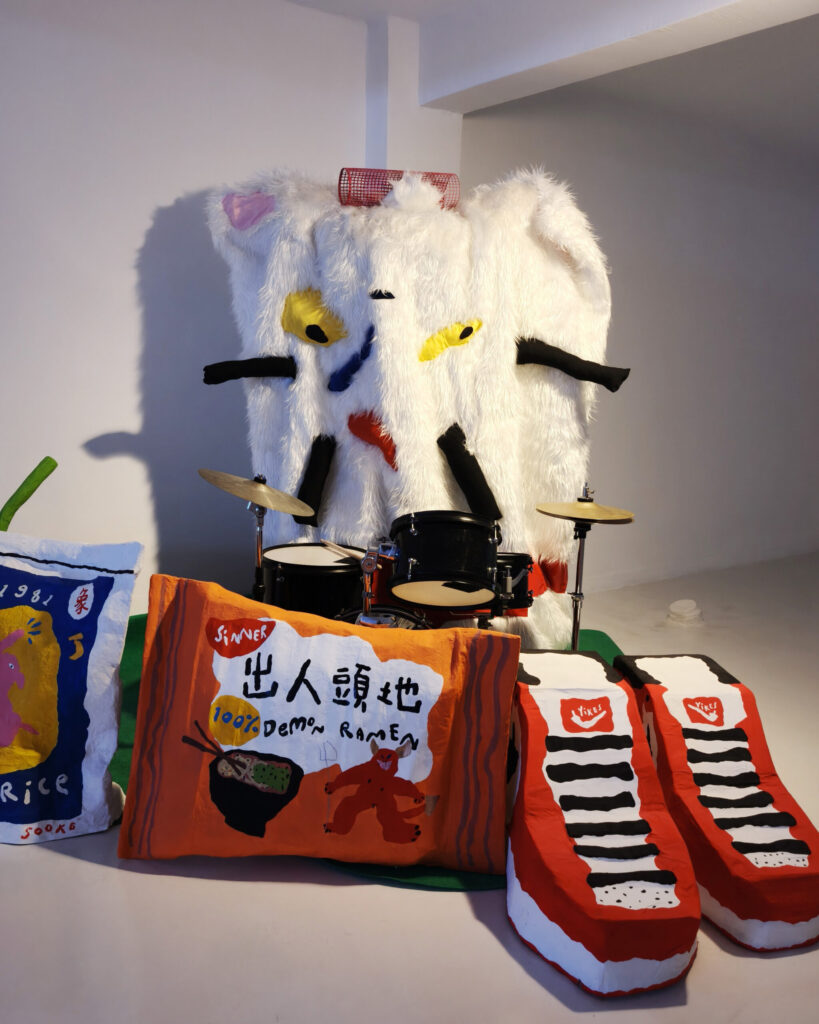
Knowing the Greeks, did you realise how important “semedakia” or porcelain plates are to our culture, or did you just have an epiphany?
By observing people I was able to cope with the difficulties in my life, for example when I was sent to England at the age of 12, I couldn’t make friends. I didn’t know how, so I couldn’t make friends because I was the ‘weird’ kid. I would sit in the canteen and watch someone who seemed to be good at making friends. I would watch how he behaved, how he talked, how he walked, for 2 or 3 weeks, and then the next week I would imitate him. Of course it didn’t work because I wasn’t myself, but I kept doing it for two or three years with different people because I really needed friends. I ended up being completely confused about who I was because I was acting like someone else. After that I gave up and decided not to have any friends for the next five years. So I was on my own.
But this disability that I had, for example, of pretending to be an introvert one day and an extrovert the next, and this defence mechanism was sort of a gift because I started to be able to observe people and understand how they were behaving and what it meant. I don’t really know how to explain it, but it became quite instinctive because I started very young. So even now, when I don’t speak Greek, I feel like I understand them. I believe in it and I try to show it in my work. I don’t claim to know Greek, but at least I try to show what I know.
When did you first come to Greece?
Six and a half years ago. My girlfriend and I were supposed to move to Lisbon, Portugal and the apartment was cancelled. We were kind of lost and couldn’t find a place, so we decided to wait two months. We had already packed everything from London and had a two-month gap. We decided to make a list of places we could go to spend those two months. I wrote down Greece and my girlfriend was totally against it because she’s from Sicily and it felt a bit too close. She’d rather go to Madagascar or Japan and I was undecided until we looked at the prices and said, OK, Greece it is. The first time, Athens seemed a bit like e, but slowly it’s like I feel like Athens is a bit like a poet who doesn’t know how to take care of himself. It seemed like a mess, but as you get to know it, it is actually very interesting. And it hides a charm that you need time to discover.
And from immigrant to nomad.
I’ve always felt like a nomad, even in my own country. But Athens somehow attracted me, every time we were about to leave, we would meet another friend who would tell us to go there and do this or do that. We stayed another month, another month, and we felt that Greece chose us more than we chose to be here. I realised that all the wrong things I said in England, things I shouldn’t have said, I can say here. I make my jokes and they get it and they carry on. They feed my weirdness, the Greeks feed my weirdness and I keep feeling like maybe we should never move out of here.
Well, Greeks we are strange in our own way.
I think all people are strange. The strangest people are the ones who think they are normal. I think I read a quote that says the only normal person is the one you don’t know well enough. It’s a great truth. And the Greeks opened up to me very quickly. In England, when they ask me how are you? They don’t really mean it. They’re not really interested in how you are. But here in Greece, if you ask them how you are, they’ll tell you: “I’m depressed. I’ll talk to my psychologist later, so I’ll be fine. And I’m going to the gym”. It’s refreshing for me.
You feel at home in a way.
Yes. When I have time to listen. Yes, I do. When I have to walk to work, it’s a bit more difficult.
You seem to have studied graphic design, the way you play with logos.
I play with pop culture. I’m very interested in graphics and colours, and I’m very interested in how my work communicates with people. I’m very interested in how to attract attention. Yes, I am interested and I think I have a head start because I studied graphic design compared to other artists who know how to do it. I think that in the past, before formal graphic design, the artist was the graphic designer, and at some point it suddenly becomes art and design. Why should they be separate? I never understood that. But I’ve noticed that a lot of visual artists don’t have that witty, catchy, attention-grabbing thing that a graphic artist has. That they can express a message in two seconds. So those two things are separated and a lot of visual artists take themselves very seriously because that’s the thing they can hold on to. And then graphic designers almost feel like I’m just making money selling logos and I’m just doing a job in graphic design.But I feel that the graphic design side is too often missing from the fine art side now. I’m not consciously trying to bring them together, but it’s a part of me.
You’re also the kind of artist who’s not afraid to put your art on merch.
No. I have done t-shirts, plates, books and various other products like ceramic bowls.
Is there a secret recipe for making beautiful things?
I feel that I can only make good art if I live well. And what I don’t understand sometimes is when artists feel that not making commercial stuff is almost like the highest status, so what? Working in the bar and then making art at home makes you better? At the end of the day we’re all part of the system anyway. So I just try to make the best of it.
What was the reaction of people who visited the ELLADA 2.0 exhibition?
I think everyone who comes here comes to KICK, which is a hipster cafe in Kypseli; it’s not the traditional Greeks who go to the kafeneio. People come here who are looking for different things, so they like it.
The reactions have been good, so what comes next?
The next thing is to digest everything that has happened. And I think I’m going to listen to something David Bowie said. He said that the best part of creativity is when you’re walking in deep water, it’s between the deep water and the shore, you’re just not touching the bottom. Your feet are about to touch, but you’re a little scared, but you know you’re safe. That is the sweet spot for creativity. And I think every time it’s my job to try something that I don’t really know how to do, but I’m excited to do it, even though I don’t know if I can do it. I’ll push myself to do it, but I’ve got to try something. So next time it’ll find me by itself, it’ll come effortlessly. But I did make this 8-bit game, a little clip called ELLADA 2.0, and it’s about choosing characters between Greek men and grandma to kill hipsters and Chinese invaders.
Yes, I really enjoyed the video game and I hope you get funded and sell it on the market. It’s retro, totally Greek and very funny. I would buy it.
Yeah, I hope so. This video game, I actually saw it before it happened. I saw the whole thing as it was going to happen. So I had to try and make at least a clip of it. I mean, I didn’t want to go in too deep and tell myself I could make a video game in a week, but I had to at least make a clip to show the world.
I think we Greeks love retro because it keeps our memories alive, as if we want to stay in the past.
You are 20 years behind, but in a good way. You are people who still care and want to spend time with the people they love, and you also continue your traditional dances that many young people like. When I go to lunch in Hong Kong, they eat the whole meal in ten minutes and then they’re all on their mobile phones. Whereas here I still see young people sitting in the café drinking their ouzo. Others spend hours together, having birthday parties with food on Philopappos Hill, or spending time together on the beach. So this ‘backward’ mentality is actually more advanced than other cultures or the modern way, like I was in London. Nobody had time for each other and you had to manage your time. You planned everything, but it’s not like that here.
You stayed in Greece for 4 years and you managed to recreate my childhood, my logos and above all the feeling of being at home, as if you were inviting me into your strange Greek home.
I hope so. I noticed people and my participation in Greek daily life probably helped a lot. I didn’t go back to Hong Kong for Christmas and my girlfriend and I went with our friends, a Greek family, to celebrate Christmas and I experienced it with and through them. I don’t even know what I managed to capture in the exhibition, I just tried. It’s almost like a love letter. The good, the bad and the ugly, as I always do, I put them on the table and I don’t judge them, I don’t criticise them, I just add my own little absurdity to the table. Those who come feel what they feel, and it seems to have touched the Greeks. People often say to me, oh well, you have brought back so many memories, but I feel sorry for you. It was the best compliment.
I feel the same way and it’s not unreasonable, it’s playful.
Not for me either. This is how my brain works every day, this is my normality.
Would you describe yourself as a strange child.
Yes. Beautifully broken. Beautiful. I use the word weird a lot. But I feel like I’m very normal. Because I’ve accepted my normality. This is who I am and this is how I express it. I feel like I’m part of society, part of people. I feel very close to my fellow human beings. I feel that I understand when Giagia is angry with the young people who come here and make noise, who party at night. I understand the young people who come here because they don’t want to go to the chain coffee shops every day. They just want a nicer place to sit and work. And I think because I understand so many different sides of them, it makes me a bit of a stranger because sometimes a lot of people can only understand one side of their story and they can’t understand the other side. And I think most of the time I feel like a stranger, like an outsider, because I can see more sides to me because of my childhood. And when I present another point of view, it’s almost like I’m speaking another language to other people who are like, “What do you mean? I feel that everyone makes a film for themselves, who is the director and the protagonist. They interact with people who think, why the hell are these extras coming into my life; they think they are the leads and the directors. So they can’t understand why other people don’t respect them. But other people don’t respect them because they are also in their own film, which is the directors themselves. So this interaction becomes very complicated because of their lack of awareness of other people’s films.
I really liked what you just said. Please think of Greece as your home, we need more people like you here.
I feel at home here. In 24 years in England I never felt at home. Never. I feel completely at home here. Hong Kong is my root and England was my school.
Is there anything you would like to say to the people about this report? Why should they visit it?
If you do not feel that you fit in. You like art, but you don’t feel that you fit into the typical art environment where it’s exclusive and you have to be serious and careful, but you want to experience art where you can feel that you belong and you can feel relaxed and you can laugh about it and say I like it or I don’t like it or it seems stupid. This is the place for you.
Well said.
Because I feel like Tarantino, he said he’s making all these films because nobody’s making them and he wants to see them. So I created a space for myself in art where I don’t feel like I belong in the art world. I’m not a designer. I’m not Cantonese from Hong Kong. I’m not Greek, I’m just me. I’m trying to create a space where I feel comfortable, nobody’s going to make it for me, so I have to make it for myself. My grandmother’s house wasn’t like that, so I created this space in the hope that people would come and feel comfortable.
HIN, in my view, has got it right: to be ourselves, to create spaces where we don’t quite fit, and to respect the personal films playing in others’ lives. To create and coexist with mutual respect.
Thank you, it was a very nice ending.
I truly embraced HIN—both literally and figuratively—and shared laughter with him. At one point, I told him, “You seem like a clean person, you have clear eyes.” “How can you tell?” he asked, amused. “Half my eyes are covered.”
The quick-witted are often self-deprecating, and you’ll see what I mean when you visit the ELLADA 2.0 exhibition. You’ll catch yourself smiling at the way HIN playfully reimagines and breathes new life into our retro past.
Info
“ELLADA 2.0” | KICK
Exhibition Duration: 15 February – 1 March
Opening hours and days:
Monday – Friday 08:00-21:00
WEEKEND 09:00-21:00
KICK, 26 Sporades, Kypseli
Free entrance